456 kr
Skickas inom 7-10 vardagar
456 kr
Skickas inom 7-10 vardagar
2 320 kr
Skickas inom 7-10 vardagar
420 kr
Skickas inom 7-10 vardagar
393 kr
Skickas inom 7-10 vardagar
377 kr
Skickas inom 7-10 vardagar
421 kr
Läs direkt efter köp
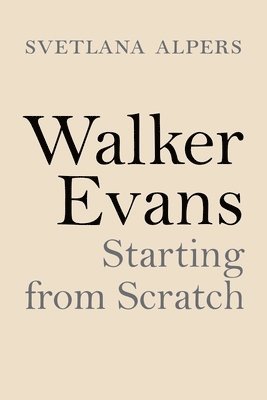
A magisterial study of celebrated photographer Walker EvansWalker Evans (1903–75) was a great American artist photographing people and places in the United States in unforgettable ways. He is known for his work for the Farm Security Administration, addressing the Great Depression, but what he actually saw was the diversity of people and the damage of the long Civil War. In Walker Evans, renowned art historian Svetlana Alpers explores how Evans made his distinctive photographs. Delving into a lavish selection of Evans’s work, Alpers uncovers rich parallels between his creative approach and those of numerous literary and cultural figures, locating Evans within the wide context of a truly international circle.Alpers demonstrates that Evans’s practice relied on his camera choices and willingness to edit multiple versions of a shot, as well as his keen eye and his distant straight-on view of visual objects. Illustrating the vital role of Evans’s dual love of text and images, Alpers places his writings in conversation with his photographs. She brings his techniques into dialogue with the work of a global cast of important artists—from Flaubert and Baudelaire to Elizabeth Bishop and William Faulkner—underscoring how Evans’s travels abroad in such places as France and Cuba, along with his expansive literary and artistic tastes, informed his quintessentially American photographic style.A magisterial account of a great twentieth-century artist, Walker Evans urges us to look anew at the act of seeing the world—to reconsider how Evans saw his subjects, how he saw his photographs, and how we can see his images as if for the first time.
303 kr
Skickas inom 7-10 vardagar
294 kr
Skickas inom 3-6 vardagar
153 kr
Läs direkt efter köp
433 kr
Skickas inom 7-10 vardagar
Spanning six decades, this critical compilation gathers Svetlana Alpers’ award-winning writings on art history
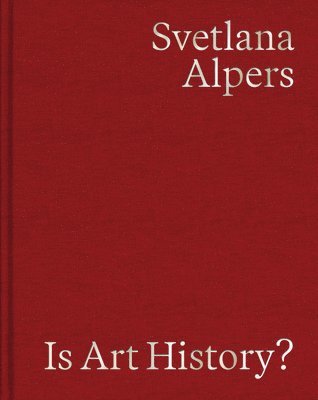
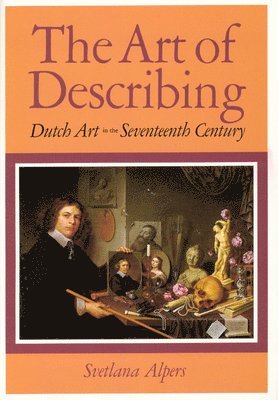
A definitive volume of writings by one of the most renowned art historians of the past century, Is Art History? brings together Svetlana Alpers’ contributions to the art historical discipline. Her writing spans over six decades: beginning with seminal essays written in examination of the constraints of the art historical discipline, including a foundational essay on Vasari (1960), “Is Art History?” (1970), “Style Is What You Make It” (1979) and “Art History and Its Exclusions” (1982); two never before published lectures and other unpublished public presentations; notable critical essays on art and recent texts on contemporary artists including Alex Katz, Catherine Murphy and Shirley Jaffe.Is Art History? also includes new prefatory notes written by the author for this occasion, an unexpected introduction by her former student, the esteemed scholar-critic Richard Meyer, and an interview with the German author and critic Ulf Erdmann Ziegler. This extensive view of Alpers’ prolific and varied career appeals both to new readers in need of an introduction and to audiences familiar with her essential writing on the great European tradition of painting.Svetlana Alpers (born 1936) is the author of The Art of Describing and Rembrandt’s Enterprise, among other titles. Alpers taught at the University of California, Berkeley from 1962 to 1994 and is the recipient of numerous awards and honors including being named a Fellow of the American Academy of Art and Sciences and the American Philosophical Society. Alpers cofounded the interdisciplinary journal Representations in 1983.