243 kr
Skickas inom 7-10 vardagar
243 kr
Skickas inom 7-10 vardagar
478 kr
Skickas inom 7-10 vardagar
344 kr
Skickas inom 7-10 vardagar
275 kr
Skickas inom 7-10 vardagar
310 kr
Skickas
292 kr
Skickas inom 7-10 vardagar
858 kr
Skickas inom 7-10 vardagar
601 kr
Skickas inom 7-10 vardagar
463 kr
Skickas
694 kr
Skickas inom 3-6 vardagar
1 120 kr
Skickas inom 7-10 vardagar
438 kr
Skickas inom 7-10 vardagar
248 kr
Skickas inom 10-15 vardagar
2 571 kr
Skickas inom 10-15 vardagar
767 kr
Skickas inom 10-15 vardagar
702 kr
Skickas inom 10-15 vardagar
3 461 kr
Skickas inom 7-10 vardagar
644 kr
Skickas inom 10-15 vardagar
2 497 kr
Skickas inom 10-15 vardagar
861 kr
Skickas inom 10-15 vardagar
350 kr
Skickas inom 7-10 vardagar
803 kr
Läs direkt efter köp
572 kr
Läs direkt efter köp
347 kr
Läs direkt efter köp
500 kr
Läs direkt efter köp
498 kr
Skickas inom 7-10 vardagar
1 352 kr
Skickas inom 7-10 vardagar
554 kr
Läs direkt efter köp
328 kr
Läs direkt efter köp
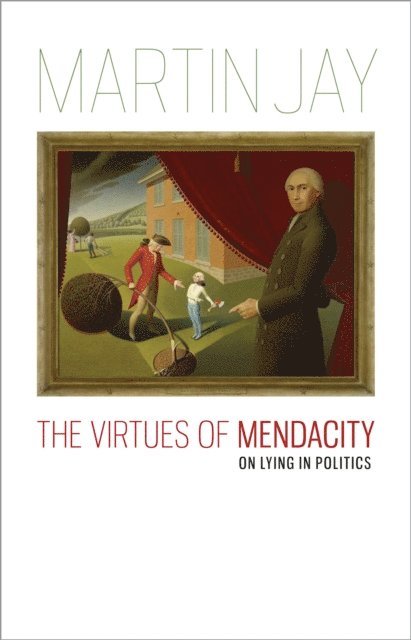
When Michael Dukakis accused George H. W. Bush of being the "Joe Isuzu of American Politics" during the 1988 presidential campaign, he asserted in a particularly American tenor the near-ancient idea that lying and politics (and perhaps advertising, too) are inseparable, or at least intertwined. Our response to this phenomenon, writes the renowned intellectual historian Martin Jay, tends to vacillate—often impotently—between moral outrage and amoral realism. In The Virtues of Mendacity, Jay resolves to avoid this conventional framing of the debate over lying and politics by examining what has been said in support of, and opposition to, political lying from Plato and St. Augustine to Hannah Arendt and Leo Strauss. Jay proceeds to show that each philosopher’s argument corresponds to a particular conception of the political realm, which decisively shapes his or her attitude toward political mendacity. He then applies this insight to a variety of contexts and questions about lying and politics. Surprisingly, he concludes by asking if lying in politics is really all that bad. The political hypocrisy that Americans in particular periodically decry may be, in Jay’s view, the best alternative to the violence justified by those who claim to know the truth.
718 kr
Läs direkt efter köp
Over his distinguished career as a European intellectual historian and cultural critic, Martin Jay has explored a variety of major themes: the Frankfurt School, the exile of German intellectuals in America during the Nazi era, Western Marxism, the denigration of vision in twentieth-century French thought, the discourse of experience in modern Europe and America, and lying in politics. Essays from the Edge assembles Jay’s writings from the intersections of this intellectual journey. Several essays focus on methodological debates in the humanities and social sciences: the limits of interdisciplinarity, the issue of national or universal philosophy, cultural relativism and visuality, and the implications of periodization in historical narrative. Others examine the concept of "scopic regime" and the metaphors of revolution and the gardening impulse. Among the theorists treated at length are Theodor Adorno, Hannah Arendt, Jacques Derrida, and Michel Foucault. The essays also include several of Jay’s Salmagundi columns, dealing with subjects as varied as the new Museum of Modern Art in New York, the impact of Colin Wilson’s The Outsider, and the demise of the Partisan Review.
All of these efforts can be considered what Arthur Schopenhauer called, to borrow the title of one of his most celebrated collections, "parerga and paralipomena." As essays from the edges of major projects, they illuminate Jay’s major arguments, elaborate points made only in passing in the larger texts, and explore ideas farther than would have been possible, given the focus of the larger works themselves. The result is a lively, diverse offering from an extraordinary intellect.