247 kr
Skickas
247 kr
Skickas
230 kr
Skickas
681 kr
Skickas inom 7-10 vardagar
588 kr
Skickas inom 7-10 vardagar
320 kr
Skickas
642 kr
Skickas
“Mathematics can be as effortless as humming a tune, if you know the tune,” writes Gareth Loy. In Musimathics, Loy teaches us the tune, providing a friendly and spirited tour of the mathematics of music—a commonsense, self-contained introduction for the nonspecialist reader. It is designed for musicians who find their art increasingly mediated by technology, and for anyone who is interested in the intersection of art and science.
In Volume 1, Loy presents the materials of music (notes, intervals, and scales); the physical properties of music (frequency, amplitude, duration, and timbre); the perception of music and sound (how we hear); and music composition. Calling himself “a composer seduced into mathematics,” Loy provides answers to foundational questions about the mathematics of music accessibly yet rigorously. The examples given are all practical problems in music and audio.
Additional material can be found at http://www.musimathics.com.
218 kr
Skickas
292 kr
Skickas
572 kr
Skickas
Herbert Simon's classic and influential The Sciences of the Artificial declares definitively that there can be a science not only of natural phenomena but also of what is artificial. Exploring the commonalities of artificial systems, including economic systems, the business firm, artificial intelligence, complex engineering projects, and social plans, Simon argues that designed systems are a valid field of study, and he proposes a science of design. For this third edition, originally published in 1996, Simon added new material that takes into account advances in cognitive psychology and the science of design while confirming and extending the book's basic thesis: that a physical symbol system has the necessary and sufficient means for intelligent action.
Simon won the Nobel Prize for Economics in 1978 for his research into the decision-making process within economic organizations and the Turing Award (considered by some the computer science equivalent to the Nobel) with Allen Newell in 1975 for contributions to artificial intelligence, the psychology of human cognition, and list processing. The Sciences of the Artificial distills the essence of Simon's thought accessibly and coherently. This reissue of the third edition makes a pioneering work available to a new audience.
285 kr
Skickas inom 3-6 vardagar
645 kr
Skickas inom 7-10 vardagar
464 kr
Skickas inom 7-10 vardagar
419 kr
Skickas inom 3-6 vardagar
597 kr
Skickas inom 3-6 vardagar
592 kr
Skickas inom 7-10 vardagar
431 kr
Skickas
This classic book, first published in 1991, was one of the first to propose the “embodied cognition” approach in cognitive science. It pioneered the connections between phenomenology and science and between Buddhist practices and science—claims that have since become highly influential. Through this cross-fertilization of disparate fields of study, The Embodied Mind introduced a new form of cognitive science called “enaction,” in which both the environment and first person experience are aspects of embodiment. However, enactive embodiment is not the grasping of an independent, outside world by a brain, a mind, or a self; rather it is the bringing forth of an interdependent world in and through embodied action. Although enacted cognition lacks an absolute foundation, the book shows how that does not lead to either experiential or philosophical nihilism. Above all, the book's arguments were powered by the conviction that the sciences of mind must encompass lived human experience and the possibilities for transformation inherent in human experience.
This revised edition includes substantive introductions by Evan Thompson and Eleanor Rosch that clarify central arguments of the work and discuss and evaluate subsequent research that has expanded on the themes of the book, including the renewed theoretical and practical interest in Buddhism and mindfulness. A preface by Jon Kabat-Zinn, the originator of the mindfulness-based stress reduction program, contextualizes the book and describes its influence on his life and work.
397 kr
Skickas
782 kr
Skickas inom 7-10 vardagar
592 kr
Skickas inom 7-10 vardagar
737 kr
Skickas inom 7-10 vardagar
422 kr
Skickas
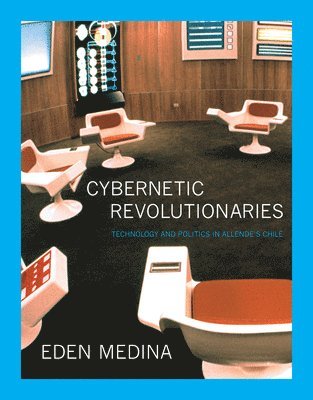
In Cybernetic Revolutionaries, Eden Medina tells the history of two intersecting utopian visions, one political and one technological. The first was Chile's experiment with peaceful socialist change under Salvador Allende; the second was the simultaneous attempt to build a computer system that would manage Chile's economy. Neither vision was fully realized—Allende's government ended with a violent military coup; the system, known as Project Cybersyn, was never completely implemented—but they hold lessons for today about the relationship between technology and politics.
Drawing on extensive archival material and interviews, Medina examines the cybernetic system envisioned by the Chilean government—which was to feature holistic system design, decentralized management, human-computer interaction, a national telex network, near real-time control of the growing industrial sector, and modeling the behavior of dynamic systems. She also describes, and documents with photographs, the network's Star Trek-like operations room, which featured swivel chairs with armrest control panels, a wall of screens displaying data, and flashing red lights to indicate economic emergencies.
Studying project Cybersyn today helps us understand not only the technological ambitions of a government in the midst of political change but also the limitations of the Chilean revolution. This history further shows how human attempts to combine the political and the technological with the goal of creating a more just society can open new technological, intellectual, and political possibilities. Technologies, Medina writes, are historical texts; when we read them we are reading history.
255 kr
Tillfälligt slut
230 kr
Tillfälligt slut
461 kr
Skickas inom 7-10 vardagar
386 kr
Skickas inom 7-10 vardagar
610 kr
Skickas inom 7-10 vardagar
1 333 kr
Skickas
357 kr
Skickas inom 3-6 vardagar
588 kr
Skickas inom 7-10 vardagar
739 kr
Skickas
What marked the evolutionary transition from organisms that lacked consciousness to those with consciousness—to minimal subjective experiencing, or, as Aristotle described it, “the sensitive soul”? In this book, Simona Ginsburg and Eva Jablonka propose a new theory about the origin of consciousness that finds learning to be the driving force in the transition to basic consciousness. Using a methodology similar to that used by scientists when they identified the transition from non-life to life, Ginsburg and Jablonka suggest a set of criteria, identify a marker for the transition to minimal consciousness, and explore the far-reaching biological, psychological, and philosophical implications.
After presenting the historical, neurobiological, and philosophical foundations of their analysis, Ginsburg and Jablonka propose that the evolutionary marker of basic or minimal consciousness is a complex form of associative learning, which they term unlimited associative learning (UAL). UAL enables an organism to ascribe motivational value to a novel, compound, non-reflex-inducing stimulus or action, and use it as the basis for future learning. Associative learning, Ginsburg and Jablonka argue, drove the Cambrian explosion and its massive diversification of organisms. Finally, Ginsburg and Jablonka propose symbolic language as a similar type of marker for the evolutionary transition to human rationality—to Aristotle's “rational soul.”