184 kr
Skickas inom 7-10 vardagar
184 kr
Skickas inom 7-10 vardagar
130 kr
Läs direkt efter köp
265 kr
Skickas inom 7-10 vardagar
287 kr
Skickas inom 7-10 vardagar
175 kr
Läs direkt efter köp
199 kr
Tillfälligt slut
765 kr
Skickas inom 10-15 vardagar
303 kr
Skickas inom 7-10 vardagar
227 kr
Kommande
218 kr
Skickas inom 7-10 vardagar
249 kr
Skickas inom 7-10 vardagar
439 kr
Skickas inom 7-10 vardagar
1 435 kr
Skickas inom 7-10 vardagar
1 963 kr
Skickas inom 10-15 vardagar
707 kr
Skickas inom 10-15 vardagar
826 kr
Läs direkt efter köp
This book offers a radical new understanding of law, beyond the confines of its formalization by the state.
The book takes off from the late work of Gilles Deleuze and Michel Foucault, for whom law and its institutions came to be liberated from an ideological perspective that had treated them as sterile instruments for the reproduction of domination. Engaging its continental history, it addresses the concept of law, not merely as a ‘command’, but as the result of a much more complex legal operation aimed at dynamically stabilizing the social relations of a community. The book thus sidesteps the usual legal-political focus on those – from Hobbes to Schmitt – who have contributed to the categorical scheme of the modern state, and with it questions of political representation, sovereignty, the rigid distinction between public law and private law, and so on, as it pursues an alternative theoretical trajectory through Ravaisson, Tarde, and Hauriou. Politics, the book maintains, can be no longer be treated simply through the state form. And, relatedly, the law must be seen as a living law: a law that cannot be treated exclusively in formal terms, but must be taken as a grammar capable of articulating a politics of process, relationality, and innovation. Reconceived as such, law can then circumvent the aporias that arise when society is viewed as a private company, and the state seen as the bearer of the only possible means of formalizing its relationships.
At the intersection of law and political theory, this book will speak to scholars and others with interests in both these areas, and especially those concerned with the limits of both conventional and critical approaches to law.
403 kr
Skickas inom 10-15 vardagar
1 837 kr
Skickas inom 10-15 vardagar
437 kr
Läs direkt efter köp
437 kr
Läs direkt efter köp
689 kr
Skickas inom 7-10 vardagar
217 kr
Skickas inom 7-10 vardagar
259 kr
Läs direkt efter köp
In the space of another generation, the population of the earth will rise by 2.5 billion. Yet the real problem we face is not so much the increase in numbers as the fact that growth will be highly uneven. Whereas rich countries will see aging populations with little growth, populations in poor countries will double or even triple, having a much higher percentage of young people.
Against this backdrop, demographer Massimo Livi Bacci examines the implications of this disproportionate demographic development for domestic social stability, international migration flows, the balance of power among nations and the natural environment. Covering 10,000 years of human history from the Stone Age to the present, Livi Bacci shows how the space available for every inhabitant of the planet has decreased by a factor of a thousand. The notion of limits to the world''s capacity - which once seemed a remote matter - is now among the most pressing issues we face, and the need to create effective global mechanisms for sustainable development is now more urgent than ever.
An indispensable book for anyone concerned with the moral and political implications of our ever more crowded planet.689 kr
Skickas inom 7-10 vardagar
230 kr
Skickas inom 7-10 vardagar
261 kr
Läs direkt efter köp
It is time for philosophy to return to the city. In today’s crisis-ridden world of globalised capitalism, increasingly closed in on itself, it may seem harder than ever to think of ways out. Philosophy runs the risk of becoming the handmaiden of science and of a hollowed-out democracy. Donatella Di Cesare calls on philosophy instead to return to the political fray and to the city, the global pólis, from which it was banished after the death of Socrates.
Suggesting a radical existentialism and a new anarchism, Di Cesare shows that Western philosophy has been characterised by a political vocation ever since its origins in ancient Greece, and argues that the separation of philosophy from its political roots robs it of its most valuable and enlightening potential. But critique and dissent are no longer enough. Mindful of a defeated exile and an inner emigration, philosophers should return to politics and forge an alliance with the poor and the downtrodden.
This passionate defence of the political relevance of philosophy and its radical potential in our globalised world will be of great interest to students and scholars of philosophy and to a wide general readership.
480 kr
Skickas inom 7-10 vardagar
146 kr
Skickas inom 7-10 vardagar
162 kr
Läs direkt efter köp
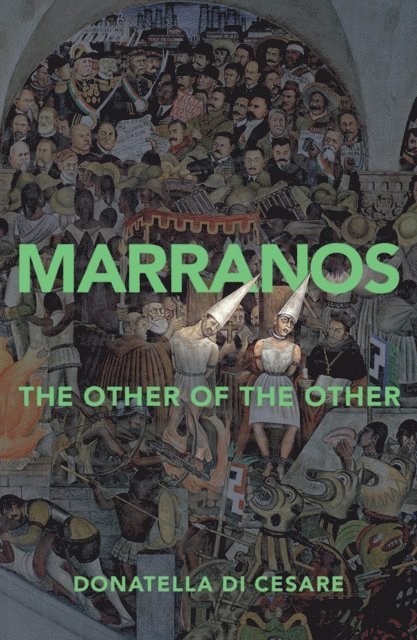
Marranos were Spanish or Portuguese Jews who converted to Christianity at the time of the Spanish Inquisition to avoid being massacred or forced to flee but who continued to practise Judaism in secret. They were persecuted by the first racist blood laws but the water of forced baptism was not enough to make them assimilate.
Donatella Di Cesare sees the marranos as the quintessential figures of the modern condition: the marranos were not just those whom modernity cast out as the ‘other’, but were those ‘others’ who were forced to disavow their beliefs and conceal themselves. They became ‘the other of the other’, doubly excluded, condemned to a life of existential duplicity with no way out, spurned by both Catholics and Jews and unable to belong fully to either community. But this double life of the marranos turned out to be a secret source of strength. Doubly estranged, with no possibility of redemption, the marranos became modernity’s first true radicals. Dissidents out of necessity, they inaugurated modernity with their ambivalence and their split self. And their story is not over.
By treating the history of the marranos as a prism through which to grasp the defining features of modernity, this highly original book will be of interest to a wide readership.