555 kr
Läs direkt efter köp
555 kr
Läs direkt efter köp
750 kr
Läs direkt efter köp
450 kr
Läs direkt efter köp
1 007 kr
Läs direkt efter köp
2 463 kr
Läs direkt efter köp
1 619 kr
Läs direkt efter köp
555 kr
Läs direkt efter köp
651 kr
Skickas inom 11-20 vardagar
In our attempts to understand crime, researchers typically focus on proximate factors such as the psychology of offenders, their developmental history, and the social structure in which they are embedded. While these factors are important, they don't tell the whole story. Evolutionary Criminology: Towards a Comprehensive Explanation of Crime explores how evolutionary biology adds to our understanding of why crime is committed, by whom, and our response to norm violations. This understanding is important both for a better understanding of what precipitates crime and to guide approaches for effectively managing criminal behavior.
This book is divided into three parts. Part I reviews evolutionary biology concepts important for understanding human behavior, including crime. Part II focuses on theoretical approaches to explaining crime, including the evolution of cooperation, and the evolutionary history and function of violent crime, drug use, property offending, and white collar crime. The developmental origins of criminal behavior are described to account for the increase in offending during adolescence and early adulthood as well as to explain why some offenders are more likely to desist than others. Proximal causes of crime are examined, as well as cultural and structural processes influencing crime. Part III considers human motivation to punish norm violators and what this means for the development of a criminal justice system. This section also considers how an evolutionary approach contributes to our understanding of crime prevention and reduction. The section closes with an evolutionary approach to understanding offender rehabilitation and reintegration.
Reviews how evolutionary findings improve our understanding of crime and punishment Examines motivations to offend, and to punish norm violators Articulates evolutionary explanations for adolescent crime increase Identifies how this knowledge can aid in crime prevention and reduction, and in offender rehabilitation455 kr
Läs direkt efter köp
555 kr
Läs direkt efter köp
194 kr
Läs direkt efter köp
780 kr
Skickas inom 11-20 vardagar
Miscarriages of justice are a regular occurrence in the criminal justice system, which is characterized by government agencies that are understaffed, underfunded, and undertrained across the board. We know this because, every week, DNA testing and innocence projects across the United States help to identify and eventually overturn wrongful convictions. As a result, the exonerated go free and the stage is set for addressing criminal and civil liability. Criminal justice students and professionals therefore have a need to be made aware of the miscarriage problem as a threshold issue. They need to know what a miscarriage of justice looks like, how to recognize it's many forms, and what their duty of care might be in terms of prevention. They also need to appreciate that identifying miscarriages, and ensuring legal remedy, is� an important function of the system that must be honored by all criminal justice professionals. The purpose of this textbook is to move beyond the law review, casebook, and true crime publications that comprise the majority of miscarriage literature. While informative, they are not designed for teaching students in a classroom setting. This text is written for use at the undergraduate level in journalism, sociology, criminology and criminal justice programs - to introduce college students to the miscarriage phenomenon in a structured fashion. The language is more broadly accessible than can be found in legal texts, and the coverage is multidisciplinary. Miscarriages of Justice: Actual Innocence, Forensic Evidence, and the Law focuses on the variety of miscarriages issues in the United States legal system. Written by leaders in the field, it is particularly valuable to forensic scientists and attorneys evaluating evidence or preparing for trial or appeal in cases where faulty evidence features prominently. It is also of value to those interested in developing arguments for miscarriage in post-conviction review of criminal cases. Chapters focus specifically on issues of law enforcement bias and corruption; false confessions; ineffective counsel and prosecutorial misconduct; forensic fraud; and more. The book closes by examining innocence projects and commissions, and civil remedies for the wrongfully convicted.This text ultimately presents the issue of miscarriages as a systemic and multi-disciplinary criminal justice issue. It provides perspectives from within the professional CJ community, and it serves as warning to future professionals about the dangers and consequences of apathy, incompetence, and neglect. Consequently, it can be used by any CJ educator to introduce any group of CJ students to the problem.
Written by practicing criminal justice professionals in plain language for undergraduate students Covers multiple perspectives across the criminal justice system Informed by experience working for Innocence Projects across the United States to achieve successful exonerations Topical case examples to facilitate teaching and learning Companion website featuring Discussion topics, Exam questions and PowerPoint slides: http://textbooks.elsevier.com/web/Manuals.aspx?isbn=9780124115583988 kr
Läs direkt efter köp
698 kr
Skickas inom 11-20 vardagar
Professional Issues in Forensic Science will introduce students to various topics they will encounter within the field of Forensic Science. Legal implications within the field will focus on expert witness testimony and procedural rules defined by both legislative statute and court decisions. These decisions affect the collection, analysis, and court admissibility of scientific evidence, such as the Frye and Daubert standards and the Federal Rules of Evidence. Existing and pending Forensic Science legislation will be covered, including laws governing state and national DNA databases. Ethical concerns stemming from the day-to-day balancing of competing priorities encountered by the forensic student will be discussed. Such competing priorities may cause conflicts between good scientific practice and the need to expedite work, meet legal requirements, and satisfy client's wishes. The role of individual morality in Forensic Science and competing ethical standards between state and defense experts will be addressed. Examinations of ethical guidelines issued by various professional forensic organizations will be conducted. Students will be presented with examples of ethical dilemmas for comment and resolution. The management of crime laboratories will provide discussion on quality assurance/quality control practices and the standards required by the accreditation of laboratories and those proposed by Scientific Working Groups in Forensic Science. The national Academy of Sciences report on Strengthening Forensic Science will be examined to determine the impact of the field.
Professional Issues in Forensic Science is a core topic taught in forensic science programs. This volume will be an essential advanced text for academics and an excellent reference for the newly practicing forensic scientist. It will also fit strategically and cluster well with our other forensic science titles addressing professional issues.
Introduces readers to various topics they will encounter within the field of Forensic Science Covers legal issues, accreditation and certification, proper analysis, education and training, and management issues Includes a section on professional organizations and groups, both in the U.S. and Internationally Incorporates effective pedagogy, key terms, review questions, discussion question and additional reading suggestions809 kr
Läs direkt efter köp
827 kr
Läs direkt efter köp
1 022 kr
Läs direkt efter köp
874 kr
Skickas inom 11-20 vardagar
Forensic Biology provides coordinated expert content from world-renowned leading authorities in forensic biology. Covering the range of forensic biology, this volume in the Advanced Forensic Science Series provides up-to-date scientific learning on DNA analysis. Technical information, written with the degreed professional in mind, brings established methods together with newer approaches to build a comprehensive knowledge base for the student and practitioner alike.
LIke each volume in the Advanced Forensic Science Series, review and discussion questions allow the text to be used in classrooms, training programs, and numerous other applications. Sections on fundamentals of forensic science, history, safety, and professional issues provide context and consistency in support of the forensic enterprise. Forensic Biology sets a new standard for reference and learning texts in mondern forensic science.
Advanced articles written by international forensic biology experts Covers the range of forensic biology, including methods and interpretation Includes entries on history, safety, and professional issues Useful as a professional reference, advanced textbook, or training review827 kr
Läs direkt efter köp
1 029 kr
Läs direkt efter köp
792 kr
Skickas inom 11-20 vardagar
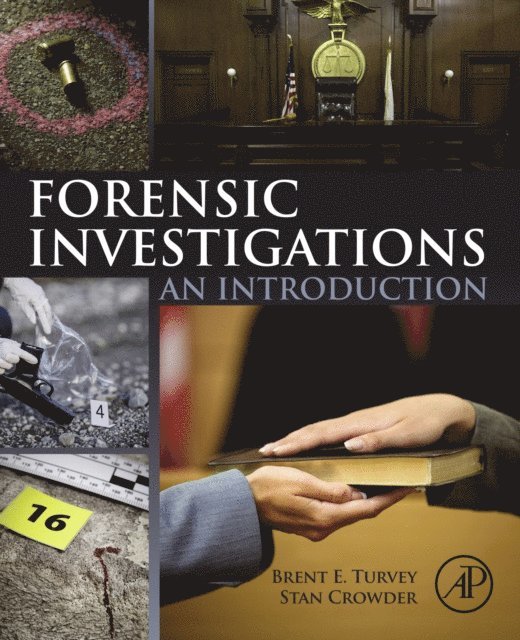
The terms forensic investigator and forensic investigation are part of our cultural identity. They can be found in the news, on television, and in film. They are invoked, generally, to imply that highly trained personnel will be collecting some form of physical evidence with eventual scientific results that cannot be questioned or bargained with. In other words, they are invoked to imply the reliability, certainty, and authority of a scientific inquiry.
Using cases from the authors' extensive files, Forensic Investigations: An Introduction provides an overview of major subjects related to forensic inquiry and evidence examination. It will prepare Criminal Justice and Criminology students in forensic programs for more specialized courses and provide a valuable resource to newly employed forensic practitioners. Written by practicing and testifying forensic professionals from law enforcement, academia, mental health and the forensic sciences, this work offers a balanced scientific approach, based on the established literature, for broad appeal.
The purpose of this book is to help students and professionals rid themselves of the myths and misconceptions they have accumulated regarding forensic investigators and the subsequent forensic investigations they help to conduct. It will help the reader understand the role of the forensic investigator; the nature and variety of forensic investigations that take place in the justice system; and the mechanisms by which such investigations become worthy as evidence in court. Its goals are no loftier than that. However, they could not be more necessary to our understanding of what justice is, how it is most reliably achieved, and how it can be corrupted by those who are burdened with apathy and alternative motives.
A primary text for instructors teaching forensic courses related to criminal and forensic investigation Written by forensic professionals, currently in practice and testifying in court Offers applied protocols for a broad range of forensic investigations Augments theoretical constructs with recent, and relevant case studies and forensic reports Based on the most recent scientific research, practice, and protocols related to forensic inquiry908 kr
Läs direkt efter köp
932 kr
Skickas inom 11-20 vardagar
False Allegations: Investigative and Forensic Issues in Fraudulent Reports of Crime provides investigators and forensic examiners with a reference manual comprised of objective protocols for managing cases. It helps them understand the nature and extent of false allegations to more accurately identify false allegations should they present in casework. It also prepares users on how to confront and explain false allegations, including instances where colleagues and supervisors may be steeped in bias, denial or self-interest.
Responding law enforcement agencies have a duty of care to investigate all reported crime, to recognize and uncover false allegations, and prevent them from causing harm to the innocent. Failure to do so can result in miscarriages of justice. When law enforcement fails in their duty of care, they are also exposed to civil liability from those that have been falsely accused.
Presents a first of it's kind forensic textbook on a subject that has been highly politicized Written by qualified investigative and forensic professionals who work cases and give expert testimony Offers applied protocols to conduct forensic investigations and evaluations, including red flags Based on the most recent scientific research, practice and protocols Includes extensive case examples used to augment a variety of different false report models1 029 kr
Läs direkt efter köp
1 029 kr
Läs direkt efter köp
1 029 kr
Läs direkt efter köp
1 029 kr
Läs direkt efter köp
1 022 kr
Läs direkt efter köp
1 029 kr
Läs direkt efter köp
1 022 kr
Läs direkt efter köp