

Häftad, Engelska, 1997
300 kr
Skickas inom 7-10 vardagar
300 kr
Skickas inom 7-10 vardagar
317 kr
Skickas inom 7-10 vardagar
The Normal and the Pathological is one of the crucial contributions to the history of science in the last half century. It takes as its starting point the sudden appearance of biology as a science in the nineteenth century and examines the conditions determining its particular makeup.Canguilhem analyzes the radically new way in which health and disease were defined in the early nineteenth century, showing that the emerging categories of the normal and the pathological were far from objective scientific concepts. He demonstrates how the epistemological foundations of modern biology and medicine were intertwined with political, economic, and technological imperatives.Canguilhem was an important influence on the thought of Michel Foucault and Louis Althusser, among others, in particular for the way in which he poses the problem of how new domains of knowledge come into being and how they are part of a discontinuous history of human thought.

266 kr
Skickas inom 7-10 vardagar
From the acclaimed French philosopher, intellectual, and novelist, a brilliant account of the social and economic costs of civilizationIn this important work, Georges Bataille uses his novel economic theory as the basis for an incisive inquiry into the very nature of civilization. He introduces here his concept of the accursed share, the surplus energy that any system, natural or cultural, must expend; it is this expenditure, according to Bataille, that most clearly defines a society. His examples include sacrifice among the Aztecs, potlatch among the Northwest Coast Indians, military conquest in Islam, and Buddhist monasticism in Tibet.In this way, Bataille proposes a theory of a “general economy” based on excess and exuberance that radically revises conventional economic models of scarcity and utility. A brilliant blend of economics and aesthetics, ethics and anthropology, The Accursed Share provides an excellent introduction to Bataille’s philosophic work. It will be of particular interest not only to readers of his fiction and essays but also to cultural theorists, anthropologists, and economists of all schools.

345 kr
Skickas inom 7-10 vardagar
In this widely anticipated book, two leading contemporary art historians present a stunning reconsideration of the problem of time in the Renaissance. With intellectual brilliance, Alexander Nagel and Christopher S. Wood reexamine the meanings, uses, and effects of chronologies, models of temporality, and notions of originality and repetition in Renaissance images and artifacts.Anachronic Renaissance reveals a web of paths traveled by works and artists, a landscape obscured by art history’s disciplinary compulsion to anchor its data securely in time. The buildings, paintings, drawings, prints, sculptures, and medals addressed in this book were shaped by concerns about authenticity, about reference to prestigious origins and precedents, and about the implications of transposition from one medium to another. Byzantine icons taken to be early Christian antiquities, the acheiropoeton or image made without hands, the activities of spoliation and citation, differing approaches to art restoration, legends about movable buildings, and forgeries and pastiches: all of these emerge as basic conceptual structures of Renaissance art. The authors show how the complex and layered temporalities of images offered a counterpoint to the linear chronologies that increasingly structured commerce, politics, travel, and everyday life in the fourteenth and fifteenth centuries.While a work of art does bear witness to the moment of its fabrication, Nagel and Wood argue that it is equally important to understand its temporal instability: how it points away from that moment, backward to a remote ancestral origin, to a prior artifact or image, even to an origin outside of time, in divinity. The authors conclude with an analysis of Roman episodes and projects of the decades around 1500, culminating in Raphael’s Stanza della Segnatura. This book is not the story about the Renaissance, nor is it just a story. It imagines the infrastructure of many possible stories. Clearly, Anachronic Renaissance will be essential reading for historians of Western art and all those concerned with the historiography of material culture.

336 kr
Skickas inom 7-10 vardagar
Objectivity has a history, and it is full of surprises. In Objectivity, Lorraine Daston and Peter Galison chart the emergence of objectivity in the mid-nineteenth-century sciences — and show how the concept differs from alternatives, truth-to-nature and trained judgment. This is a story of lofty epistemic ideals fused with workaday practices in the making of scientific images.From the eighteenth through the early twenty-first centuries, the images that reveal the deepest commitments of the empirical sciences — from anatomy to crystallography — are those featured in scientific atlases: the compendia that teach practitioners of a discipline what is worth looking at and how to look at it. Atlas images define the working objects of the sciences of the eye: snowflakes, galaxies, skeletons, even elementary particles.Galison and Daston use atlas images to uncover a hidden history of scientific objectivity and its rivals. Whether an atlas maker idealizes an image to capture the essentials in the name of truth-to-nature or refuses to erase even the most incidental detail in the name of objectivity or highlights patterns in the name of trained judgment is a decision enforced by an ethos as well as by an epistemology.As Daston and Galison argue, atlases shape the subjects as well as the objects of science. To pursue objectivity — or truth-to-nature or trained judgment — is simultaneously to cultivate a distinctive scientific self wherein knowing and knower converge. Moreover, the very point at which they visibly converge is in the very act of seeing not as a separate individual but as a member of a particular scientific community. Embedded in the atlas image, therefore, are the traces of consequential choices about knowledge, persona, and collective sight. Objectivity is a book addressed to any one interested in the elusive and crucial notion of objectivity — and in what it means to peer into the world scientifically.
335 kr
Skickas inom 7-10 vardagar
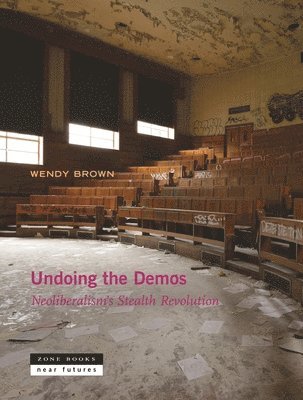
Neoliberal rationality — ubiquitous today in statecraft and the workplace, in jurisprudence, education, and culture — remakes everything and everyone in the image of homo oeconomicus. What happens when this rationality transposes the constituent elements of democracy into an economic register? In vivid detail, Wendy Brown explains how democracy itself is imperiled.The demos disintegrates into bits of human capital; concerns with justice cede to the mandates of growth rates, credit ratings, and investment climates; liberty submits to the imperative of human capital appreciation; equality dissolves into market competition; and popular sovereignty grows incoherent. Liberal democratic practices may not survive these transformations. Radical democratic dreams may not either.In an original and compelling theoretical argument, Brown explains how and why neoliberal reason undoes the political form and political imaginary it falsely promises to secure and reinvigorate. Through meticulous analyses of neoliberalized law, political practices, governance, and education, she charts the new common sense.Undoing the Demos makes clear that, far from being the lodestar of the twenty-first century, a future for democracy depends upon it becoming an object of struggle and rethinking.
294 kr
Skickas inom 7-10 vardagar
In this groundbreaking work, Ariella Azoulay thoroughly revises our understanding of the ethical status of photography. It must, she insists, be understood in its inseparability from the many catastrophes of recent history. She argues that photography is a particular set of relations between individuals and the powers that govern them and, at the same time, a form of relations among equals that constrains that power. Anyone, even a stateless person, who addresses others through photographs or occupies the position of a photograph’s addressee, is or can become a member of the citizenry of photography.The crucial arguments of the book concern two groups that have been rendered invisible by their state of exception: the Palestinian noncitizens of Israel and women in Western societies. Azoulay’s leading question is: Under what legal, political, or cultural conditions does it become possible to see and show disaster that befalls those with flawed citizenship in a state of exception? The Civil Contract of Photography is an essential work for anyone seeking to understand the disasters of recent history and the consequences of how they and their victims are represented.

239 kr
Skickas inom 7-10 vardagar

234 kr
265 kr
Skickas inom 7-10 vardagar
336 kr

270 kr
Skickas
A compelling analysis of the work of art historian Aby Warburg and its radical implications for the study of visual imagesAby Warburg (1866–1929) is best known as the originator of the discipline of iconology and as the founder of the institute that bears his name. His followers included some of the celebrated art historians of the twentieth century, such as Erwin Panofsky, Edgar Wind, and Fritz Saxl. But his heirs developed, for the most part, a domesticated iconology based on the decipherment and interpretation of symbolic material. As Philippe-Alain Michaud demonstrates in this important book, Warburg’s project was remote from any positivist or neo-Kantian ambitions. Nourished on the work of Friedrich Nietzsche and Jacob Burckhardt, Warburg fashioned a “critical iconology” to reveal the irrationality of the image in Western culture.Opposing the grand teleological narratives of art inaugurated by Giorgio Vasari, Warburg’s method operated through historical anachronisms and discontinuities. Using procedures of “montage-collision” he brought together pagan artifacts with masterpieces of Florentine Renaissance art, the astrology of the ancient Near East with the Lutheran Reformation, Mannerist festivals with the sacred dances of Native Americans. Michaud insists that for Warburg, the practice of art history was not only the recognition of the radical heterogeneity of objects but the discovery within the art work itself of lines of fracture, contradictions, tensions, and the energies of magic, empathy, totemism, and animism.Michaud provides us with a book that not only is about Warburg but also extends his intuitions and discoveries into analyses of other categories of imagery like the daguerreotype, the chronophotography of Étienne-Jules Marey, early cinema, and the dances of Loïe Fuller. This edition also includes a foreword by Georges Didi-Huberman and texts by Warburg not previously translated into English.Chosen as one of the best art books of 2004 by the Washington Post and Bookforum.
274 kr
Skickas inom 7-10 vardagar
239 kr
Skickas inom 7-10 vardagar
398 kr
Skickas inom 7-10 vardagar

317 kr
Skickas inom 7-10 vardagar
352 kr
Skickas inom 7-10 vardagar
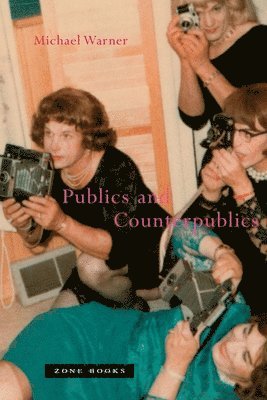
Publics and Counterpublics revolves around a central question: What is a public? The idea of a public is a cultural form, a kind of practical fiction, present in the modern world in a way that is very different from other or earlier societies. Like the idea of rights, or nations, or markets, it can now seem universal. But it has not always been so. Publics exist only by virtue of their imagining. They are a kind of fiction that has taken on life, and very potent life at that.Publics have some regular properties as a form, with powerful implications for the way our social world takes shape; but much of modern life involves struggles over the nature of publics and their interrelation. There are ambiguities, even contradictions in the idea of a public. As it is extended to new contexts and media, new polities and rhetorics, its meaning can be seen to change, in ways that we have scarcely begun to appreciate.By combining historical analysis, theoretical reflection, and extended case studies, Publics and Counterpublics shows how the idea of a public works as a formal device in modern culture and traces its implications for contemporary life. Michael Warner offers a revisionist account at the junction of two intellectual traditions with which he has been associated: public-sphere theory and queer theory. To public-sphere theory, this book brings a new emphasis on cultural forms, and a new focus on the dynamics of counterpublics. To queer theory, it brings a new way of seeing how queer culture (among other examples) is shaped by the counterpublic environment.
273 kr
Skickas inom 7-10 vardagar
Neoliberal rationality — ubiquitous today in statecraft and the workplace, in jurisprudence, education, and culture — remakes everything and everyone in the image of homo oeconomicus. What happens when this rationality transposes the constituent elements of democracy into an economic register? In vivid detail, Wendy Brown explains how democracy itself is imperiled.The demos disintegrates into bits of human capital; concerns with justice cede to the mandates of growth rates, credit ratings, and investment climates; liberty submits to the imperative of human capital appreciation; equality dissolves into market competition; and popular sovereignty grows incoherent. Liberal democratic practices may not survive these transformations. Radical democratic dreams may not either.In an original and compelling theoretical argument, Brown explains how and why neoliberal reason undoes the political form and political imaginary it falsely promises to secure and reinvigorate. Through meticulous analyses of neoliberalized law, political practices, governance, and education, she charts the new common sense.Undoing the Demos makes clear that, far from being the lodestar of the twenty-first century, a future for democracy depends upon it becoming an object of struggle and rethinking.

345 kr
Skickas inom 7-10 vardagar
A new mapping of castrato afterlives in modern RomeAround 1830, opera houses stopped using castrati, and Rome and the Vatican became home to their glorious singing, engineered by surgery and intensive vocal training. Castrati were long mired in secrecy, obfuscations, and lies about their origin and conditions, not least the last of them, Alessandro Moreschi. Musicologist Martha Feldman declines to accept these deep-seated mysteries and concealments. After a decade and more of digging through archives and family histories comes her exciting transdisciplinary and quasi-cinematic account of Moreschi, whose recordings preserve the only sonic trace of a solo castrato.Yet Moreschi’s story extends far beyond him. It opens up intrigues, politics, and histories of the Vatican, everyday histories of nineteenth- and twentieth-century Rome, the world of Roman opera, the city’s unique mélange of sacred and vernacular tropes, and representations of Rome by iconic film director Federico Fellini. Moreschi and Fellini turn out to have been related by marriage, but also to share synergies grounded in Rome’s persistent inclination to vernacularize the sacred. Far from telling of one anomalous figure, Feldman’s gripping history convinces readers that Moreschi, like Fellini, can be read as an improbable index of Roman consciousness, both during his own life and well beyond.
375 kr
Skickas inom 7-10 vardagar
305 kr
Skickas inom 7-10 vardagar
335 kr
Skickas inom 7-10 vardagar
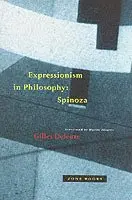
In this remarkable work, Gilles Deleuze, the renowned French philosopher, reflects on one of the thinkers of the past who most influenced his own sweeping reconfiguration of the tasks of philosophy. For Deleuze, Spinoza, along with Nietzsche and Lucretius, conceived of philosophy as an enterprise of liberation and radical demystification. He locates in Spinoza “a set of affects, a kinetic determination, an impulse” and makes Spinoza into “an encounter, a passion.”Expressionism in Philosophy was the culmination of a series of monographic studies by Deleuze (on Hume, Bergson, Nietzsche, Proust, Kant, and Sacher-Masoch) and prepared the transition from these abstract treatments of historical schemes of experience to the nomadology of Capitalism and Schizophrenia (Anti-Oedipus and A Thousand Plateaus, co-authored with Félix Guattari). Thus, Expressionism in Philosophy is both a pivotal reading of Spinoza’s work and a crucial text within the development of Deleuze’s thought.

395 kr
Skickas inom 7-10 vardagar
258 kr
Skickas inom 7-10 vardagar
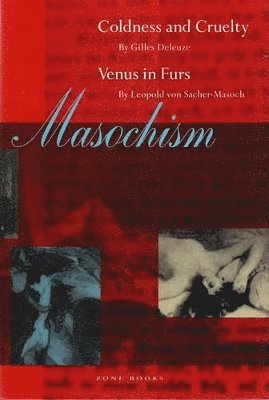
In his stunning essay Coldness and Cruelty Gilles Deleuze provides a rigorous and informed philosophical examination of the work of late nineteenth-century German novelist Leopold von Sacher-Masoch. Deleuze’s essay, certainly the most profound study yet produced on the relations between sadism and masochism, seeks to develop and explain Masoch’s “peculiar way of ‘desexualizing’ love while at the same time sexualizing the entire history of humanity.” He shows that masochism is something far more subtle and complex than the enjoyment of pain, that masochism has nothing to do with sadism: their worlds do not communicate, just as the genius of those who created them — Masoch and Sade — lie stylistically, philosophically, and politically poles apart.Venus in Furs, the most famous of Masoch’s novels, belongs to an unfinished cycle of works that Masoch entitled The Heritage of Cain. The cycle was to treat a series of themes, including love, war, and death. The present work is about love. Although the entire constellation of symbols that has come to characterize the masochistic syndrome can be found here — fetishes, whips, disguises, fur-clad women, contracts, humiliations, punishment, and always the volatile presence of a terrible coldness — these received associations do not eclipse the truly singular and surprising power of Masoch’s eroticism.

247 kr
Skickas inom 7-10 vardagar

345 kr
Skickas inom 7-10 vardagar
An illuminating account of how new knowledge about human respiration impacted architectural design in the early twentieth centuryBreathing Space is a compelling and wide-ranging analysis of pneumatic phenomena in modern culture. Architect and historian Tim Altenhof brilliantly explores the physiology of breathing and its reciprocal relationship to bodies and buildings, both of which share a common atmosphere. Because breathing is controlled by the autonomic nervous system and cannot be willfully overridden, it takes place unconsciously and involuntarily—most of the time. However, beginning in the mid-nineteenth century, attitudes toward breathing changed significantly. Breathing became a widely investigated cultural and physiological phenomenon and was the basis for techniques and bodily practices that heightened pulmonary awareness. New understandings of air pollution and disease stimulated a widespread preoccupation with ventilation, impacting architecture in countless ways. Altenhof’s close readings of built structures show how the science of breathing was incorporated into architecture, whether in the design of factories, residences, or medical facilities. The lungs form a major part of the respiratory system and like no other organ tie the living body directly to its surroundings. Yet the role of lungs also poses a topological problem: engaging in atmospheric transfer, they dissolve the division between inside and outside, and despite being an internal organ, they sustain a permanent and living connection to the external world. This ambiguity and permeability constitute the spatial dimension of breathing.
317 kr
Skickas inom 7-10 vardagar

277 kr
Skickas inom 7-10 vardagar
275 kr
Skickas inom 7-10 vardagar
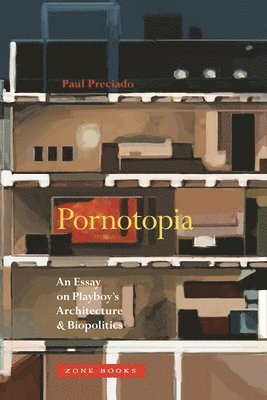
Published for the first time in 1953, Playboy was not only the first pornographic popular magazine in America; it also came to embody an entirely new lifestyle through the construction of a series of utopian multimedia spaces — from the Playboy Mansion and fictional Playboy’s Penthouse of 1959 to the Playboy Clubs and hotels appearing around the world in the 1960s. Simultaneously, the invention of the contraceptive pill provided access to a biochemical technique that separated (hetero) sexuality and reproduction.Addressing these concurrent cultural shifts, Paul Preciado investigates the strategic relationships between space, gender, and sexuality in popular sites related to the production and consumption of pornography that have tended to reside at the margins of traditional histories of architecture: bachelor pads, multimedia rotating beds, and design objects, among others.Combining historical perspectives with contemporary critical theory, gender and queer theory, porn studies, the history of technology, and a range of primary transdisciplinary sources — treatises on sexuality, medical and pharmaceutical handbooks, architecture journals, erotic magazines, building manuals, and novels — Pornotopia explores the use of architecture as a biopolitical technique for governing sexual relations and the production of gender in the postwar United States.
351 kr
Skickas inom 7-10 vardagar