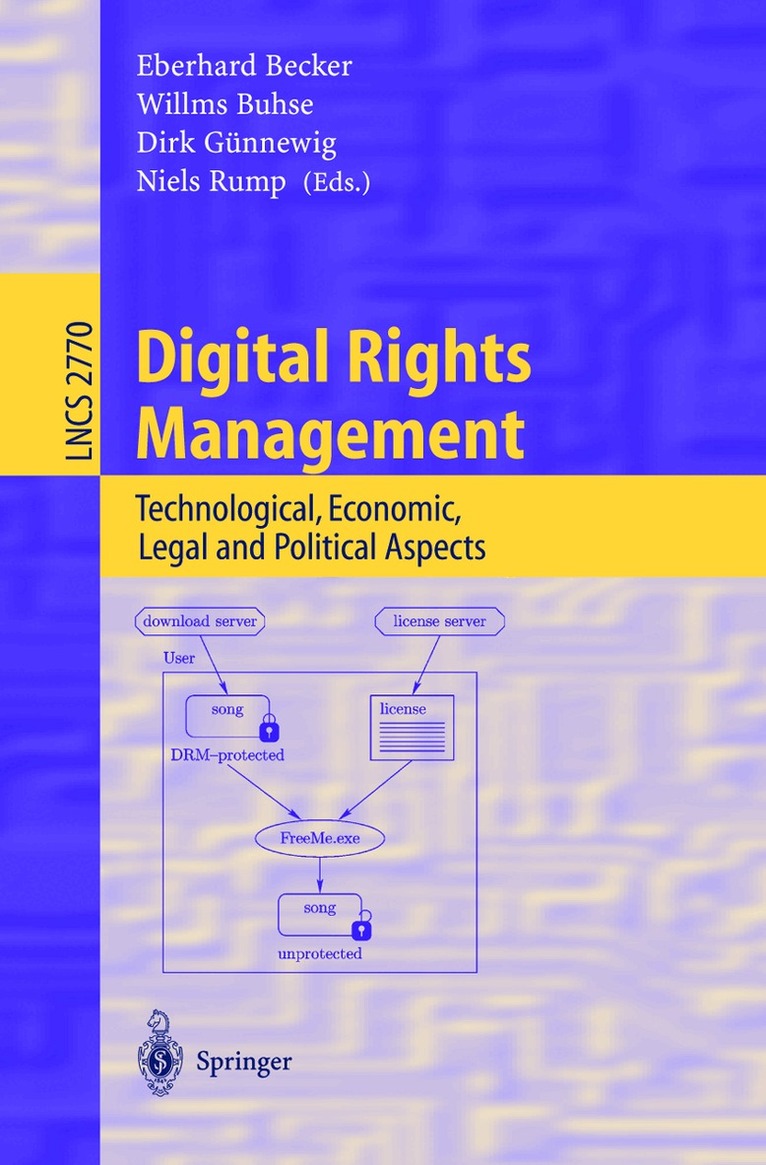
Digital Rights Management (DRM) is a topic of interest to a wide range of people from various backgrounds: engineers and technicians, legal academics and lawyers, economists and business practitioners. The two conferences on the issue held in 2000 and 2002 in Berlin, Germany, brought these people together for fruitful discussions. This book continues this process by providing insights into the three main areas that DRM in?uences and that DRM is influenced by: technology, economics, and law and politics. Looking at the first results of the two conferences we would like to emphasize three aspects. Firstly, DRM is a fairly young topic with many issues still - resolved. Secondly, there is still an acute lack of objective information about DRM and the consequences of using (or not using) DRM in our Information Society. And, finally, only open discussions amongst all the interested parties and people from different scientific and practical backgrounds can help to create a foundation on whichDRM can actually become useful.
Digital Rights Management (DRM) is a topic of interest to a wide range of people from various backgrounds: engineers and technicians, legal academics and lawyers, economists and business practitioners. The two conferences on the issue held in 2000 and 2002 in Berlin, Germany, brought these people together for fruitful discussions. This book continues this process by providing insights into the three main areas that DRM in?uences and that DRM is influenced by: technology, economics, and law and politics. Looking at the first results of the two conferences we would like to emphasize three aspects. Firstly, DRM is a fairly young topic with many issues still - resolved. Secondly, there is still an acute lack of objective information about DRM and the consequences of using (or not using) DRM in our Information Society. And, finally, only open discussions amongst all the interested parties and people from different scientific and practical backgrounds can help to create a foundation on whichDRM can actually become useful.
Eine der größten Herausforderungen für die Medienindustrie durch das Internet ist der (legale wie illegale) Vertrieb ihrer Inhalte über Online-Kanäle. Bisher wurde das Thema primär aus technischer und juristischer Sicht diskutiert.Willms Buhse untersucht die Folgen der aktuellen technischen Entwicklungen im Bereich der digitalen Musikverwertung aus betriebswirtschaftlicher Perspektive. Im Kern geht es um die Frage, wie sich im Umfeld von Darknet und Digital Rights Management Geschäftsmodelle für digitale Inhalte in Szenarien einordnen und analysieren lassen. Am Beispiel Onlinemusik entwickelt und diskutiert der Autor vier Szenarien und zeigt Wettbewerbsstrategien und Geschäftsmodelle zur Positionierung von Musikunternehmen bei der Schaffung digitaler Distributionskanäle auf. Es wird deutlich, dass die Ergebnisse seiner Studie auf die Medien- und Softwarebranche generell, z.B. für digitalisierte Filme, Computerspiele, Verlagsprodukte und Open-Source-Software, übertragbar sind. Der Verfasser stützt sich auf umfassende internationale Erfahrungen in der Medienindustrie und leistet einen fundierten Beitrag zur Gestaltung von Geschäftsmodellen in der Multimediabranche.