If you want to survive any kind of crisis, you must defend yourself. This does not mean that you must be in a constant struggle or fight. It is not about living in a defensive mode. In my opinion, it means to be aware of the red lights in your heart, your mind, or your spirit. To ignore these signals is to deliver control of your life or your health to an alien entity. As I have said repeatedly, only you know what really happens in your body. It seems a great responsibility to learn to know ourselves. In general, no one educates us for that. For instance, if we present symptoms, they can be quieted with medicine, but in many cases, we need to get to the bottom of the symptom to eradicate the root problem. If we do not know ourselves, if we do not listen or understand the language of our bodies, if we turn a deaf ear to our hearts, then time will take care of making us face that situation, sooner or later. I think it s vital that we teach our children to listen to themselves. We should give them, when the occasion warrants it, the opportunity to choose a solution for their problems. In this way, they will have the chance to make contact with their truth. In the same way, if they tell us they re feeling pain or distress, we must give them that credit so as not to silence their souls.
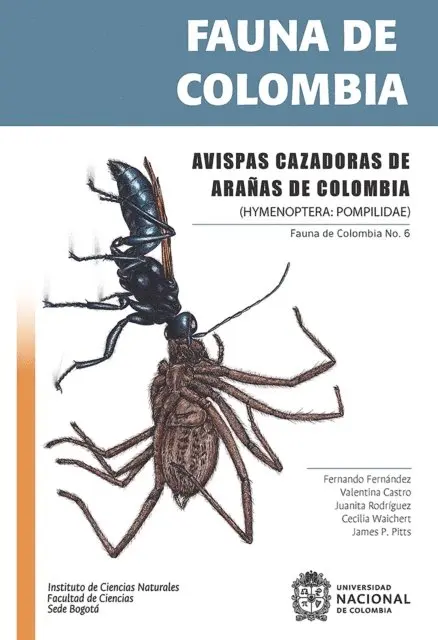
Las avispas cazadoras de arañas son una familia de himenópteros (Pompilidae) cuyas hembras cazan exclusivamente arañas para alimentar a su progenie, siendo siempre un huevo por araña paralizada. Hay una notable diversidad de tamaños, desde algunas pequeñas de pocos milímetros hasta las gigantescas Pepsis, cazadoras de tarántulas cuyas hembras pueden sobrepasar los 7 cm de longitud y 13 cm de envergadura de alas. La fauna de Colombia no ha sido objeto de investigación hasta el presente aporte, donde se ofrece una introducción general a la sistématica y biología de la familia, morfología, y claves ilustradas para las subfamilias y géneros en el país. Se presenta una sinopsis de los géneros conocidos para Colombia, con fotografías de hembra y macho, claves para especies (en la mayoría de géneros) y mapas de distribución.