1 237 kr
Skickas inom 10-15 vardagar
1 237 kr
Skickas inom 10-15 vardagar
1 203 kr
Skickas inom 10-15 vardagar
1 982 kr
Skickas inom 7-10 vardagar
438 kr
Skickas inom 7-10 vardagar
505 kr
Läs direkt efter köp
Simulation and the Monte Carlo Method, Second Edition reflects the latest developments in the field and presents a fully updated and comprehensive account of the major topics that have emerged in Monte Carlo simulation since the publication of the classic First Edition over twenty-five years ago. While maintaining its accessible and intuitive approach, this revised edition features a wealth of up-to-date information that facilitates a deeper understanding of problem solving across a wide array of subject areas, such as engineering, statistics, computer science, mathematics, and the physical and life sciences.
The book begins with a modernized introduction that addresses the basic concepts of probability, Markov processes, and convex optimization. Subsequent chapters discuss the dramatic changes that have occurred in the field of the Monte Carlo method, with coverage of many modern topics including:
Markov Chain Monte Carlo
Variance reduction techniques such as the transform likelihood ratio method and the screening method
The score function method for sensitivity analysis
The stochastic approximation method and the stochastic counter-part method for Monte Carlo optimization
The cross-entropy method to rare events estimation and combinatorial optimization
Application of Monte Carlo techniques for counting problems, with an emphasis on the parametric minimum cross-entropy method
An extensive range of exercises is provided at the end of each chapter, with more difficult sections and exercises marked accordingly for advanced readers. A generous sampling of applied examples is positioned throughout the book, emphasizing various areas of application, and a detailed appendix presents an introduction to exponential families, a discussion of the computational complexity of stochastic programming problems, and sample MATLAB® programs.
Requiring only a basic, introductory knowledge of probability and statistics, Simulation and the Monte Carlo Method, Second Edition is an excellent text for upper-undergraduate and beginning graduate courses in simulation and Monte Carlo techniques. The book also serves as a valuable reference for professionals who would like to achieve a more formal understanding of the Monte Carlo method.
1 281 kr
Läs direkt efter köp
Praise for the first edition:
“In nine succinct but information-packed chapters, the authors provide a logically structured and robust introduction to the mathematical and statistical methods underpinning the still-evolving field of AI and data science.â€
- Joacim Rocklöv and Albert A. Gayle, International Journal of Epidemiology, Volume 49, Issue 6
“This book organizes the algorithms clearly and cleverly. The way the Python code was written follows the algorithm closely—very useful for readers who wish to understand the rationale and flow of the background knowledge.â€
- Yin-Ju Lai and Chuhsing Kate Hsiao, Biometrics, Volume 77, Issue 4
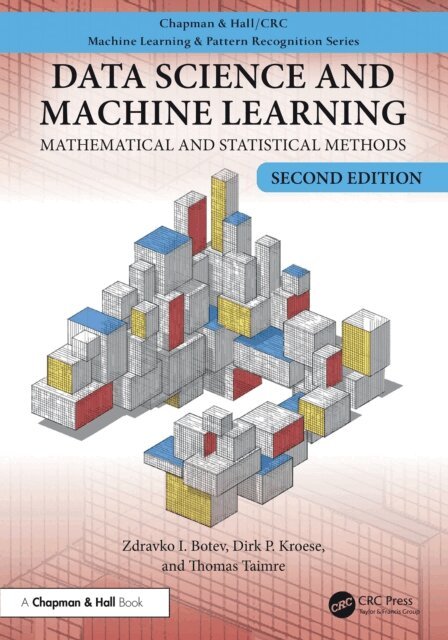
The purpose of Data Science and Machine Learning: Mathematical and Statistical Methods is to provide an accessible, yet comprehensive textbook intended for students interested in gaining a better understanding of the mathematics and statistics that underpin the rich variety of ideas and machine learning algorithms in data science.
New in the Second Edition
This expanded edition provides updates across key areas of statistical learning:
Monte Carlo Methods: A new section introducing regenerative rejection sampling - a simpler alternative to MCMC. Unsupervised Learning: Inclusion of two multidimensional diffusion kernel density estimators, as well as the bandwidth perturbation matching method for the optimal data-driven bandwidth selection. Regression: New automatic bandwidth selection for local linear regression. Feature Selection and Shrinkage: A new chapter introducing the klimax method for model selection in high-dimensions. Reinforcement Learning: A new chapter on contemporary topics such as policy iteration, temporal difference learning, and policy gradient methods, all complete with Python code. Appendices: Expanded treatment of linear algebra, functional analysis, and optimization that includes the coordinate-descent method and the novel Majorization–Minimization method for constrained optimization.Key Features:
Focuses on mathematical understanding. Presentation is self-contained, accessible, and comprehensive. Extensive list of exercises and worked-out examples. Many concrete algorithms with Python code. Full color throughout and extensive indexing. A single-counter consecutive numbering of all theorems, definitions, equations, etc., for easier text searches.1 281 kr
Läs direkt efter köp
Praise for the first edition:
“In nine succinct but information-packed chapters, the authors provide a logically structured and robust introduction to the mathematical and statistical methods underpinning the still-evolving field of AI and data science.â€
- Joacim Rocklöv and Albert A. Gayle, International Journal of Epidemiology, Volume 49, Issue 6
“This book organizes the algorithms clearly and cleverly. The way the Python code was written follows the algorithm closely—very useful for readers who wish to understand the rationale and flow of the background knowledge.â€
- Yin-Ju Lai and Chuhsing Kate Hsiao, Biometrics, Volume 77, Issue 4
The purpose of Data Science and Machine Learning: Mathematical and Statistical Methods is to provide an accessible, yet comprehensive textbook intended for students interested in gaining a better understanding of the mathematics and statistics that underpin the rich variety of ideas and machine learning algorithms in data science.
New in the Second Edition
This expanded edition provides updates across key areas of statistical learning:
Monte Carlo Methods: A new section introducing regenerative rejection sampling - a simpler alternative to MCMC. Unsupervised Learning: Inclusion of two multidimensional diffusion kernel density estimators, as well as the bandwidth perturbation matching method for the optimal data-driven bandwidth selection. Regression: New automatic bandwidth selection for local linear regression. Feature Selection and Shrinkage: A new chapter introducing the klimax method for model selection in high-dimensions. Reinforcement Learning: A new chapter on contemporary topics such as policy iteration, temporal difference learning, and policy gradient methods, all complete with Python code. Appendices: Expanded treatment of linear algebra, functional analysis, and optimization that includes the coordinate-descent method and the novel Majorization–Minimization method for constrained optimization.Key Features:
Focuses on mathematical understanding. Presentation is self-contained, accessible, and comprehensive. Extensive list of exercises and worked-out examples. Many concrete algorithms with Python code. Full color throughout and extensive indexing. A single-counter consecutive numbering of all theorems, definitions, equations, etc., for easier text searches.2 297 kr
Läs direkt efter köp
More and more of today’s numerical problems found in engineering and finance are solved through Monte Carlo methods. The heightened popularity of these methods and their continuing development makes it important for researchers to have a comprehensive understanding of the Monte Carlo approach. Handbook of Monte Carlo Methods provides the theory, algorithms, and applications that helps provide a thorough understanding of the emerging dynamics of this rapidly-growing field.
The authors begin with a discussion of fundamentals such as how to generate random numbers on a computer. Subsequent chapters discuss key Monte Carlo topics and methods, including:
Random variable and stochastic process generation Markov chain Monte Carlo, featuring key algorithms such as the Metropolis-Hastings method, the Gibbs sampler, and hit-and-run Discrete-event simulation Techniques for the statistical analysis of simulation data including the delta method, steady-state estimation, and kernel density estimation Variance reduction, including importance sampling, latin hypercube sampling, and conditional Monte Carlo Estimation of derivatives and sensitivity analysis Advanced topics including cross-entropy, rare events, kernel density estimation, quasi Monte Carlo, particle systems, and randomized optimizationThe presented theoretical concepts are illustrated with worked examples that use MATLAB®, a related Web site houses the MATLAB® code, allowing readers to work hands-on with the material and also features the author''s own lecture notes on Monte Carlo methods. Detailed appendices provide background material on probability theory, stochastic processes, and mathematical statistics as well as the key optimization concepts and techniques that are relevant to Monte Carlo simulation.
Handbook of Monte Carlo Methods is an excellent reference for applied statisticians and practitioners working in the fields of engineering and finance who use or would like to learn how to use Monte Carlo in their research. It is also a suitable supplement for courses on Monte Carlo methods and computational statistics at the upper-undergraduate and graduate levels.
2 297 kr
Läs direkt efter köp
More and more of today’s numerical problems found in engineering and finance are solved through Monte Carlo methods. The heightened popularity of these methods and their continuing development makes it important for researchers to have a comprehensive understanding of the Monte Carlo approach. Handbook of Monte Carlo Methods provides the theory, algorithms, and applications that helps provide a thorough understanding of the emerging dynamics of this rapidly-growing field.
The authors begin with a discussion of fundamentals such as how to generate random numbers on a computer. Subsequent chapters discuss key Monte Carlo topics and methods, including:
Random variable and stochastic process generation Markov chain Monte Carlo, featuring key algorithms such as the Metropolis-Hastings method, the Gibbs sampler, and hit-and-run Discrete-event simulation Techniques for the statistical analysis of simulation data including the delta method, steady-state estimation, and kernel density estimation Variance reduction, including importance sampling, latin hypercube sampling, and conditional Monte Carlo Estimation of derivatives and sensitivity analysis Advanced topics including cross-entropy, rare events, kernel density estimation, quasi Monte Carlo, particle systems, and randomized optimizationThe presented theoretical concepts are illustrated with worked examples that use MATLAB®, a related Web site houses the MATLAB® code, allowing readers to work hands-on with the material and also features the author''s own lecture notes on Monte Carlo methods. Detailed appendices provide background material on probability theory, stochastic processes, and mathematical statistics as well as the key optimization concepts and techniques that are relevant to Monte Carlo simulation.
Handbook of Monte Carlo Methods is an excellent reference for applied statisticians and practitioners working in the fields of engineering and finance who use or would like to learn how to use Monte Carlo in their research. It is also a suitable supplement for courses on Monte Carlo methods and computational statistics at the upper-undergraduate and graduate levels.
1 578 kr
Läs direkt efter köp
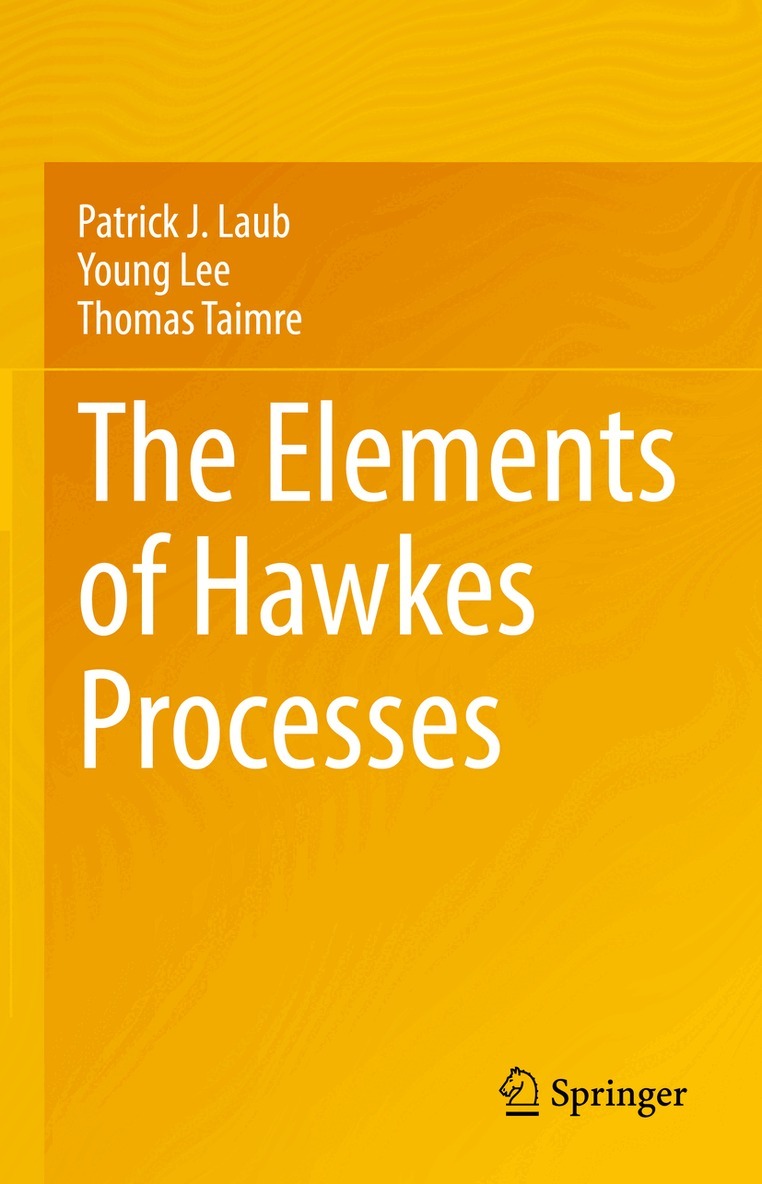
Hawkes processes are studied and used in a wide range of disciplines: mathematics, social sciences, and earthquake modelling, to name a few. This book presents a selective coverage of the core and recent topics in the broad field of Hawkes processes. It consists of three parts. Parts I and II summarise and provide an overview of core theory (including key simulation methods) and inference methods, complemented by a selection of recent research developments and applications. Part III is devoted to case studies in seismology and finance that connect the core theory and inference methods to practical scenarios.
This book is designed primarily for applied probabilists, statisticians, and machine learners. However, the mathematical prerequisites have been kept to a minimum so that the content will also be of interest to undergraduates in advanced mathematics and statistics, as well as machine learning practitioners. Knowledge of matrix theory with basics of probability theory, including Poisson processes, is considered a prerequisite. Colour-blind-friendly illustrations are included.
1 203 kr
Skickas inom 10-15 vardagar