1 524 kr
Skickas inom 10-15 vardagar
1 524 kr
Skickas inom 10-15 vardagar
1 524 kr
Skickas inom 10-15 vardagar
1 956 kr
Läs direkt efter köp
2 390 kr
Skickas inom 7-10 vardagar
Der umfangreiche Briefwechsel zwischen den Mathematikern Richard Dedekind und Heinrich Weber liegt nun erstmals in transkribierter Form vor. Es handelt sich dabei um einen der wichtigsten - wenn nicht um den wichtigsten -- Briefwechsel von Mathematikern der zweiten Hälfte des 19. und des beginnenden 20. Jahrhunderts, da nahezu jedes Teilgebiet der Mathematik angesprochen wird und damals beginnende Entwicklungen intensiv diskutiert wurden. Personen- und Werkverzeichnisse erleichtern den Überblick über die in den Briefen diskutierten Personen und Themen. Mit diesem Band wird ein Desiderat der Mathematikgeschichte geliefert, denn im Briefwechsel Dedekind-Weber spiegeln sich die großen Veränderungen und die Fortschritte, die die Mathematik in der stürmischen Entwicklungsphase des 19. Jahrhunderts kennzeichnete.
1 557 kr
Skickas inom 10-15 vardagar
1 942 kr
Läs direkt efter köp
462 kr
Läs direkt efter köp
216 kr
Läs direkt efter köp
465 kr
Skickas inom 7-10 vardagar
830 kr
Skickas inom 7-10 vardagar
312 kr
Skickas inom 3-6 vardagar
377 kr
Skickas inom 3-6 vardagar
377 kr
Skickas inom 3-6 vardagar
679 kr
Skickas inom 11-20 vardagar
869 kr
Skickas inom 3-6 vardagar
2 199 kr
Läs direkt efter köp
570 kr
Läs direkt efter köp
552 kr
Läs direkt efter köp
734 kr
Läs direkt efter köp
734 kr
Läs direkt efter köp
355 kr
Läs direkt efter köp
367 kr
Läs direkt efter köp
359 kr
Läs direkt efter köp
365 kr
Läs direkt efter köp
367 kr
Läs direkt efter köp
367 kr
Läs direkt efter köp
463 kr
Skickas inom 10-15 vardagar
311 kr
Skickas inom 10-15 vardagar
Springer-Verlag Berlin and Heidelberg GmbH & Co. KG
7 788 kr
Skickas inom 10-15 vardagar
8 649 kr
Läs direkt efter köp
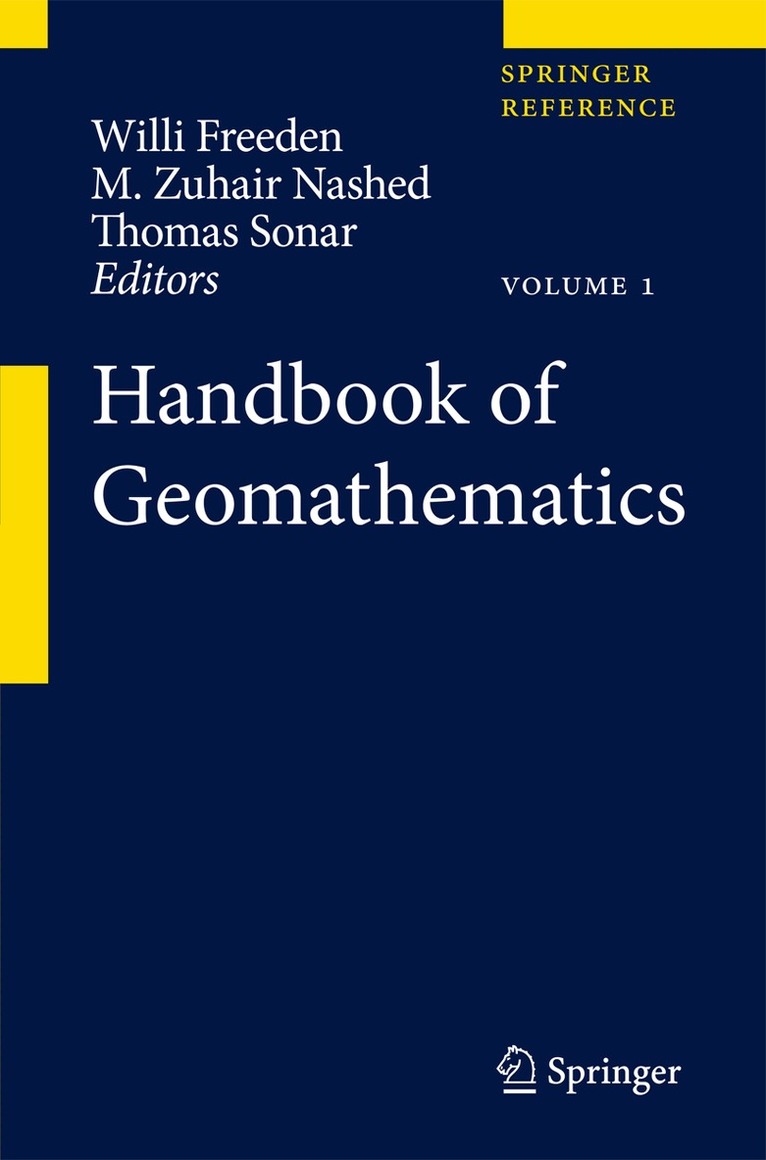
During the last three decades geosciences and geo-engineering were influenced by two essential scenarios: First, the technological progress has changed completely the observational and measurement techniques. Modern high speed computers and satellite based techniques are entering more and more all geodisciplines. Second, there is a growing public concern about the future of our planet, its climate, its environment, and about an expected shortage of natural resources. Obviously, both aspects, viz. efficient strategies of protection against threats of a changing Earth and the exceptional situation of getting terrestrial, airborne as well as spaceborne data of better and better quality explain the strong need of new mathematical structures, tools, and methods. Mathematics concerned with geoscientific problems, i.e., Geomathematics, is becoming increasingly important.
The ‘Handbook Geomathematics’ as a central reference work in this area comprises the following scientific fields: (I) observational and measurement key technologies (II) modelling of the system Earth (geosphere, cryosphere, hydrosphere, atmosphere, biosphere) (III) analytic, algebraic, and operator-theoretic methods (IV) statistical and stochastic methods (V) computational and numerical analysis methods (VI) historical background and future perspectives.