637 kr
Skickas inom 10-15 vardagar
637 kr
Skickas inom 10-15 vardagar
2 526 kr
Skickas inom 10-15 vardagar
695 kr
Skickas inom 10-15 vardagar
734 kr
Skickas inom 10-15 vardagar
808 kr
Läs direkt efter köp
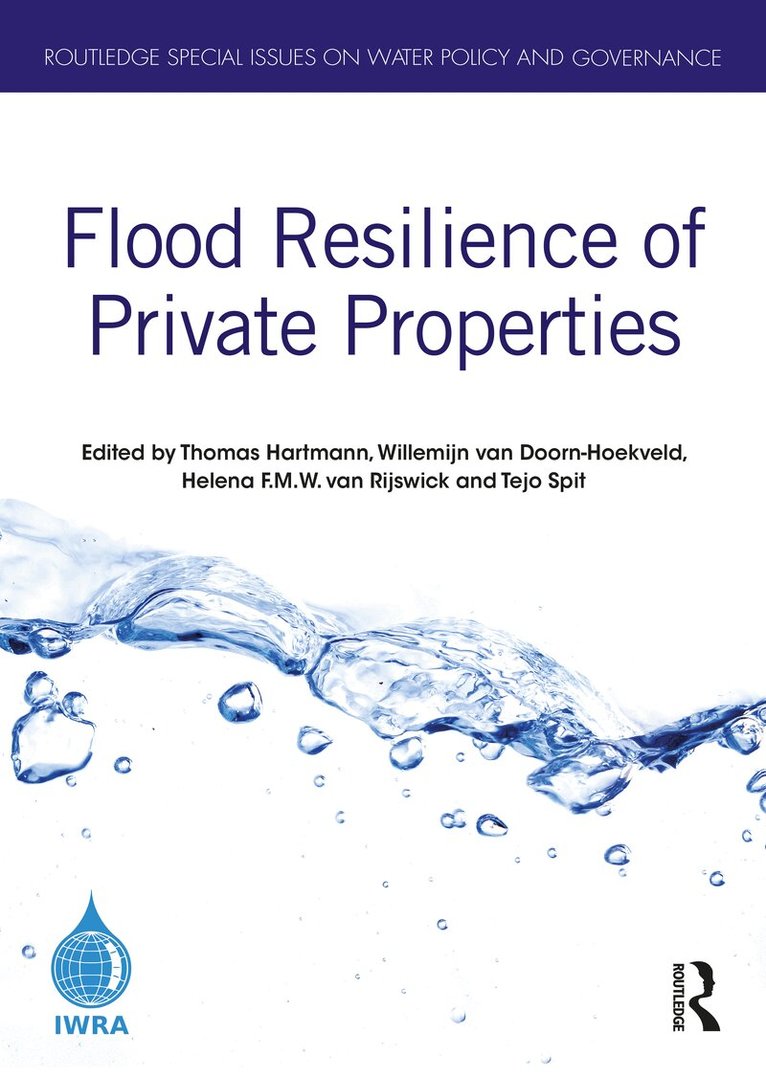
Flood Resilience of Private Properties examines the division and balance of responsibilities between the public and the private when discussing flood resilience of private properties.
Flooding is an expensive climate-related disaster and a threat to urban life. Continuing development in flood-prone zones compound the risks. Protecting all properties to the same standards is ever more challenging. Research has focused on improved planning and adapting publicly-owned infrastructure such as streets, evacuation routes, and retention ponds. However, damages often happen on private land. To realize a flood-resilient city, owners of privately-owned residential houses also need to act. Measures such as mobile barriers and backwater valves or avoiding vulnerable uses in basements can make homes more flood-resilient. But private owners may be unaware of flooding risks or may lack the means and knowledge to act. Incentives may be insufficient, while fragmented or unclear property rights and responsibilities entrench inertia. The challenge is motivating homeowners to take steps. Political and societal systems influence the action citizens are prepared to take and what they expect their governments to do. The responsibility for implementing such measures is shared between the public and the private domain in different degrees in different countries.
This book will be of great interest to scholars of water law, property rights, flood risk management and climate adaptation. This book was originally published as a special issue of Water International.
796 kr
Läs direkt efter köp
Financial schemes for flood recovery, if properly designed and implemented, might increase flood resilience. However, options for the increase of flood resilience during the recovery phase are to a large extent overlooked and the diversity of existing schemes shows that there has been a lack of consensus on how to achieve resilient flood recovery.
Financial Schemes for Resilient Flood Recovery investigates how the implementation of financial schemes (government relief subsidies, insurance schemes, buy-outs, etc.) might increase flood resilience. The chapters included in this edited volume address the following questions: Shall government relief subsidies exist when there is flood insurance in place, and, if so, how might they both be coordinated? Where (or how) to decide about build back better incentives and where to go for planned relocation programs? What is the distributional equity of financial schemes for flood recovery, and has it been sufficiently treated?
The book covers different approaches to flood recovery schemes with specific intervention rationales in different countries. Empirical evidence provided clearly shows the great diversity of financial flood recovery schemes. This diversity of state-funded schemes, private-based insurance schemes, and hybrids as well as planned relocation schemes indicates a lack of a consistent and strategic approach in flood risk management and flood resilience about flood recovery.
The chapters in this book were originally published in the Environmental Hazards.
808 kr
Läs direkt efter köp
Financial schemes for flood recovery, if properly designed and implemented, might increase flood resilience. However, options for the increase of flood resilience during the recovery phase are to a large extent overlooked and the diversity of existing schemes shows that there has been a lack of consensus on how to achieve resilient flood recovery.
Financial Schemes for Resilient Flood Recovery investigates how the implementation of financial schemes (government relief subsidies, insurance schemes, buy-outs, etc.) might increase flood resilience. The chapters included in this edited volume address the following questions: Shall government relief subsidies exist when there is flood insurance in place, and, if so, how might they both be coordinated? Where (or how) to decide about build back better incentives and where to go for planned relocation programs? What is the distributional equity of financial schemes for flood recovery, and has it been sufficiently treated?
The book covers different approaches to flood recovery schemes with specific intervention rationales in different countries. Empirical evidence provided clearly shows the great diversity of financial flood recovery schemes. This diversity of state-funded schemes, private-based insurance schemes, and hybrids as well as planned relocation schemes indicates a lack of a consistent and strategic approach in flood risk management and flood resilience about flood recovery.
The chapters in this book were originally published in the Environmental Hazards.
379 kr
Läs direkt efter köp
This book provides an introduction to spatial planning in the Netherlands. It explores the academic underpinnings of the discipline and its practical implications, making use of insights on planning practices from the Netherlands. As an academic book with relevance for spatial planning teaching and practice, the relation between planning practice and planning as an academic discipline are discussed.
A key analytical concept is introduced to discuss the different dimensions of planning: the planning triangle. This framework helps to bridge the strategic and conceptual elements of planning with its realization. The object, process, and context of planning and its relations are discussed. The core of the academic discipline and profession of spatial planning entails looking (far) into the future, stimulating discussion, formulating a desired future direction through an informal and collective planning process, and then formalizing and placing current action into that future perspective. In that sense, spatial planning can be understood as the strategic organization of hopes and expectations.
As a study book it is suitable for students of planning at various universities, but also for students in higher professional education. For those involved in the professional field of spatial planning, this book offers a sound foundation.
627 kr
Skickas inom 7-10 vardagar
705 kr
Skickas inom 7-10 vardagar
2 515 kr
Skickas inom 10-15 vardagar
692 kr
Skickas inom 10-15 vardagar
847 kr
Skickas
336 kr
Skickas inom 10-15 vardagar
2 491 kr
Kommande
3 441 kr
Kommande
2 489 kr
Skickas inom 10-15 vardagar
857 kr
Skickas inom 10-15 vardagar
564 kr
Skickas inom 10-15 vardagar
2 564 kr
Skickas inom 10-15 vardagar
902 kr
Skickas inom 10-15 vardagar
784 kr
Skickas inom 10-15 vardagar
2 540 kr
Skickas inom 10-15 vardagar
1 516 kr
Skickas inom 10-15 vardagar
685 kr
Läs direkt efter köp
In dealing with scarce land, planners often need to interact with, and sometimes confront, property right-holders to address complex property rights situations. To reinforce their position in situations of rivalrous land uses, planners can strategically use and combine different policy instruments in addition to standard land use plans. Effectively steering spatial development requires a keen understanding of these instruments of land policy.
This book not only presents how such instruments function, it additionally examines how public authorities strategically manage the scarcity of land, either increasing or decreasing it, to promote a more sparing use of resources. It presents 13 instruments of land policy in specific national contexts and discusses them from the perspectives of other countries. Through the use of concrete examples, the book reveals how instruments of land policy are used strategically in different policy contexts.
685 kr
Läs direkt efter köp
In dealing with scarce land, planners often need to interact with, and sometimes confront, property right-holders to address complex property rights situations. To reinforce their position in situations of rivalrous land uses, planners can strategically use and combine different policy instruments in addition to standard land use plans. Effectively steering spatial development requires a keen understanding of these instruments of land policy.
This book not only presents how such instruments function, it additionally examines how public authorities strategically manage the scarcity of land, either increasing or decreasing it, to promote a more sparing use of resources. It presents 13 instruments of land policy in specific national contexts and discusses them from the perspectives of other countries. Through the use of concrete examples, the book reveals how instruments of land policy are used strategically in different policy contexts.
842 kr
Läs direkt efter köp
Property Rights and Climate Change explores the multifarious relationships between different types of climate-driven environmental changes and property rights. This original contribution to the literature examines such climate changes through the lens of property rights, rather than through the lens of land use planning. The inherent assumption pursued is that the different types of environmental changes, with their particular effects and impact on land use, share common issues regarding the relation between the social construction of land via property rights and the dynamics of a changing environment.
Making these common issues explicit and discussing the different approaches to them is the central objective of this book. Through examining a variety of cases from the Arctic to the Australian coast, the contributors take a transdisciplinary look at the winners and losers of climate change, discuss approaches to dealing with changing environmental conditions, and stimulate pathways for further research. This book is essential reading for lawyers, planners, property rights experts and environmentalists.