E-bok
Engelska, 202682 kr
Läs direkt efter köp
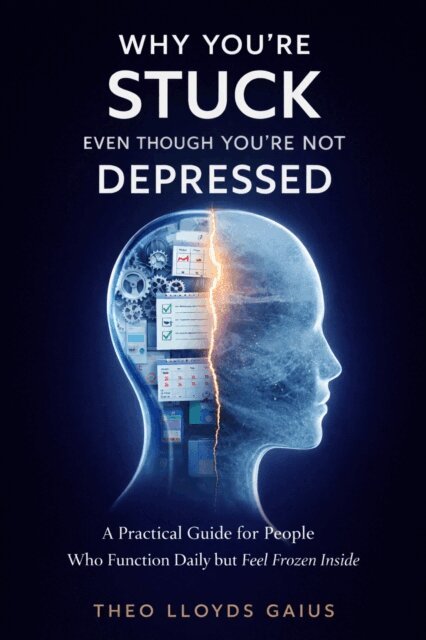
You go to work. You answer emails. You keep the house running and show up where people expect you to. From the outside, nothing looks wrong. But inside, something has gone quiet. You've been feeling frozen inside and going through the motions for weeks, maybe months, doing what needs to be done while the things that actually matter to you sit untouched. The project. The conversation. The decision. You think about them constantly. You just can't make yourself move toward them.If you've been asking yourself why can't I do anything when I'm not even sad, you are not lazy, ungrateful, or unmotivated. You are stuck in a nervous system state that most self-help books never address. It is called functional freeze, and it happens when your body activates a protective shutdown response while keeping just enough energy online to maintain daily functioning. You can perform. You can cope. But you cannot move forward. And no amount of goal-setting, discipline, or motivational advice will fix it, because the problem was never motivation. The problem is that your nervous system has classified forward action as unsafe.This book is a functional freeze symptoms recovery guide written in plain, direct language for people who are tired of being told to just push through. It explains what is happening in your body when you feel stuck but not depressed, why your brain avoids the next step even when you genuinely want to take it, and how the freeze response creates a self-reinforcing loop that gets harder to break the longer it runs. Every claim is backed by published research, and every citation is real and verifiable.The science behind this book draws on nervous system regulation and polyvagal theory, the model developed by neuroscientist Stephen Porges that explains how your autonomic nervous system shifts between states of safety, mobilization, and shutdown. You will learn how dorsal vagal shutdown drives functional freeze, why your body chose this pattern, and what it takes to begin shifting out of it. The explanation is thorough but accessible. No jargon. No clinical language that requires a degree to follow. Just a clear picture of what your nervous system is doing and why.The practical chapters focus on the freeze response and stress and burnout recovery using a body-first approach. Rather than forcing action through willpower, the strategies in this book work with your biology. Specific tools include breathing techniques that activate the vagus nerve within minutes, the 2-Minute Bridge method for approaching tasks your nervous system has flagged as threatening, the One-Task Rule that builds momentum without triggering overwhelm, and a complete 7-Day Reactivation Plan designed to work even on your lowest-energy days. Each day requires no more than 15 minutes of active engagement. Every day includes a minimum viable version for when capacity is limited.This book also explains what to stop doing. Self-criticism, overplanning, waiting for motivation, consuming more information as a substitute for action, and saying yes to things that drain your remaining bandwidth are all patterns that deepen the freeze cycle. Removing them is as important as adding new tools.If you have been stuck and unmotivated and cannot figure out why, if the standard self-help advice has failed you repeatedly, or if you have started to believe the problem is you, this book offers functional freeze help grounded in evidence rather than empty reassurance. It was written for people who function well enough that nobody notices they are struggling, and for anyone who needs a self-help book that finally matches what they are actually experiencing: not depression, not burnout in the traditional sense, but a quiet, persistent inability to move forward while life continues around them.