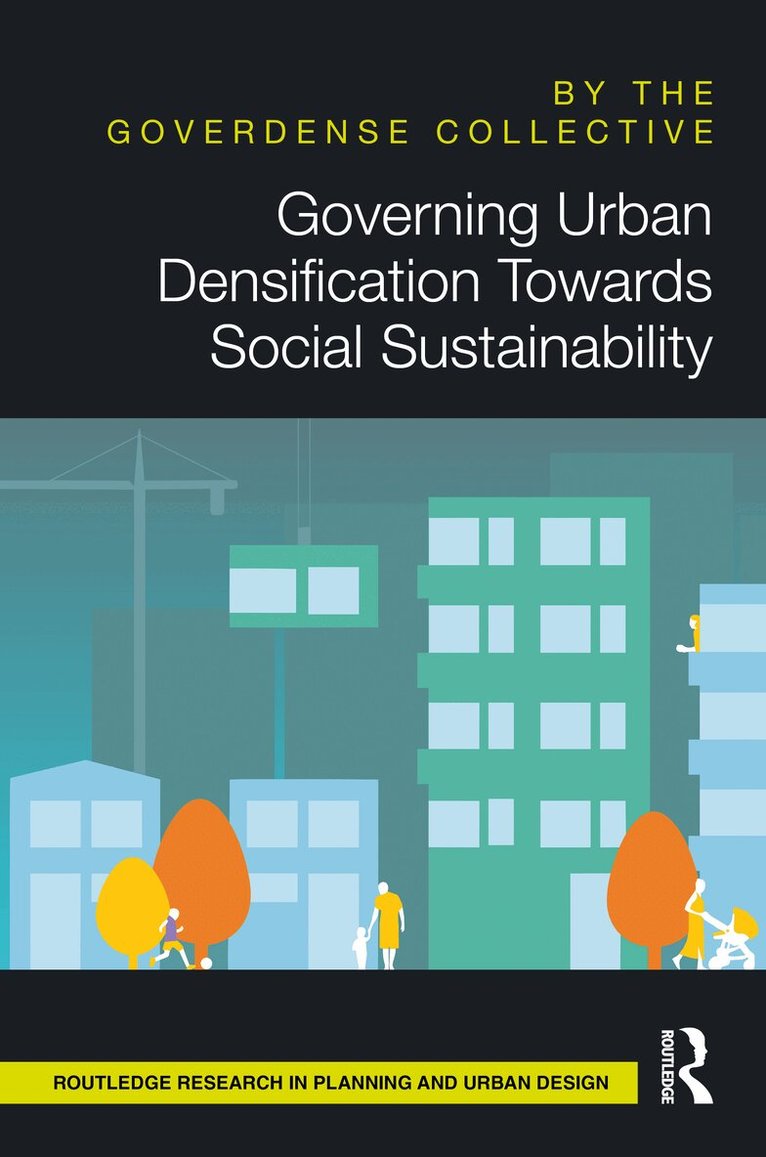
This book explores the relationship between densification and social sustainability, aiming to understand the complexities and contradictions inherent to contemporary urban development. Densification can exacerbate social tensions, as it contributes to creating denser, but gentrified neighbourhoods. Moreover, densification is increasingly associated with greenwashing, with many projects marketed as densification projects only marginally increasing population density. What goes wrong?“Governing Densification” addresses this paradox by pursuing four interrelated objectives. First, it analyses densification as a political process through which stakeholders compete over a variety of goals. Second, it examines the mechanisms leading to the shortcomings of densification – insisting on the tricky role played by more managerial and project-based approaches in planning. Third, the book revisits the crucial planning concept of power dynamics in urban development, offering new insights into how power is distributed and exercised in project-based negotiations. Finally, it provides illustrative examples from which lessons are drawn on how spatial planning can lead to negotiated density increases while maintaining urban quality for residents, including vulnerable socio-economic groups.The book is aimed at academics interested in spatial and urban planning, as well as those in other subject areas, including geo-information, urban studies, and administrative and public policy sciences.
Swiss citizens approve of their government and the way democracy is practiced; they trust the authorities and are satisfied with the range of services Swiss governments provide. This is quite unusual when compared to other countries. This open access book provides insight into the organization and the functioning of the Swiss state. It claims that, beyond politics, institutions and public administration, there are other factors which make a country successful. The authors argue that Switzerland is an interesting case, from a theoretical, scientific and a more practice-oriented perspective. While confronted with the same challenges as other countries, Switzerland offers different solutions, some of which work astonishingly well.
Swiss citizens approve of their government and the way democracy is practiced; they trust the authorities and are satisfied with the range of services Swiss governments provide. This is quite unusual when compared to other countries. This open access book provides insight into the organization and the functioning of the Swiss state. It claims that, beyond politics, institutions and public administration, there are other factors which make a country successful. The authors argue that Switzerland is an interesting case, from a theoretical, scientific and a more practice-oriented perspective. While confronted with the same challenges as other countries, Switzerland offers different solutions, some of which work astonishingly well.
L''adoption de l''article constitutionnel et de la législation fédérale sur les résidences secondaires a marqué de manière manifeste et durable le régime des constructions dans les zones touristiques en Suisse, plus particulièrement dans les régions alpines. La demi-journée de droit de l''environnement organisée par l''Université de Lausanne en 2021 a été consacrée aux nouveaux enjeux de l''urbanisation en montagne – en Suisse, mais également en France. Le présent ouvrage réunit les actes des conférenciers ayant participé à cette édition. Le droit applicable aux résidences secondaires occupe une place particulière dans cette publication, en raison des subtilités qu''il contient et de la multitude de situations qu''il régit. Une première contribution est consacrée à une analyse complète du régime fédéral applicable aux nouvelles résidences secondaires, y compris ses exceptions. Elle est suivie d''une contribution relative aux logements de l''ancien droit et à la garantie de la situation acquise qui leur est accordée. Les constructions en montagne ne se limitent pas aux logements, mais englobent diverses infrastructures et installations qu''il s''agit d''inscrire dans le cadre d''une utilisation judicieuse et mesurée du sol. Les enjeux globaux de l''urbanisation en montagne sont à cet égard examinés successivement au travers de la loi « Montagne » en France, d''une analyse prospective des politiques publiques en matière d''aménagement du territoire et de l''étude des instruments de planification territoriale permettant de repenser les politiques publiques sectorielles et les territoires institutionnels par une approche fonctionnelle du sol.