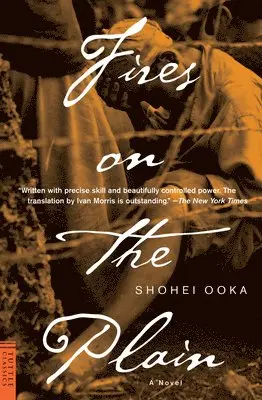
"Written with precise skill and beautifully controlled power. The translation by Ivan Morris is outstanding." —The New York Times**Winner of the 1952 Yomiuri Prize**This haunting novel explores the complete degradation and isolation of a man by war. Fires on the Plain is set on the island of Leyte in the Philippines during World War II, where the Japanese army is disintegrating under the hammer blows of the American landings. Within this broader disintegration is another, that of a single human being, Private Tamura. The war destroys each of his ties to society, one by one, until Tamura, a sensitive and intelligent man, becomes an outcast.Nearly losing the will to survive, he hears of a port still in Japanese hands and struggles to walk through the American lines. Unfazed by danger, he welcomes the prospect of dying, but first, he loses his hope, and then his sanity. Lost among his hallucinations, Tamura comes to fancy himself an angel enjoined by God to eat no living thing—but even angels fall.Tamura is never less than human, even when driven to the ultimate sin against humanity. Shocking as the outward events are, the greatness of the novel lies in its uplifting vision during a time of crushing horror. As relevant today as when it was originally published, Fires on the Plain will strike a chord with anyone who has lived through the horrors of war.
Ōoka Shōhei (1909–88) was a distinguished member of the Japanese literary establishment for more than four decades following the end of the Pacific War. While the war was the defining experience for Ōoka, his work exhibits enormous range and depth. The Shade of Blossoms, for which he was honored in 1961 with both the Mainichi and the Shincho literary prizes, marks an especially important stage in his development as an artist. In his postscript Ōoka describes this story as a novel of manners, and certainly the setting of the novel, the demimonde of the Ginza bar scene in the 1950s, and its subject, the aging bar hostess Yōko, seem far removed from the universe of battle. Nonetheless, The Shade of Blossoms not only shares key elements of style but also extends in important ways the moral concerns of his earlier works. The Shade of Blossoms provides a disturbing view of lives at the margins of Japanese society. Ōoka’s is a powerfully ethical literature that describes the inner search for meaning and identity in a world where received values have been disrupted by war or by social upheavals. His moral imagination is uncompromising and disturbing, and his emotional intelligence is matched by few postwar writers.
A Wife in Musashino, published in 1950, was a major critical and commercial success and was quickly adapted to the screen by the director Mizoguchi Kenji in 1951. Composed simultaneously with portions of Ōoka’s great war novel Fires on the Plain, A Wife in Musashino recounts the story of the ill-fated love between a young demobilized soldier, Tsutomu, and his married cousin, Michiko. The impact on Ōoka of French writers such as Stendhal and Radiguet is apparent not only in his finely detailed observations of human emotions, but also in his trenchant critique of social customs and conventions. The novel’s depiction of the motivations and circumstances of its characters and its subtle portrait of class conflict and family tensions bring the tumultuous Japanese postwar period to life, revealing with rich insight the impact of the war on Japanese society and on individual lives.