283 kr
Skickas
283 kr
Skickas
335 kr
Skickas inom 7-10 vardagar
309 kr
Skickas
287 kr
Skickas inom 7-10 vardagar
154 kr
Skickas
179 kr
Skickas inom 7-10 vardagar
325 kr
Skickas inom 7-10 vardagar
313 kr
Skickas
383 kr
Tillfälligt slut
312 kr
Skickas
985 kr
Skickas inom 10-15 vardagar
827 kr
Skickas inom 10-15 vardagar
2 526 kr
Skickas inom 10-15 vardagar
3 545 kr
Skickas inom 10-15 vardagar
1 766 kr
Skickas inom 7-10 vardagar
322 kr
Skickas inom 7-10 vardagar
1 324 kr
Skickas inom 7-10 vardagar
1 218 kr
Skickas inom 7-10 vardagar
1 248 kr
Skickas inom 7-10 vardagar
486 kr
Läs direkt efter köp
472 kr
Läs direkt efter köp
440 kr
Läs direkt efter köp
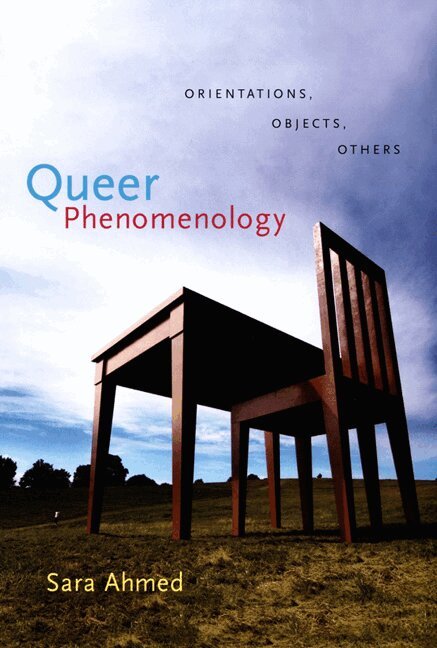
Ahmed proposes that a queer phenomenology might investigate not only how the concept of orientation is informed by phenomenology but also the orientation of phenomenology itself. Thus she reflects on the significance of the objects that appear—and those that do not—as signs of orientation in classic phenomenological texts such as Husserl’s Ideas. In developing a queer model of orientations, she combines readings of phenomenological texts—by Husserl, Heidegger, Merleau-Ponty, and Fanon—with insights drawn from queer studies, feminist theory, critical race theory, Marxism, and psychoanalysis. Queer Phenomenology points queer theory in bold new directions.

543 kr
Läs direkt efter köp
Ahmed draws on the intellectual history of happiness, from classical accounts of ethics as the good life, through seventeenth-century writings on affect and the passions, eighteenth-century debates on virtue and education, and nineteenth-century utilitarianism. She engages with feminist, antiracist, and queer critics who have shown how happiness is used to justify social oppression, and how challenging oppression causes unhappiness. Reading novels and films including Mrs. Dalloway, The Well of Loneliness, Bend It Like Beckham, and Children of Men, Ahmed considers the plight of the figures who challenge and are challenged by the attribution of happiness to particular objects or social ideals: the feminist killjoy, the unhappy queer, the angry black woman, and the melancholic migrant. Through her readings she raises critical questions about the moral order imposed by the injunction to be happy.
440 kr
Läs direkt efter köp
704 kr
Läs direkt efter köp
722 kr
Läs direkt efter köp
1 147 kr
Läs direkt efter köp
1 130 kr
Läs direkt efter köp
866 kr
Läs direkt efter köp
Examining the relationship between strangers, embodiment and community, Strange Encounters challenges the assumptions that the stranger is simply anybody we do not recognize and instead proposes that he or she is socially constructued as somebody we already know. Using feminist and postcolonial theory this book examines the impact of multiculturalism and globalization on embodiment and community whilst considering the ethical and political implication of its critique for post-colonial feminism.A diverse range of texts are analyzed which produce the figure of ''the stranger'', showing that it has alternatively been expelled as the origin of danger - such as in neighbourhood watch, or celebrated as the origin of difference - as in multiculturalism. The author argues that both of these standpoints are problematic as they involve ''stranger fetishism''; they assume that the stranger ''has a life of its own''.