Reads a wide range of contemporary feminist theorists to show how they invest in sound as a medium of critical thought.In The Sounds of Feminist Theory, Ruth Salvaggio follows a distinctive turn toward the oral and evocative qualities of language in feminist theory. Questioning paradigms of female voice and varied feminist claims to language, she suggests that feminist theorists listen to the ways in which words mean more than they ostensibly signify, the ways in which language and epistemology-like sound-are mobile. She calls this theoretical project "Hearing the O," a process of listening for and seizing those wavering qualities of language that invite changes, often remarkable alterations, in how we think.A range of contemporary feminist critical writers are discussed: Gloria Anzaldúa, Judith Butler, Hélène Cixous, Rachel Blau DuPlessis, Jane Flax, Susan Griffin, Donna Haraway, Luce Irigaray, Julia Kristeva, Elaine Pagels, Adrienne Rich, Eve Sedgwick, Joan Scott, Jane Tompkins, Trinh Minh-ha, and Patricia Williams. Their investment in the oral modulations of words marks not only a provocative engagement with the incommensurability of contemporary theory, but also a turn to the ambiguous and tangled qualities of language-"poetic literacy"-that generate an evocative epistemology.
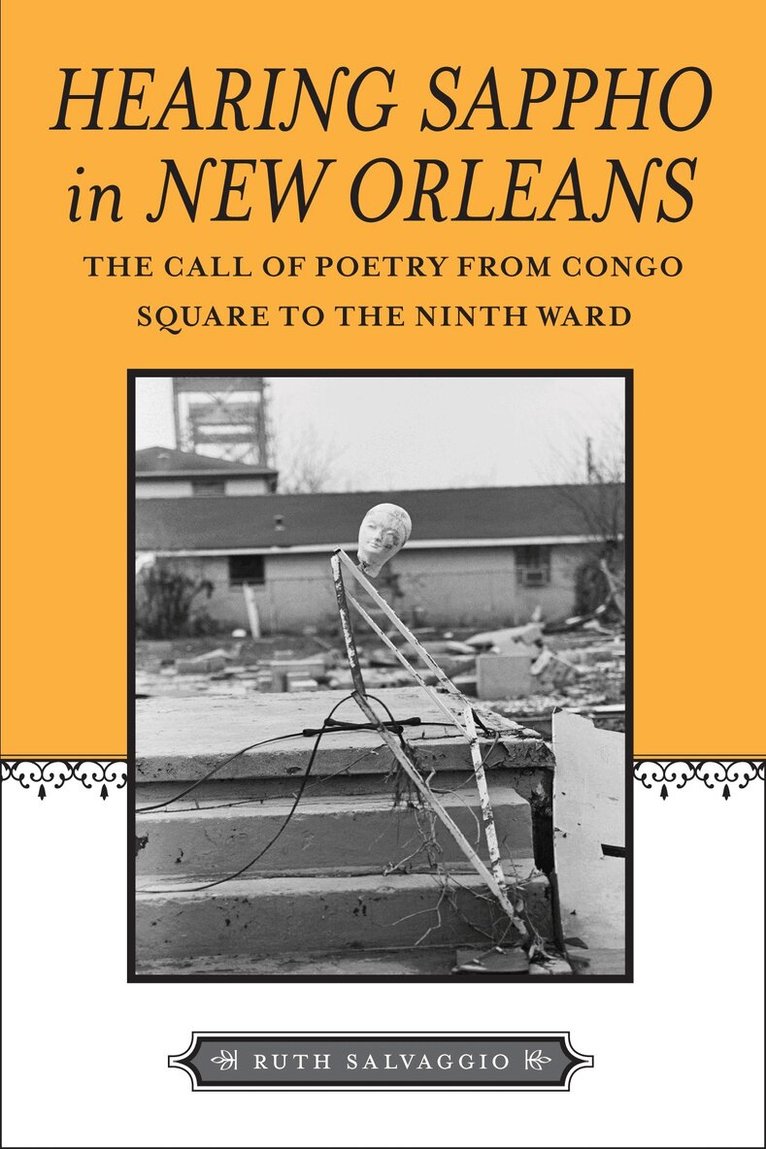
While sifting through trash in her flooded New Orleans home, Ruth Salvaggio discovered an old volume of Sappho's poetry stained with muck and mold. In her efforts to restore the book, Salvaggio realised that the process reflected how Sappho's own words were unearthed from the refuse of the ancient world. Undertaking such a task in New Orleans, she sets out to recover the city's rich poetic heritage while searching through its flooded debris.Hearing Sappho in New Orleans is at once a meditation on this poetic city, its many languages and cultures, and a history of its forgotten poetry. Using Sappho's fragments as a guide, Salvaggio roams the streets and neighborhoods of the city as she explores the migrations of lyric poetry from ancient Greece through the African slave trade to indigenous America and ultimately to New Orleans.The book also directs us to the lyric call of poetry, the voice always in search of a listener. Writing in a post-Katrina landscape, Salvaggio recovers and ponders the social consequences of the ""long song"", lyric chants, especially the voices of women lost in time, as it resonates from New Orleans's ""poetic sites"" like Congo Square, where Africans and Indians gathered in the early eighteenth century, to the modern-day Maple Leaf Bar, where poets still convene on Sunday afternoons. She recovers, for example, an all-but-forgotten young Creole woman named Lélé and leads us all the way up to celebrated contemporary writers such as former Louisiana poet laureate Brenda Marie Osbey, Sybil Kein, Nicole Cooley, and Katherine Soniat. Hearing Sappho in New Orleans is a reminder of poetry's ability to restore and secure fragile and fragmented connections in a vulnerable and imperiled world.