2 610 kr
Skickas inom 10-15 vardagar
2 610 kr
Skickas inom 10-15 vardagar
658 kr
Skickas inom 10-15 vardagar
745 kr
Läs direkt efter köp
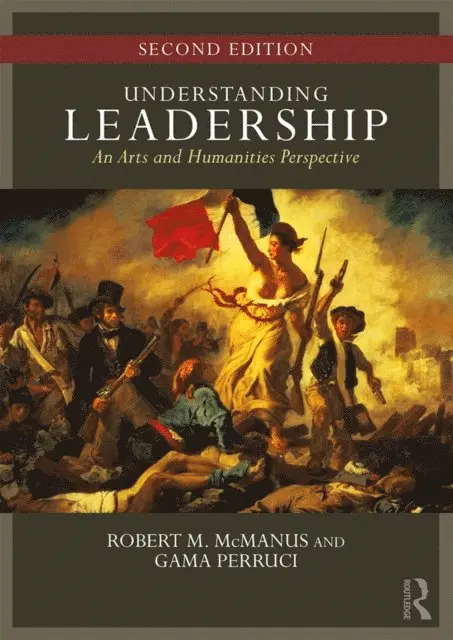
Laozi, Marx, the Buddha, Ibsen, Machiavelli – these are just a few of the world’s great thinkers who have weighed in on the subject of leadership over the centuries. Yet the contemporary student of leadership often overlooks many of these names in favor of more recent theorists hailing from the social sciences. Understanding Leadership: An Arts and Humanities Perspective takes a different angle, employing the works of the great philosophers, authors, and artists found in world civilization and presenting an arts and humanities perspective on the study of leadership.
The authors build their conceptual framework using their Five Components of Leadership Model, which recognizes the leader, the followers, the goal, the context, and the cultural values and norms that make up the leadership process.
Supporting the text are a wealth of case studies that reflect on works such as Ayn Rand’s novella Anthem, Eugène Delacroix’s painting Liberty Leading the People, Charlie Chaplin’s film Modern Times, Athol Fugard’s play "Master Harold" . . . and the boys, Laozi’s poetic work Dao De Jing, and AntonÃn Dvořák’s New World Symphony. The authors also introduce studies from various world cultures to emphasize the role that cultural values and norms play in leadership. This illuminating framework promotes the multidimensional thinking that is necessary for understanding and problem-solving in a complex world.
Understanding Leadership: An Arts and Humanities Perspective will be a valuable resource for both undergraduate and postgraduate leadership students, while leadership professionals will also appreciate the book’s unique liberal arts and cultural approach.
710 kr
Läs direkt efter köp
By using the Five Components of Leadership Model as a consistent point of reference, McManus, Ward, and Perry offer readers a variety of insights on ethical leadership. Conclusions include the importance of drawing from multiple ethical and leadership perspectives, moving away from exclusively leader-centric approaches to ethical leadership, the importance of asking questions to maximize self-awareness, and considering multiple points of view whenever addressing an ethical conundrum. To connect ''ethical thinking'' and ''ethical doing'', the text uses classroom-friendly framing questions, timelines, visual models, summary tables, case studies, discussion questions, and recommended resources for additional study. After reading the book, students will benefit from a foundational understanding of theories and models of both ethics and leadership, as well as a concrete view of what these theories and models look like in practice. Professors will benefit by having all these resources in one text, viewed through the lens of the Five Components of Leadership Model.
Striving to be both comprehensive and approachable, this book is an excellent resource for upper-level students studying leadership, especially those who are new to philosophy or ethics. It is inclusive enough to serve as a primary text or as a supplement for a well-rounded ethics or leadership course.
Contributors include: J. Cervantes, A. Council, B.P. Dean, G.G. Enck, R.M. McManus, B.A. Pauchnik, A.K. Perry, S. Raible, M. Saleem-Tanner, P.H. Sarkaria, L. Sequeira, M. Sowcik, J.N. Thomas, S.C. Trainor, S. Varnon-Hughes, S.J. Ward
2 145 kr
Skickas inom 7-10 vardagar
697 kr
Läs direkt efter köp
By using the Five Components of Leadership Model as a consistent point of reference, McManus, Ward, and Perry offer readers a variety of insights on ethical leadership. Conclusions include the importance of drawing from multiple ethical and leadership perspectives, moving away from exclusively leader-centric approaches to ethical leadership, the importance of asking questions to maximize self-awareness, and considering multiple points of view whenever addressing an ethical conundrum. To connect ‘ethical thinking’ and ‘ethical doing,’ the text uses classroom-friendly framing questions, timelines, visual models, summary tables, case studies, discussion questions, and recommended resources for additional study. After reading the book, students will benefit from a foundational understanding of theories and models of both ethics and leadership, as well as a concrete view of what these theories and models look like in practice. Professors will benefit by having all of these resources in one text, viewed through the lens of the Five Components of Leadership Model.
Striving to be both comprehensive and approachable, this book is an excellent resource for upper-level students studying leadership, especially those who are new to philosophy or ethics. It is inclusive enough to serve as a primary text or as a supplement for a well-rounded ethics or leadership course.
736 kr
Skickas inom 7-10 vardagar