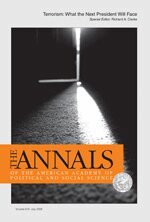
The United States′ approach to fighting terrorism is among the most debated in the 2008 presidential campaign. The new administration will face an immediate need to address Islamist extremist terrorism and develop a long-term strategy that will shape U.S. interests abroad and life at home. This special volume of the ANNALS provides valuable insight that can help influence policy choices and strategies for addressing the challenges of combating terrorism. Special editor, Richard A. Clarke, served the past three presidents as a senior White House advisor on counterterrorism. Clarke has pulled together a panel of distinguished scholars and experts to prepare a detailed background and agenda for a U.S. strategy to address the problem of Islamist extremist terrorism. Taken together, these unclassified briefs are designed to assist the new president and administration—as well as scholars and the general public-- to examine terrorism. They provide a fresh perspective from which to set an agenda to counter violent Islamist extremists – especially the growing threat of nuclear terrorism – immediately following the inauguration, before day-to-day crises obstructs long-term planning and strategies. Divided into four parts, this substantial collection offers considerations of strategic policymaking: I. Al Quaeda′s IncarnationsExamines the recent status of this violent and well-known Islamist extremist groupII. MotivationsAttempts to explain the impetus for terrorists to carry out violence against innocent peopleIII. Specific U.S. Policies and ProgramsReviews important areas of expertise where the United States must succeed in order to counter violent groupsIV. Overall U.S. StrategyProposes ways to develop broad strategies to counter violent Islamist extremists Drawing from the diligent work of scholars, journalists, prosecutors, and legislators, this collection of articles elucidates, analyzes, and sets an agenda for addressing the threat of terrorism. It is a must-read for students of political sciences as well as policymakers, and although prepared as a brief for the new administration, it is in the interest of every U.S. citizen to gain the important knowledge gathered in these articles.
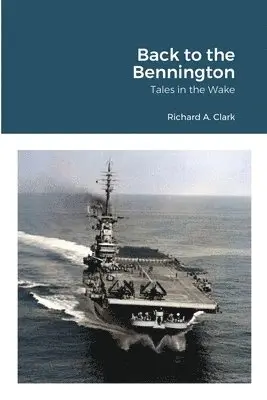
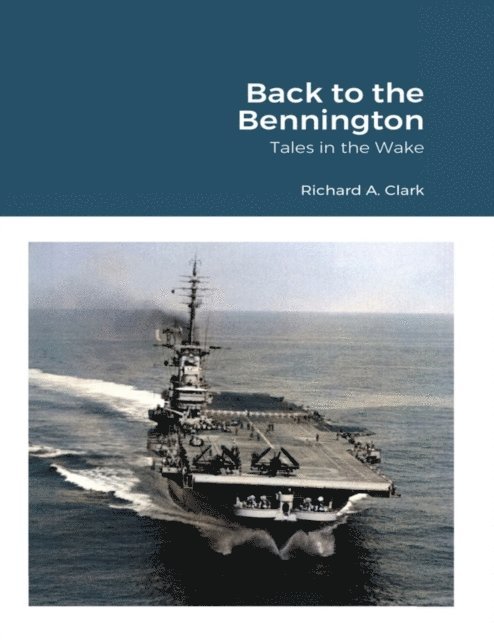
Back to the Bennington: Tales in the Wake (published by Merriam Press) is the author''s memoir of his service on the aircraft carrier USS Bennington (CVA-20), during a Mediterranean cruise, 1953-54. Includes much of the history of the ship during this period with additional information from crew mates and other sources. Clark describes his Navy years on the USS Bennington and with FASRON 77/VR-24 Detachment (Naples, Italy) as “a series of ‘rewardingly-exciting’ experiences—experiences upon which I constantly reflect and for which I’ll be forever thankful… ” From the book: "An aircraft carrier’s flight deck has been called the second most dangerous place on earth to work, and rightly so... [Dozens of aircraft and scores of men] are crammed onto little more than [a few] acres of hardened steel armor plate. Searing jet exhaust can cook a man or blow him overboard. At times the air is so hot that he can’t breathe. Jet intakes can pull a man off his feet and devour him. An unwary sailor can fall prey to a spinning propeller’s razor-sharp, invisible arc. On the flight deck men move in many different directions in what appears to the uninitiated observer to be chaotic. Yet nothing is as organized as the flight deck of a U.S. Navy carrier. It’s like an orchestra, with each section devoted to performing a part of the overall symphony of carrier operations." —Excerpt from "A Guide to Carrier Flight Deck Operations." 59 photos and illustrations. Merriam Press Military Memoir.
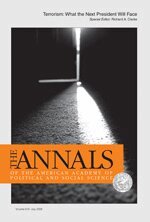
The United States′ approach to fighting terrorism is among the most debated in the 2008 presidential campaign. The new administration will face an immediate need to address Islamist extremist terrorism and develop a long-term strategy that will shape U.S. interests abroad and life at home. This special volume of the ANNALS provides valuable insight that can help influence policy choices and strategies for addressing the challenges of combating terrorism. Special editor, Richard A. Clarke, served the past three presidents as a senior White House advisor on counterterrorism. Clarke has pulled together a panel of distinguished scholars and experts to prepare a detailed background and agenda for a U.S. strategy to address the problem of Islamist extremist terrorism. Taken together, these unclassified briefs are designed to assist the new president and administration—as well as scholars and the general public-- to examine terrorism. They provide a fresh perspective from which to set an agenda to counter violent Islamist extremists – especially the growing threat of nuclear terrorism – immediately following the inauguration, before day-to-day crises obstructs long-term planning and strategies. Divided into four parts, this substantial collection offers considerations of strategic policymaking: I. Al Quaeda′s IncarnationsExamines the recent status of this violent and well-known Islamist extremist groupII. MotivationsAttempts to explain the impetus for terrorists to carry out violence against innocent peopleIII. Specific U.S. Policies and ProgramsReviews important areas of expertise where the United States must succeed in order to counter violent groupsIV. Overall U.S. StrategyProposes ways to develop broad strategies to counter violent Islamist extremists Drawing from the diligent work of scholars, journalists, prosecutors, and legislators, this collection of articles elucidates, analyzes, and sets an agenda for addressing the threat of terrorism. It is a must-read for students of political sciences as well as policymakers, and although prepared as a brief for the new administration, it is in the interest of every U.S. citizen to gain the important knowledge gathered in these articles.