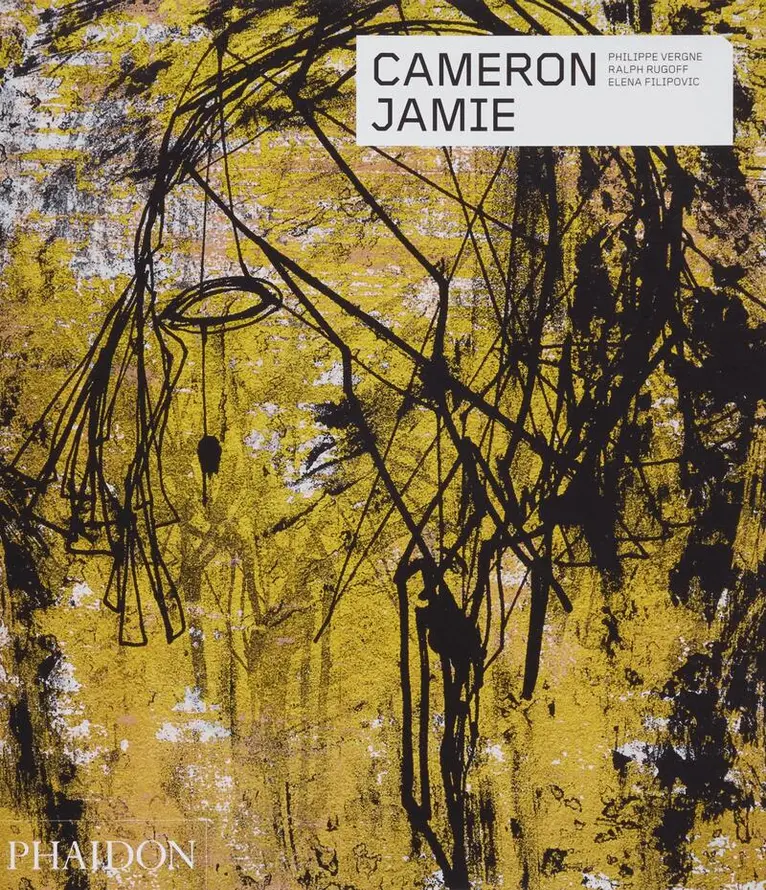
The first serious study on the work of one of the most iconoclastic artists living today An aesthetic outlier and artistic maverick, Cameron Jamie is a Los Angeles-born, Paris-based American artist whose critically acclaimed art has been exhibited worldwide in some of the most prestigious exhibitions and institutional venues. Over the course of more than three decades, Jamie has established a multi-faceted practice defined by cultural exploration and formal experimentation that resists categorizations. His artwork encompasses a wide range of artistic cross-disciplines including drawing, painting, sculpture, ceramics, printmaking, photography, performance, filmmaking, music, and independent publishing. Jamie’s groundbreaking work has explored, investigated, and analysed how the structures of mythology and rituals in popular and vernacular cultures are shaped and shared, and the extent to which they participate in the creation of individuals’ fictional worlds and fictional selves. Featuring a large number of previously unpublished images and never-seen-before archival material, this fascinating and long-overdue book will be the first comprehensive monographic publication dedicated to one of the most significant artistic visionaries working today.
In Gedi Sibony's sculptural work, cardboard, wood, carpets, plastic sheets and latex paint are embedded into the exhibition rooms' architectural context. His spatial collages oscillate between objectlike appearance and installation-esque ensembles. One could describe them as low-key high art. Born in 1973 in New York, Sibony showed his work at New York's New Museum in 2007.
A major retrospective catalogue on the career of minimalist sculptor and poet Carl AndreCarl Andre (b. 1935) redefined the parameters of abstract sculpture in the 1960s and 1970s. He was a highly influential voice in the American minimalist movement, recognized for his ordered linear and grid formats. In the early 1960s, Andre’s creative focus shifted to writing poetry when he took a job as a freight brakeman and conductor for the Pennsylvania Railroad. His poems echoed and extended the themes in his sculptural work, and his experience with the railroad significantly influenced his choice of materials in later years.In this stunning catalogue, which accompanies the first retrospective of Andre’s work since 1970, the artist’s legacy is examined in eleven essays by international scholars. The book presents a broad range of sculpture made over the past fifty years, including Andre’s emblematic floor and corner pieces, highlighting his radical use of standardized units of industrial material such as timber planks, concrete blocks, and metal plates. A vast selection of Andre’s previously unpublished concrete poems, together with letters, postcards, ephemera, and documentation of important installations, further complements our understanding of an essential figure in the history of contemporary art.Published in association with Dia Art FoundationExhibition Schedule:Dia: Beacon(05/04/14–03/02/15) Museo Nacional Centro de Arte Reina Sofia, Madrid(05/14/14–10/15/15)Hamburger Bahnhof, Museum für Gegenwart, Berlin(05/08/16–09/25/16)Musée d'art moderne de la Ville de Paris(10/22/16–01/29/17)
The Walker Art Center recently opened its expanded space, which includes a new theater, a new restaurant and more galleries, but is best known for being Herzog & de Meuron's first public building in the United States. The project drew national coverage from media including The New York Times. Expanding the Center addresses this public interest in the building with a generous selection of images, including sketches, renderings and photographs of the construction process and the completed work. Herzog & de Meuron's shimmering but grounded design mirrors the textures and shades of the Walker's original space, and an institutional philosophy based in innovation and risk-taking, the exploration of alternative approaches to learning, the experimental use of technologies to communicate information, and the design of spaces to enhance a variety of museum experiences. The book is organized around the decisions and actions of the architects, builders, Walker staff and the audience--i.e. designing, constructing, unveiling, staging, gathering, patterning, framing, collecting--and highlights the thinking that led to the visible form of the Center as well as the innovative projects and initiatives that give it its inimitable character.