1 137 kr
Läs direkt efter köp
1 137 kr
Läs direkt efter köp
1 137 kr
Läs direkt efter köp
1 267 kr
Skickas inom 5-8 vardagar
725 kr
Skickas inom 10-15 vardagar
1 530 kr
Skickas inom 10-15 vardagar
2 526 kr
Skickas inom 10-15 vardagar
3 419 kr
Skickas inom 3-6 vardagar
1 902 kr
Skickas inom 3-6 vardagar
3 083 kr
Skickas inom 3-6 vardagar
1 791 kr
Skickas inom 3-6 vardagar
463 kr
Skickas inom 7-10 vardagar
2 227 kr
Skickas inom 3-6 vardagar
843 kr
Läs direkt efter köp
The Synchronization of National Policies shows how it is possible that there is remarkable uniformity in the policies that the nation-states adopt, although there is no world government. Mainstream research attributes such global governance to the influence of leading countries, to functional requirements created by capitalism and technological development, or to international organizations. This book argues that to understand how national policies are synchronized we need to realize that the global population forms a single global tribe of moderns, divided into some 200 clans called nations.
While previous research on the world culture of moderns has focused on the diffusion of ideas, this book concentrates on the active role of local actors, who introduce global models and domesticate them to nation-states. In national policymaking, actors justify new policies by international comparisons, by the successes and failures of models adopted in other countries, and by building and appealing to the authority of international organizations. Consequently, national policies are synchronized with each other. Yet, because of the way such domestication of global trends takes place, citizens retain and reproduce the understanding that they follow a sovereign national trajectory.
This book will be of interest to students and scholars of sociology, world culture theory, globalization, international relations, and political science.
830 kr
Läs direkt efter köp
The Synchronization of National Policies shows how it is possible that there is remarkable uniformity in the policies that the nation-states adopt, although there is no world government. Mainstream research attributes such global governance to the influence of leading countries, to functional requirements created by capitalism and technological development, or to international organizations. This book argues that to understand how national policies are synchronized we need to realize that the global population forms a single global tribe of moderns, divided into some 200 clans called nations.
While previous research on the world culture of moderns has focused on the diffusion of ideas, this book concentrates on the active role of local actors, who introduce global models and domesticate them to nation-states. In national policymaking, actors justify new policies by international comparisons, by the successes and failures of models adopted in other countries, and by building and appealing to the authority of international organizations. Consequently, national policies are synchronized with each other. Yet, because of the way such domestication of global trends takes place, citizens retain and reproduce the understanding that they follow a sovereign national trajectory.
This book will be of interest to students and scholars of sociology, world culture theory, globalization, international relations, and political science.
619 kr
Läs direkt efter köp
Notions of social change are often divided into local versus international. But what actually happens at the national level—where policies are ultimately made and implemented—when policy-making is interdependent worldwide? How do policy-makers take into account the prior choices of other countries? Far more research is needed on the process of interdependent decision-making in the world polity.
National Policy-Making: domestication of global trends offers a unique set of hybrid cases that straddle these disciplinary and conceptual divides. The volume brings together well-researched case studies of policy-making from across the world that speak to practical issues but also challenge current theories of global influence in local policies. Distancing itself from approaches that conceive narrowly of policy transfer as a "one-way street" from powerful nations to weaker ones, this book argues instead for an understanding of national decision-making processes that emphasize cross-national comparisons and domestic field battles around the introduction of worldwide models.
The case studies in this collection show how national policies appear to be synchronized globally yet are developed with distinct "national" flavors. Presenting new theoretical ideas and empirical cases, this book is aimed globally at scholars of political science, international relations, comparative public policy, and sociology.
534 kr
Skickas inom 10-15 vardagar
3 453 kr
Skickas inom 3-6 vardagar
814 kr
Läs direkt efter köp
343 kr
Läs direkt efter köp
The Handbook includes chapters on each phase of the research process: research design, methods of data collection, and the processes of analyzing and interpreting data. The volume maintains that there is much more to research than learning skills and techniques; methodology involves the fit between theory, research questions research design and analysis. The book also includes several chapters that describe historical and current directions in social research, debating crucial subjects such as qualitative versus quantitative paradigms, how to judge the credibility of types of research, and the increasingly topical issue of research ethics.
The Handbook serves as an invaluable resource for approaching research with an open mind. This volume maps the field of social research methods using an approach that will prove valuable for both students and researchers.
1 258 kr
Skickas inom 3-6 vardagar
768 kr
Skickas inom 10-15 vardagar
978 kr
Läs direkt efter köp
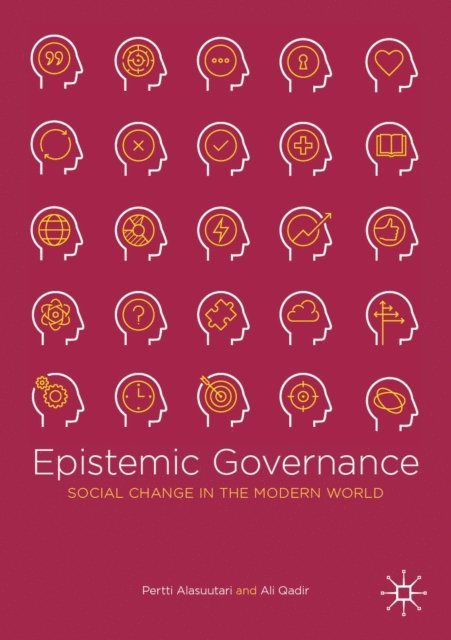
This book argues that modern governance is performed by actors who seek social change epistemically, by drawing on widespread, public views of reality. Agents of change such as parliamentarians or social movement activists will assess and affect what they believe to be people’s conceptions of what is possible, rational, and desirable. This often means that these key authority figures will invest in credible knowledge production, as well as appeal to individual and group identifications, emotions, and values.
Alasuutari and Qadir show how this epistemic governance works in three important arenas of social change: parliaments, which debate laws that constitute the bulk of reforms; international organizations that circulate global norms; and social movements and NGOs. Through their analysis, the authors’ detailed, innovative methodology for discourse analysis indicates the utility of epistemic governance as a new paradigm for research into global social change.
This book will be of use to students in upper level degree programs who want to design empirical research into social change as well as researchers in sociology, political science and public policy.
366 kr
Läs direkt efter köp
337 kr
Läs direkt efter köp
278 kr
Läs direkt efter köp
278 kr
Läs direkt efter köp