Not all politics is party politics. Nowhere is this fact more apparent than within the boundaries of South Dakota. Although the state is known for its agrarian conservatism, political tradition in the land of infinite variety is more than simply Republican or Democrat. An awareness of the influence of culture lies at the core of understanding the decisions of political leaders and voters alike.In this capstone volume of The Plains Political Tradition series, editors Jon K. Lauck, John E. Miller, and Paula M. Nelson gather essays from historians and other scholars who identify major influences on the political culture of South Dakota. Against a backdrop of agricultural ups and downs, varied religious beliefs, worldwide conflict, and powerful personalities, the authors examine ingredients critical to the success and failure of civic movements, legislation, and political campaigns and careers.
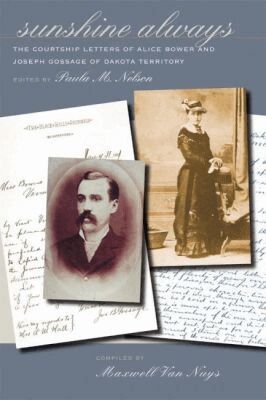
With intelligence and growing passion, Alice Bower of Vermillion and Joseph Gossage of Rapid City corresponded with each other during their 16-month-long courtship. Though they did not meet in person until late 1881, 29-year-old Gossage, publisher of a small newspaper, had been introduced to 20-year-old Bower, an experienced typesetter, several years earlier by a mutual acquaintance who had encouraged him to hire her to set type for his new Black Hills Weekly Journal. Their letters and Bower’s journal offer a window, not only on their hearts, but also on that particular time and place on the Dakota frontier. Bower and Gossage’s correspondence reminds us of a time when the newspaper office was the dynamic center of community life. Modern-day readers will enjoy fascinating glimpses not only into the settling of eastern and western Dakota Territory, fraught with floods and economic cycles of boom and bust, but also into a middle-class Victorian courtship - in which exchanging letters and photographs was an indication of serious interest and discussing temperance and the intention not to become parents reflected the earnest spirit of the times.
South Dakota' s unique blend of ethnic cultures, varied landscapes, and small, largely agrarian population have made for fascinating politics. This fourth volume of The Plains Political Tradition offers ten essays on diverse aspects of the region's political history, from nonindigenous settlement patterns to campaign strategies to the shaping of state budgets. Employing a broad definition of political culture, editors Jon k. Lauck and Paula M. Nelson present a wide variety of eyewitness as well as scholarly perspectives in this anthology, all of which contribute to a better understanding of South Dakota's singular historical experience.