While James Joyce was a central figure of high modernism, Malcom Lowry spoke for the next generation of modernist writers and, despite his denials, was almost certainly influenced by Joyce. Wherever the truth lies, there are correspondences and differences to be explored between Joyce and Lowry that are far more interesting than the question of direct influence. Despite numerous differences, their works have much in common: verbal richness, experimentation with narrative structure and perspective, a fascination with cultural and historical forces as well as with the process of artistic creation, and the inclusion of artist figures who are in varying degrees ironic self-portrayals.The contributors to Joyce/Lowry examine the relationship of these two expatriates writers, both to each other and to broader issues in the study of literary modernism and its aftermath. This collection embraces a variety of approaches. The volume begins with a consideration of Joyce and Lowry as practitioners of Expressionist art and concludes with an essay on John Huston's cinematic interpretation of works by both writers. In between are explorations of nationalism, anti-Semitism, syphilis, mental illness, and authorial design.
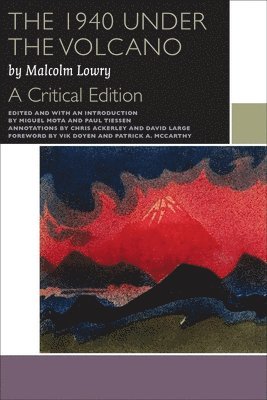
The 1940 Under the Volcano—hidden for too long in the shadows of Lowry’s 1947 masterpiece—differs from the latter in significant ways. It is a bridge between Lowry’s 1930s fiction (especially In Ballast to the White Sea) and the 1947 Under the Volcano itself. Joining the recently published Swinging the Maelstrom and In Ballast to the White Sea, The 1940 Under the Volcano takes its rightful place as part of Lowry’s exciting 1930s/early-40s trilogy. Scholars have only recently begun to pay systematic attention to convergences and divergences between this earlier work and the 1947 version. Miguel Mota and Paul Tiessen’s insightful introduction, together with extensive annotations by Chris Ackerley and David Large, reveal the depth and breadth of Lowry’s complex vision for his work. This critical edition fleshes out our sense of the enormous achievement by this twentieth-century modernist.Published in English.
While James Joyce was a central figure of high modernism, Malcom Lowry spoke for the next generation of modernist writers and, despite his denials, was almost certainly influenced by Joyce. Wherever the truth lies, there are correspondences and differences to be explored between Joyce and Lowry that are far more interesting than the question of direct influence. Despite numerous differences, their works have much in common: verbal richness, experimentation with narrative structure and perspective, a fascination with cultural and historical forces as well as with the process of artistic creation, and the inclusion of artist figures who are in varying degrees ironic self-portrayals.The contributors to Joyce/Lowry examine the relationship of these two expatriates writers, both to each other and to broader issues in the study of literary modernism and its aftermath. This collection embraces a variety of approaches. The volume begins with a consideration of Joyce and Lowry as practitioners of Expressionist art and concludes with an essay on John Huston's cinematic interpretation of works by both writers. In between are explorations of nationalism, anti-Semitism, syphilis, mental illness, and authorial design.
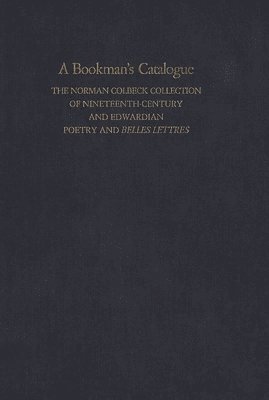
The Colbeck collection was formed over half a century ago by the Bournemouth bookseller Norman Colbeck. Focusing primarily on British essayists and poets of the nineteenth century from the Romantic Movement through the Edwardian era, the collection features nearly 500 authors and lists over 13,000 works. Entries are alphabetically arranged by author with copious notes on the condition and binding of each copy. Nine appendices provide listings of selected periodicals, series publications, anthologies, yearbooks, and topical works.
The eighty letters, cards and other messages in this correspondence-- produced mainly by Lowry and Gerald Noxon but also by Margerie(Bonner) Lowry -- offer a fresh introduction to Lowry, a certain"Canadian" Lowry. At the same time they give insight into twowriting careers (Bonner and Noxon) closely intertwined with his andvigorously championed by him in the 1940s.The letters observe the mind of Lowry at play on questions ofliterary technique, on films, and on the beauties and rigors of life inhis Dollarton shack on an inlet near Vancouver. They reveal a warm,supportive, enormously sensitive and intelligent man, modifyingsomewhat the image of him now available. With their dramatization ofNoxon's role in Lowry's writing career, they illuminate for thefirst time something of Lowry's method of actually solving theproblems he encountered in re-writing Under the Volcano.Noxon, CBC radio dramatist, novelist, and poet, emerges as atalented and perceptive writer who was able to encourage Lowry bothmorally and practically. Noxon's deftness in expertly combining theunofficial roles of devoted and spirited family member and literaryeditor gives the letters -- often brimming with high spirits and fondaffection -- a relaxed and buoyant tone missing from much other Lowrycorrespondence.
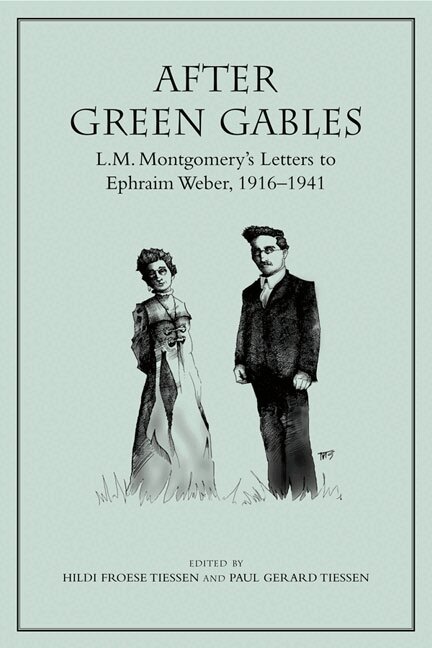
Ephraim Weber (18701956) was a struggling young writer when he began corresponding with L.M. Montgomery (18741942) in 1902, six years before she published her first novel. Weber's initial letter was that of an admirer. Montgomery responded warmly, and the two quickly began a correspondence that became an intellectual mainstay for both of them over the following forty years. After Green Gables is a fascinating collection of letters sent by Montgomery to Weber between 1916 and 1941. This was the period of Montgomery's greatest literary success, but privately she was deeply troubled by her unhappy marriage.The letters, revealing an intense social and intellectual dynamic between Montgomery and Weber, cover, among other subjects, their strong differences of opinion on matters such as pacifism and war and their joint rejection of the effects of literary modernism. Drawing on Weber's voluminous correspondence with other Canadian figures particularly journalist Wilfred Eggleston editors Paul Tiessen and Hildi Froese Tiessen skilfully illuminate Weber's interaction with Montgomery, especially in matters concerning literature and culture, religion and politics, and education and entertainment. The editors provide various readings of Weber, based on his aspirations as a writer, his active participation in the Canadian culture of his day (including his friendships with hometown schoolmate William Lyon Mackenzie King and community leader Leslie Staebler), and his heritage as a Mennonite.After Green Gables brings to life a distinctly Canadian literary and intellectual association of writers. Montgomery's letters to a man committed to writing and to the cultural development of Canada reveal her intellectual preoccupations and her personal hardships. This is an essential text for Montgomery fans and scholars as well as readers with an interest in the development of Canada's literary culture.
This is a wide-ranging collection of essays and memoirs about Malcolm Lowry (1909-1957), one of the century's great novelists. Part I, the biographical section, includes Gordon Bowker's interview with British artist Julian Trevelyan, Gerald Noxon's memoir, Paul Tiessen's essays on Lowry's and Noxon's shared lives in Cambridge and Canada, and William C. McConnell's account of the writing experiences he shared with Lowry in Canada. Part II focuses on Under the Volcano. Part III discusses Lowry's career as modernist and post-modernist.