Workers' remittances have become a major source of financing for developing countries and are especially important in Latin America and the Caribbean (LAC), which is at the top of the ranking of remittances receiving regions in the world. While there has been a recent surge in analytical work on the topic, this book is motivated by the large heterogeneity in migration and remittances patterns across countries and regions, and by the fact that existing evidence for LAC is restricted to only a few countries, such as Mexico and El Salvador. Because the nature of the phenomenon varies across countries, its development impact and policy implications are also likely to differ in ways that are still largely unknown. This book helps fill the gap by exploring, in the specific context of Latin America and Caribbean countries, some of the main questions faced by policymakers when trying to respond to increasing remittances flows.
Informality: Exit and Exclusion analyzes informality in Latin America, exploring root causes and reasons for and implications of its growth. The authors use two distinct but complementary lenses: informality driven by ""exclusion"" from state benefits or the circuits of the modern economy, and driven by voluntary ""exit"" decisions resulting from private cost-benefit calculations that lead workers and firms to opt out of formal institutions. They find both lenses have considerable explanatory power to understand the causes and consequences of informality in the region.""Informality: Exit and Exclusion"" concludes that reducing informality levels and overcoming the ""culture of informality"" will require actions to increase aggregate productivity in the economy, reform poorly designed regulations and social policies, and increase the legitimacy of the state by improving the quality and fairness of state institutions and policies. Although the study focuses on Latin America, its analysis, approach, and conclusions are relevant for all developing countries."" Informality: Exit and Exclusion"" will be of value to professionals and academics studying labor market, social protection, tax, microenterprise development, and urban public policies, and to those working in government, international organizations, research institutions, and universities.
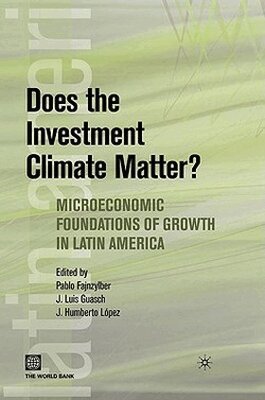
Although the Latin American region's growth rates are at a three decade high, they have been historically disappointing in relative terms, which cannot be dissociated from the microeconomic environment in which firms operate. Policy makers may need to complement their focus on macroeconomic stability with an increased emphasis on microeconomic reforms. By providing empirical evidence linking actual firm performance to shortcomings in Latin America's investment climate, the book discusses policies that could have a significant impact on firm productivity by improving the environment in which firms invest and operate.
There is an increasing consensus in the scientific community that climate change is a real and present threat. Despite the large uncertainty on the timing, magnitude and even the direction of some of the physical and economic effects of this phenomenon, it is widely accepted that they will be regionally differentiated and that developing countries and lower income populations will tend to suffer the most. In this context, it is critical that Latin American countries develop their own strategies for adapting to the various impacts of climate change, and for contributing to global efforts aimed at mitigating them.This book aims at contributing to these efforts by addressing a number of questions related to the causes and consequences of climate change in the case of Latin America: What are the likely impacts of climate change in the region? Which countries and regions will be most affected? What can governments do to tackle the challenges associated with adapting to climate change? And, what role can Latin America play in the area of climate change mitigation?While the study does not attempt to provide definitive answers to these questions, its goal is to contribute new information and analysis that could help inform the public policy debate on this important issue.
By providing empirical evidence linking actual firm performance to shortcomings in Latin America's investment climate, this book looks at macroeconomic stability and mircoeconomic reforms and discusses policies that could have a significant impact on firm productivity by improving the environment in which firms invest and operate.
Seeks to inform Governments and civil society in Latin America and the Caribbean as well the global community about the potential costs and benefits of combating climate change, their policy options over the next decades, and the global context for these policy decisions.