880 kr
Läs direkt efter köp
880 kr
Läs direkt efter köp
874 kr
Läs direkt efter köp
765 kr
Läs direkt efter köp
529 kr
Läs direkt efter köp
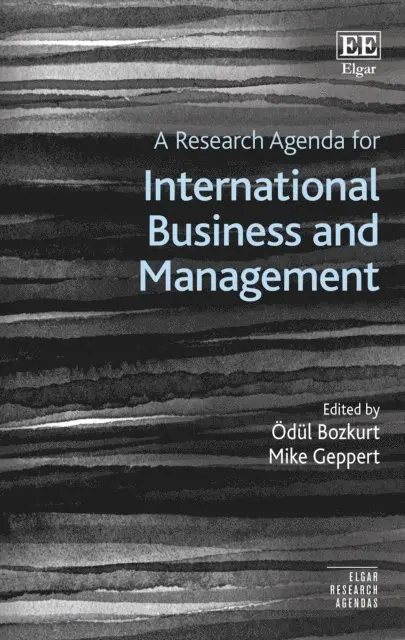
This insightful Research Agenda provides reflections on the state of the international business and management discipline and also highlights important future topics for research. The book especially covers a range of thought-provoking ideas on key subjects, from externalisation theory to emerging market economies to societal crises and modern slavery.
This Research Agenda also revisits the relevance of core theories; examines the changing roles of nation states and multinationals as well as power relations and ideologies; and discusses new phenomena in international business and management (IB/M). Authors emphasise the merits of and the need for incorporating insights from critical perspectives and, finally, a commentary is given on fulfilling the future agendas laid out in the chapters.
This will be a useful read for postgraduate students and researchers of IB/M. Academics in neighbouring subfields including social geography, political science and economic sociology will also find beneficial insights.
907 kr
Läs direkt efter köp
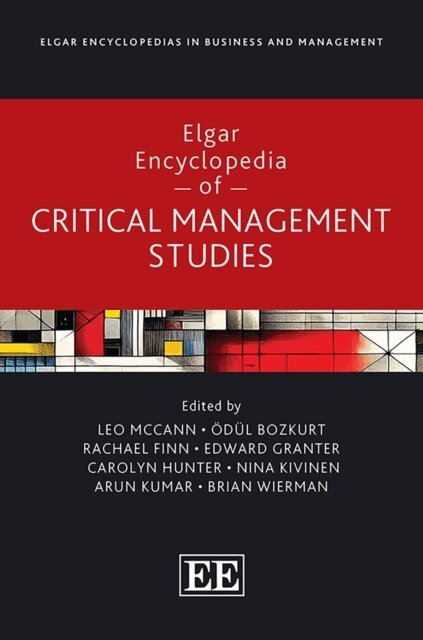
With over 100 entries written by an international collective of expert scholars, it covers the full range of concepts and debates in CMS, from affect, alienation and anarchism, to whistleblowing, workplace wellbeing and writing differently.
The Encyclopedia will be of great value to scholars working in CMS and organization studies. It will also interest students exploring international business, management studies, and work and employment relations.
Key Features:
Extensive onward references for further reading and researchEntries authored by a diverse selection of writers, from highly experienced professors to fresh perspectives from up-and-coming scholars
Key topics covered include classic ideas such as class, critical theory and postmodernism, as well as more recent developments such as critical diversity studies, hauntology, and modern slavery. Also included are detailed entries on the intellectual development of CMS itself, CMS in North America, and criticisms of CMS1 452 kr
Läs direkt efter köp
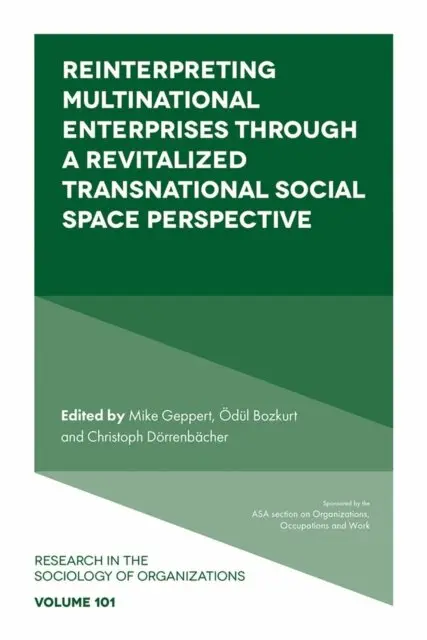
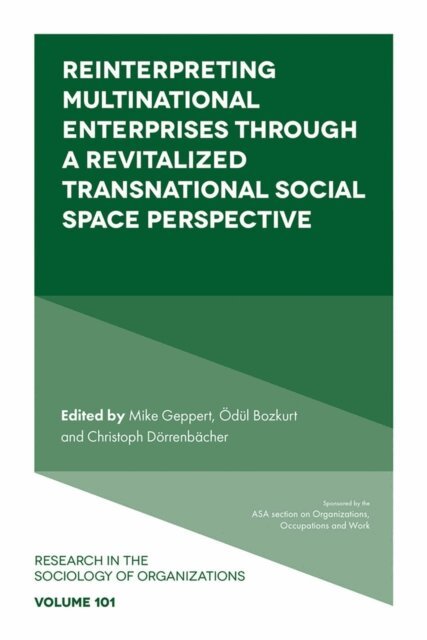
The transnational social space approach has been extensively utilized in migration studies and partly also in management studies. In the latter, a key research focus is on multinational enterprises (MNEs). This Research in the Sociology of Organizations volume reinvigorates and leverages the transnational social space approach to further develop it, addressing the role of MNEs in solving Grand Challenges.
Taking an interdisciplinary approach by drawing on ideas outside of mainstream Organization Studies, such as Social Geography, Migration Studies, Political Economy, Economic Sociology, and International Business, papers take on the challenge of addressing ‘wicked problems’ like climate change, poverty, health, and inequality.
Applying the transnational social space idea as an ‘envelop framework’, the papers broaden the scope of theorizing from various theoretical angles and disciplines and enlarge the empirical scope to fields where the MNE is not automatically the central unit of study. Also, paying attention to whether and how MNEs can shape and, in some cases, distort transnational social spaces as powerful players, the papers, taken together, investigate when, why, and how MNEs can be seen as part of the problem or the solution to grand challenges.
1 406 kr
Läs direkt efter köp
The transnational social space approach has been extensively utilized in migration studies and partly also in management studies. In the latter, a key research focus is on multinational enterprises (MNEs). This Research in the Sociology of Organizations volume reinvigorates and leverages the transnational social space approach to further develop it, addressing the role of MNEs in solving Grand Challenges.
Taking an interdisciplinary approach by drawing on ideas outside of mainstream Organization Studies, such as Social Geography, Migration Studies, Political Economy, Economic Sociology, and International Business, papers take on the challenge of addressing ‘wicked problems’ like climate change, poverty, health, and inequality.
Applying the transnational social space idea as an ‘envelop framework’, the papers broaden the scope of theorizing from various theoretical angles and disciplines and enlarge the empirical scope to fields where the MNE is not automatically the central unit of study. Also, paying attention to whether and how MNEs can shape and, in some cases, distort transnational social spaces as powerful players, the papers, taken together, investigate when, why, and how MNEs can be seen as part of the problem or the solution to grand challenges.