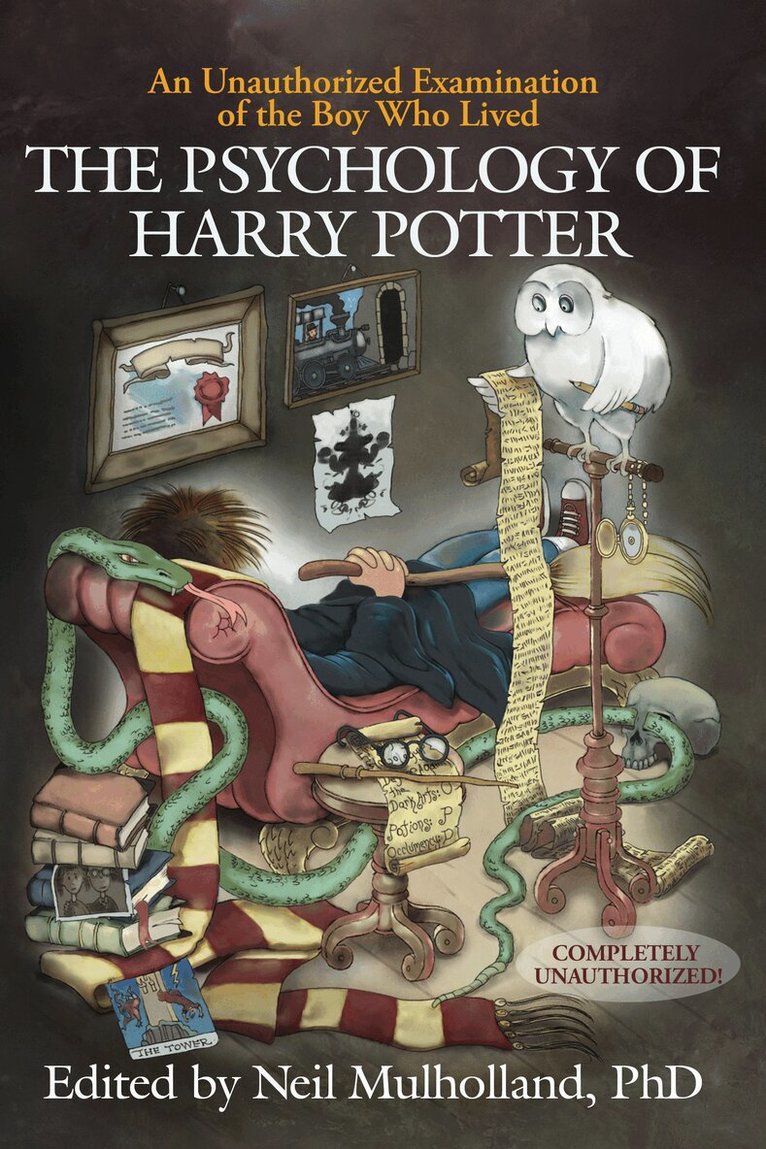
Harry Potter has provided a portal to the wizarding world for millions of readers, but an examination of Harry, his friends and his enemies will take us on yet another journey: through the psyche of the Muggle (and wizard!) mind. The twists and turns of the series, as well as the psychological depth and complexity of J. K. Rowling’s characters, have kept fans enthralled with and puzzling over the many mysteries that permeate Hogwarts and beyond: • Do the Harry Potter books encourage disobedience? • Why is everyone so fascinated by Professor Lupin? • What exactly will Harry and his friends do when they finally pass those N.E.W.T.s? • Do even wizards live by the ticking of the clock? • Is Harry destined to end up alone? And why did it take Ron and Hermione so long to get together?Now, in The Psychology of Harry Potter, leading psychologists delve into the ultimate Chamber of Secrets, analyzing human mind and motivation by examining the themes and characters that make the Harry Potter books the bestselling fantasy series of all time. Grab a spot on the nearest couch, and settle in for some fresh revelations about our favorite young wizard!
This book proposes ‘paragogic’ methods to re-imagine the art academy. While art schooling was revolutionised in the early 20th century by the Bauhaus, the author argues that many art schools are unwittingly recycling the same modernist pedagogical fashions. Stagnating in such traditions, today’s art schools are blind to recent advances in the scholarship of teaching and learning. As discipline-based education research in art eternally battles the perceived threat of epistemicide, transformative educational practices are rapidly overcoming the perennialism of the art school. The author develops critical case studies of open source and peer-to-peer methods for re-imagining the art academy (para-academia) and andragogy (paragogy). This innovative book will be of interest and value to students and scholars of the art school, as well as how the art academy can be reimagined and rebuilt.
This book proposes ‘paragogic’ methods to re-imagine the art academy. While art schooling was revolutionised in the early 20th century by the Bauhaus, the author argues that many art schools are unwittingly recycling the same modernist pedagogical fashions. Stagnating in such traditions, today’s art schools are blind to recent advances in the scholarship of teaching and learning. As discipline-based education research in art eternally battles the perceived threat of epistemicide, transformative educational practices are rapidly overcoming the perennialism of the art school. The author develops critical case studies of open source and peer-to-peer methods for re-imagining the art academy (para-academia) and andragogy (paragogy). This innovative book will be of interest and value to students and scholars of the art school, as well as how the art academy can be reimagined and rebuilt.
Title first published in 2003. What happened to art in Britain when the balance began to shift from public to private subsidy following the IMF crisis in 1976? In this polemical book, Neil Mulholland charts the political and cultural shifts in art in Britain from the mid-1970's to the end of the twentieth century. His account covers the key trends and artists of this extraordinarily diverse period, including critical postmodernism, feminism, neoconservatism, object sculpture, the new image, Brit Art, and Scottish neoconceptualism, and traces the development of critical thinking from the opinions of critics such as Richard Cork, John Roberts and Matthew Collings to tabloid press art scandals. The Cultural Devolution offers a broad critical and historical framework within which to understand public debate on the merits of young British artists such as Damien Hirst while looking beyond such celebrities to re-discover the wealth and range of work produced. Essential reading for anyone interested in contemporary art in Britain.