521 kr
Skickas inom 10-15 vardagar
521 kr
Skickas inom 10-15 vardagar
735 kr
Skickas inom 10-15 vardagar
1 581 kr
Skickas inom 10-15 vardagar
2 463 kr
Skickas inom 10-15 vardagar
2 852 kr
Skickas inom 10-15 vardagar
858 kr
Läs direkt efter köp
This volume brings together in a single resource fourteen empirical studies examining a variety of emotions and behaviors covering many aspects of love, romance, and sexual interaction from recent issues of Current Psychology. Scholars from universities and research centers bring under the empiricist''s microscope a variety of emotions and behaviors, ranging from dating relationships, criteria for the ideal mate held by both men and women, the relationship between perceptions of parents and partners in a direct test of psychoanalytic conceptualizations of mate selection, how the media influence perceptions about love and romance, sources of marital conflict, gender differences in responses to infidelity, and even the attitudes of "consumers" toward prostitution.
Contributors and topics of discussion include: Albert Mehrabian and Jeffrey S. Blum, "Physical Appearance, Attractiveness, and the Mediating Effect of Emotions"; Gordon L. Flett, Paul L. Hewitt, Brenley Shapiro, and Jill Rayman, "Perfectionism, Beliefs, and Adjustment in Dating Relationships"; Robert Ervin Cramer, Jeffrey T. Schaefer, and Suzanne Reid, "Identifying the Ideal Mate: More Evidence for Male-Female Convergence"; Glenn Geher, "Perceived and Actual Characteristics of Parents and Partners: A Freudian Model of Mate Selection"; Claudia J. Haferkamp, "Beliefs about Relationships in Relation to Television Viewing, Soap Opera Viewing, and Self-Monitoring"; Blaine J. Flowers and Brooks Applegate, "Marital Satisfaction and Conventionalization Examined Didactically"; Claudia J. Haferkamp, "Dysfunctional Beliefs, Self-Monitoring, and Marital Conflict"; Emily A. Impett, Kristin P. Beals, and Letitia A. Peplau, "Testing the Investment Model of Relationship Commitment and Stability in a Longitudinal Study of Married Couples"; Richard Clements and Clifford H. Swensen, "Commitment to One''s Spouse as a Predictor of Marital Quality among Older Couples"; Robert Ervin Cramer, William Todd Abraham, Lesley M. Johnson, Barbara Manning-Ryan, "Gender Differences in Subjective Distress to Emotional and Sexual Infidelity"; William Todd Abraham, Robert Ervin Cramer, Ana Maria Fernandez, and Eileen Mahler, "Infidelity, Race, and Gender"; Ami Rokach, "Strategies of Coping with Loneliness throughout the Lifespan."
606 kr
Läs direkt efter köp
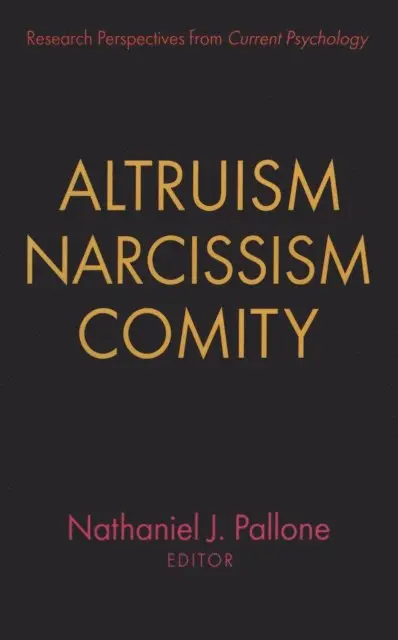
How does the sense of basic fairness--or selflessness versus selfishness--arise? How is it exhibited behaviorally? How is it maintained? Few topics hold more contemporary significance or have proved more elusive to specification in precise scientific terms. Current research perspectives on altruism, narcissism, and comity by distinguished behavioral scientists from around the world were brought together in a special issue of Current Psychology (Summer 1998) and are offered here in a useful compendium.
Chapters and contributors include: "Equity, Justice, and Altruism" by Graham F. Wagstaff; "Reactions to the Fate of One''s Brainchild After Its Disclosure" by Sidney Rosen and Shannon Wheatman; "Need Norm, Demographic Influence, Social Role, and Justice Judgment" by Helen E. Linkey and Sheldon Alexander; "Adaptive and Maladaptive Narcissism" by Robert W. Hill and Greg Yousey; "Perceptions of Self-Oriented and Other-Oriented Help-Providers" by Mark A. Barnett, Guy D. Vitaglione, Jeffrey S. Bartel, Birgit S. Valdez, Lee Ann Steadman, and Kimberly K. G. Harper; and "Pathological Narcissism and Serial Homicide" by Louis B. Schlesinger. Altruism, Narcissism, Comity will benefit students, researchers, and practitioners in the psychological sciences, sociology, political science, philosophy, law, and other disciplines concerned with the nature of selflessness, heroism, justice, and their variants.
593 kr
Läs direkt efter köp
How does the sense of basic fairness--or selflessness versus selfishness--arise? How is it exhibited behaviorally? How is it maintained? Few topics hold more contemporary significance or have proved more elusive to specification in precise scientific terms. Current research perspectives on altruism, narcissism, and comity by distinguished behavioral scientists from around the world were brought together in a special issue of Current Psychology (Summer 1998) and are offered here in a useful compendium.
Chapters and contributors include: "Equity, Justice, and Altruism" by Graham F. Wagstaff; "Reactions to the Fate of One''s Brainchild After Its Disclosure" by Sidney Rosen and Shannon Wheatman; "Need Norm, Demographic Influence, Social Role, and Justice Judgment" by Helen E. Linkey and Sheldon Alexander; "Adaptive and Maladaptive Narcissism" by Robert W. Hill and Greg Yousey; "Perceptions of Self-Oriented and Other-Oriented Help-Providers" by Mark A. Barnett, Guy D. Vitaglione, Jeffrey S. Bartel, Birgit S. Valdez, Lee Ann Steadman, and Kimberly K. G. Harper; and "Pathological Narcissism and Serial Homicide" by Louis B. Schlesinger. Altruism, Narcissism, Comity will benefit students, researchers, and practitioners in the psychological sciences, sociology, political science, philosophy, law, and other disciplines concerned with the nature of selflessness, heroism, justice, and their variants.
642 kr
Läs direkt efter köp
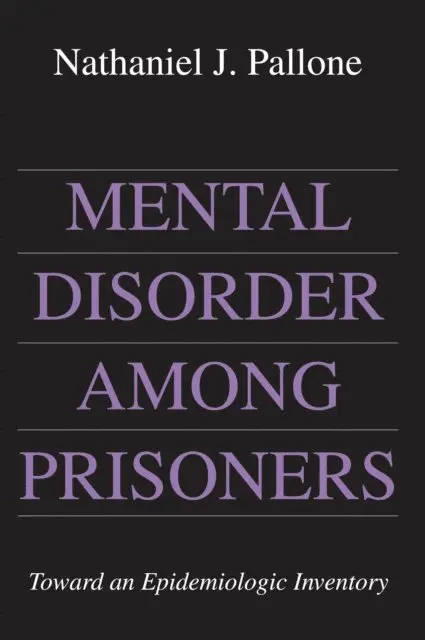
What do we know about the mental health of inmates? What are the implications of what we know? Nathaniel J. Pallone characterizes opinion on these questions as falling into two broad camps: the "tender-hearted," those who see an overlap between mental illness and criminal behavior, and are treatment-oriented; and the "tough-minded," those who have little confidence in psychiatric categories, do not really accept arguments about diminished responsibility, and who feel the emphasis should be on punishment. Which is closer to the truth?
When this book was first published, the incidence of mental disorder among prisoners was nearly four times greater than among comparable groups in the general population in part because prisoners are disproportionately drawn from demographic groups with a high incidence of mental disorder—nonwhite and from lower socioeconomic strata. But other data is equally dismaying: mental retardation is 50 percent higher; alcohol and drug abuse is between five and eight times greater; and neurogenic disorders may be 1,700 times greater. In all categories of mental illness, the incidence among prisoners is far higher than among the general population.
Pallone asserts that evidence suggests that the design and implementation of mental health care needs serious reevaluation, particularly in view of Supreme Court decisions mandating mental health care despite obstacles with implementation. Palone saw mental health care as the primary issue for those who manage prisons. Sadly, this remains as true as when this book was first published.
552 kr
Skickas inom 10-15 vardagar
839 kr
Skickas inom 10-15 vardagar
1 148 kr
Tillfälligt slut