Your Career Game demonstrates how game theory can help readers to understand and proactively take charge of their career strategy. Authors Nathan Bennett and Stephen A. Miles teach readers to manage the interdependencies and interconnectedness among coworkers, managers, and others in a manner that supports personal career efforts. Then, they show how readers can become better players. The key to learning how to play the career game is "career agility"—in short, nimble individuals are better game players. Thois book includes conversations with a wide range of successful professionals such as Ursula Burns (Xerox), Stephen Elop (Microsoft), Marius Kloppers (BHP Billiton), Ken Frazier (Merck), and Liz McCartney (The St. Bernard Project), and discusses how their career moves demonstrate elements of a game theory approach to career management. This is a must-read strategic guide for anyone who seeks to advance their career and navigate today's job market.
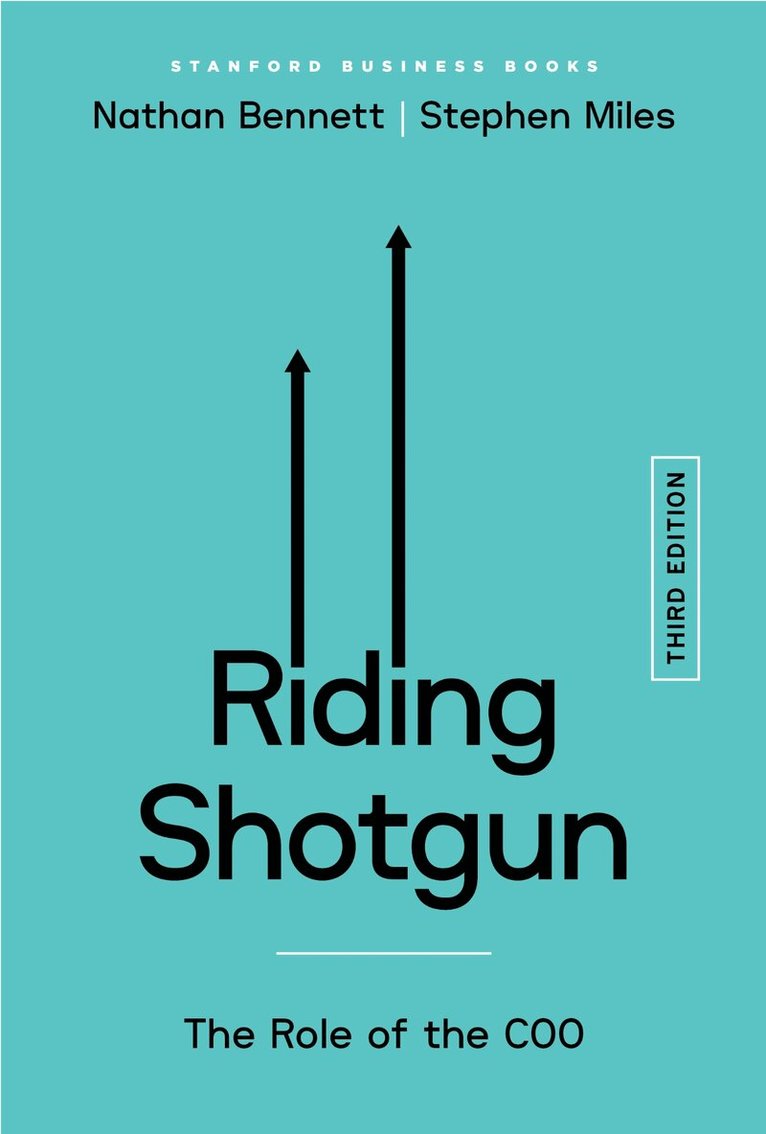
In today's fast-moving business world, the Chief Operating Officer (COO) plays a critical yet often misunderstood role. Nathan Bennett and Stephen A. Miles's Riding Shotgun: The Role of the COO offers a deep dive into what it takes to succeed as a second-in-command.This insightful book explores how COOs support CEOs, drive strategy, and ensure smooth day-to-day operations. Drawing from real-world examples and extensive research, Bennett and Miles uncover the unique challenges and opportunities of the job. Whether you're a current or aspiring COO, a CEO looking to strengthen your leadership team, or simply curious about executive dynamics, this book provides valuable takeaways.With engaging storytelling and practical insights, Riding Shotgun breaks down the different types of COOs, the skills required to excel in the role, and how businesses can leverage this position for long-term success. It's a must-read for anyone interested in leadership, corporate strategy, and the power of effective teamwork at the highest levels of an organization.
In today's fast-moving business world, the Chief Operating Officer (COO) plays a critical yet often misunderstood role. Nathan Bennett and Stephen A. Miles's Riding Shotgun: The Role of the COO offers a deep dive into what it takes to succeed as a second-in-command. This insightful book explores how COOs support CEOs, drive strategy, and ensure smooth day-to-day operations. Drawing from real-world examples and extensive research, Bennett and Miles uncover the unique challenges and opportunities of the job. Whether you're a current or aspiring COO, a CEO looking to strengthen your leadership team, or simply curious about executive dynamics, this book provides valuable takeaways. With engaging storytelling and practical insights, Riding Shotgun breaks down the different types of COOs, the skills required to excel in the role, and how businesses can leverage this position for long-term success. It's a must-read for anyone interested in leadership, corporate strategy, and the power of effective teamwork at the highest levels of an organization.
Leadership development has become a vast enterprise of competency models, assessments, courses, simulations, coaching, and carefully constructed learning experiences. Yet many programs remove the very conditions that make leadership difficult: incomplete information, competing demands, consequential choices, shifting relationships, limited authority, political risk, and pressure to act before the situation is fully understood. Participants may acquire useful concepts and perform well in the classroom while remaining poorly prepared for the environments in which leadership must occur.Designing Crucibles argues that knowledge and practice alone cannot produce the adaptive capability necessary for successful leaders. Instead, Nathan Bennett introduces a constraints-led approach (CLA)—translating research from sports science into a systematic methodology for leadership development. Leadership-development designers will learn how pressure, uncertainty, interdependence, incomplete control, and meaningful consequences can be calibrated to create "smaller crucibles": bounded experiences that reproduce the developmental logic of major career challenges without requiring leaders to endure their full organizational and personal costs. Connecting theories of adaptive leadership with actionable tools for constructing these exercises, this book offers a rigorous and practical framework for rethinking how leaders are developed.