This volume contains a representative sample of studies presented at the 17th meeting of the Generative Approaches to Second Language Acquisition conference (GASLA-17). The chapters explore new frontiers, and make connections between second language acquisition, bilingualism, psycholinguistic methods, and computational methods. The chapters ask theoretically informed questions about the underlying grammars of language learners and bilinguals, use experimental methods to arrive at answers to those questions, and consider the value of using 'big data' to address questions in generative second language acquisition. This volume is intended for scholars and students of generative second language acquisition and related fields. It builds on prior literature by addressing the acquisition of a variety of phenomena (in syntax, semantics, pragmatics and phonology), by a variety of populations, and using a variety of data collection methods.
Differential Object marking (DOM), a linguistic phenomenon in which a direct object is morphologically marked for semantic and pragmatic reasons, has attracted the attention of several subfields of linguistics in the past few years. DOM has evolved diachronically in many languages, whereas it has disappeared from others; it is easily acquired by monolingual children, but presents high instability and variability in bilingual acquisition and language contact situations. This edited collection contributes to further our understanding of the nature and development of DOM in the languages of the world, in acquisition, and in language contact, variation, and change. The thirteen chapters in this volume present new empirical data from Estonian, Spanish, Turkish, Korean, Hindi, Romanian and Basque in different acquisition contexts and learner populations. They also bring together multiple theoretical and methodological perspectives to account for the complexity and dynamicity of this widespread linguistic phenomenon.
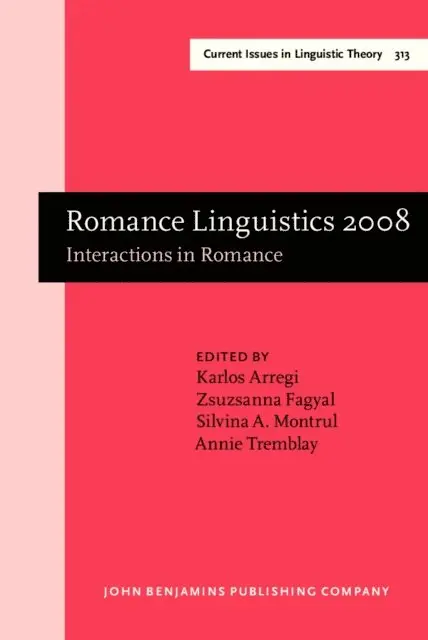
The sixteen papers here united have been selected from the 38th Linguistic Symposium of the Romance Languages held in Champaign-Urbana in 2008. The papers, whose authors include both well-known researchers and younger scholars, cover a broad and truly interdisciplinary range of topics in phonology, morphology, syntax, semantics, and their interfaces. Among the plethora of topics examined are stress in Quebec French, vowel deletion in Tuscan Italian, bare singulars in Brazilian Portuguese, case in Romanian, and hiatus in Argentine Spanish. The volume’s novelty is to extend the traditional scope of linguistic inquiry to dynamic cognitive and societal connections between Romance and other languages, investigating, among others, how Spanish phonotactics informs psycholinguistic models of speech production, how bilinguals express subject pronouns in Chipilo contact Spanish relative to monolingual Mexican Spanish, and whether Spanish-speaking immigrants in Montreal acquire the constraints typical to natives in loanword adaptations.
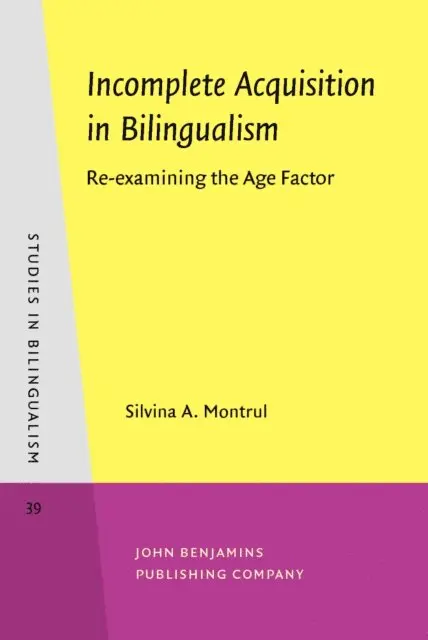
Age effects have played a particularly prominent role in some theoretical perspectives on second language acquisition. This book takes an entirely new perspective on this issue by re-examining these theories in light of the existence of apparently similar non-native outcomes in adult heritage speakers who, unlike adult second language learners, acquired two or more languages in childhood. Despite having been exposed to their family language early in life, many of these speakers never fully acquire, or later lose, aspects of their first language sometime in childhood. The book examines the structural characteristics of "incomplete" grammatical states and highlights how age of acquisition is related to the type of linguistic knowledge and behavior that emerges in L1 and L2 acquisition under different environmental circumstances. By underscoring age of acquisition as a unifying factor in the study of L2 acquisition and L1 attrition, it is claimed that just as there are age effects in L2 acquisition, there are also age effects, or even perhaps a critical period, in L1 attrition. The book covers adult L2 acquisition, attrition in adults and in children, and includes a comparison of adult heritage language speakers and second language learners.
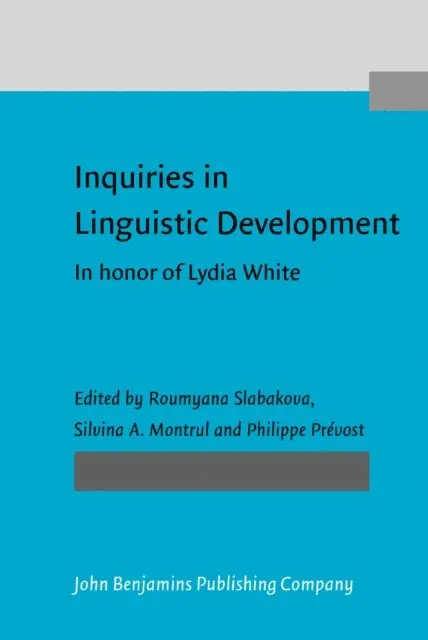
The focus of this collection is on important themes in L2 acquisition, the nature of grammatical systems developed by language learners in L1 acquisition, third language acquisition, and bilingualism and language attrition. The chapters present an interesting mix of theoretical contributions, overview studies, and experimental designs exploring various research questions, such as learnability and access to UG, L1 influence, the nature of initial and endstate grammars, and variability. The linguistic domains investigated are also extremely diverse: morphosyntax, phonology, the lexicon, argument realization, language processing, and interface phenomena. This book, edited and written by McGill University alumni, is intended as a tribute to Lydia White''s contribution to the field of generative second language acquisition. The authors present current work on language acquisition which further investigates several themes developed by White''s research. Through these state-of-the-art contributions the reader will be able to identify important new directions in which generative language acquisition is developing and expanding.
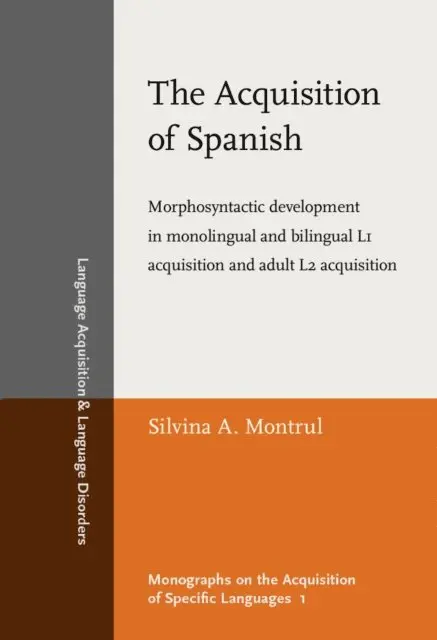
This is the first book on the acquisition of Spanish that provides a state-of-the-art comprehensive overview of Spanish morphosyntactic development in monolingual and bilingual situations. Its content is organized around key grammatical themes that form the empirical base of research in generative grammar: nominal and verbal inflectional morphology, subject and object pronouns, complex structures involving movement (topicalizations, questions, relative clauses), and aspects of verb meaning that have consequences for syntax. The book argues that Universal Grammar constrains all instances of language acquisition and that there is a fundamental continuity between monolingual, bilingual, child and adult early grammatical systems. While stressing their similarities with respect to linguistic representations and processes, the book also considers important differences between these three acquisition situations with respect to the outcome of acquisition. It is also shown that many linguistic properties of Spanish are acquired earlier than in English and other languages. This book is a must read for those interested in the acquisition of Spanish from different theoretical perspectives as well as those working on the acquisition of other languages in different contexts.