1. Land Resources, Land Use and Projected Land Availability for Alternative Uses in the EC.- 1.1. Introduction.- 1.2. Land Use Structure.- 1.3. Climate and Soils.- 1.4. Slope Characteristics of Land.- 1.5. Assessing Future Land Requirements for Major Uses in the EEC.- 1.6. Projected Land Use Changes.- 1.7. Concluding Remarks.- 2. Trends in the Transformation of European Agriculture.- 2.1. Introduction.- 2.2. Types of Agriculture in Europe.- 2.3. Agricultural Regions in Europe.- 2.4. Conclusions.- 3. Future Land Use Patterns in Europe.- 3.1. Introduction.- 3.2. Land Use Patterns in Europe.- 3.3. New Technologies and Changing Land Use Patterns.- 3.4. Climate Change and Soil Degradation in Relation to Changing Land Use Patterns.- 3.5. Future Land Use Changes in Europe.- 3.6. Concluding Remarks.- 4. The Role and Impact of Biophysical Determinants on Present and Future Land Use Patterns in Europe.- 4.1. Introduction.- 4.2. Major Determinants of Land Use Patterns in Europe.- 4.3. Effect of Biophysical Parameters on Crop Growth.- 4.4. Land Assessment Based on the Physical Potential of the Land.- 4.5. Concluding Remarks.- 5. Atmospheric Methane: Estimates of Its Past. Present and Future and Its Role in Effecting Changes in Atmospheric Chemistry.- 5.1. Introduction.- 5.2. The Greenhouse Effect.- 5.3. Chemical Interferences.- 5.4. Climatic Implications.- 5.5. The Global Methane Budget.- 5.6. Biogenic Sources.- 5.7. Methane of Non-biological Origin.- 5.8. Pre-industrial Methane Emissions.- 5.9. Future Trends.- 5.10. Concluding Remarks.- 6. Perspectives on a Changing Hydroclimate: Land Use Implications.- 6.1. Introduction.- 6.2. The Hydrological Cycle.- 6.3. Interdependency of Catchment Hydrology and Land Use.- 6.4. Environmental Manipulation.- 6.5. Influence of Climatic Change.- 6.6. Sustainable Interaction between Society and the Water Cycle.- 6.7. Matrices to Clarify the Impacts of Changes.- 6.8. Conclusion.- 7. Dynamics in Land Use Patterns: Socio-economic and Environmental Aspects of the Second Agricultural Land Use Revolution.- 7.1. Introduction.- 7.2. Development and Sustainability: A Methodological Framework.- 7.3. Land Use and Economics: An Historical Orientation.- 7.4. Agricultural Land Use and the Environment.- 7.5. Overproduction in the Agricultural Sector: An International Perspective.- 7.6. Strategic and Scientific Options for Co-evolutionary Development.- 8. Climatic Change and Land Use Impact in Europe.- 8.1. Introduction.- 8.2. European Climate-Vegetation-Soil Relationships.- 8.3. Major Future Shifts of Biomes and Land Use.- 8.4. Climate Related Acidification, Eutrophication and Aridification.- 9. Climatic Changes and Land Use Potential in Europe.- 9.1. Introduction.- 9.2. Specific Approaches.- 9.3. A Summary of Possible Effects of Climatic Change on Agricultural Potential in Europe.- 9.4. Potential Technological and Management Responses.- 9.5. Conclusions.- 10. Environmental Constraints on Agricultural Production.- 10.1. Introduction.- 10.2. Materials and Methods Applied.- 10.3. Results of the Experiments.- 10.4. Measures to Prevent Leaching.- 10.5. Conclusion.- 11. Potential Effects of Climate and Land Use Changes on the Water Balance Structure in Poland.- 11.1. Introduction.- 11.2. Methods of Assessing the Heat and Water Balance Structure.- 11.3. Scenarios of Heat and Water Balance Components.- 11.4. Conclusions.- 12. Soil Erosion, Soil Degradation and Climatic Change.- 12.1. Introduction.- 12.2. Soil Erosion in Western Europe.- 12.3. Establishing Information on Erosion and Degradation.- 12.4. Land Degradation: The World Problem.- 12.5. Soil Erosion and Climatic Change.- 13. Salinization Potential of European Soils.- 13.1. Introduction.- 13.2. Salinization of Groundwater and Soils.- 13.3. Major Aspects of Soil Salinity.- 13.4. Future Potential for Salt-affected Soils in Europe.- 13.5. Prevention and Monitoring of Secondary Salinization.- 14. Changes in Rates of Weathering and Erosion Induced by Acid Emissions and Ag...
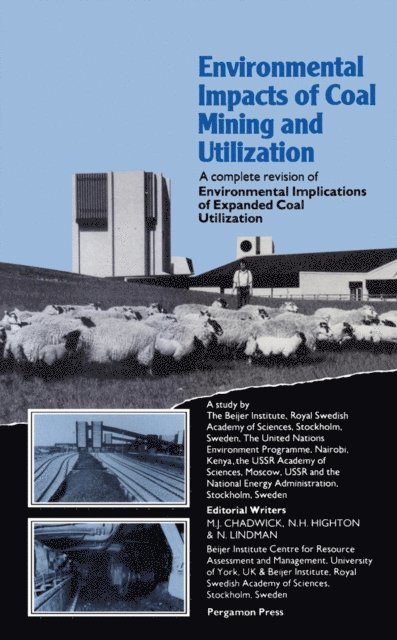
Environmental Implications of Expanded Coal Utilization focuses on the increasing consideration of coal as an alternative source of energy. This book comes as an answer to the issues on health and environment regarding the extraction, production, and use of coal. Composed of nine chapters, the selection starts by underlining the potential prospects for coal, which plays a vital role in meeting energy demands. The book also shows that problems have evolved regarding the use of coal, including land disturbance and increased land occupation due to mining. The text also notes that the international trade of coal will surely generate waste products, and some of which can be the result of poor transportation and handling. The book focuses on coal gasification and liquefaction and emphasizes that the processes involved must be carefully understood in order to avoid the environmental impacts of coal use. Attempts have been made to establish a conceptual framework to be used in assessing the health and environmental health impacts of the conversion and utilization of coal. Relative to this, discussions that follow include the trace elements that are the products of coal combustion and conversion and also coal derived carbon compounds. Another sector is focused on the evaluation of the effects of emissions on human health, especially of workers in the industry. The effects of the utilization of coal on communities are also considered. The text is a vital source of information to those involved in the research on the use of coal as alternative source of energy.
As coal is considered as a substitute for other fuels, more serious attention is being given to the environmental impacts of the whole coal fuel cycle: mining, transport, storage, combustion and conversion. This volume presents an up-to-date account of these environmental impacts and the recent developments to combat and control them. A feature of the book is the way in which it discusses not only the experience and developments in North America and Western Europe but also presents much information made available for this study on the developments in the socialist countries of Eastern Europe.
G. T. Goodman and M. J. Chadwick With the increasing pressure worldwide on mineral and fossil fuel resources, there is a growing awareness of the need to utilize all available workable deposits as thoroughly and effic iently as possible. This inevitably means disturbance, often of high quality environments. Adverse environmental impacts on land, water and air, and frequently to human health and biological resources, have been taking place for many years in different parts of the world. In total cycle of mineral extraction, trans portation use and disposal involves all compartments of the biosphere. The need to minimise these impacts by wise environ mental management has never been more important than it is today. There is great interest, therefore, in pooling our understanding of the scientific processes involved and our technical capability of dealing with these problems. Scientists and engineers who are expert in handling differ ent types of mineral process have much to learn from one another particularly when codes of practice from different countries in the field of land reclamation are compared. In order to illust rate the scientific and technical expertise required in the necessary detail it was deemed essential in this Advanced Study Institute to concentrate on specific case studies utilizing a range of actual sites. The examples of Coal, China Clay and Non ferrous Metals were chosen as displayed in the United Kingdom and Germany.
The patterns of land use that have evolved in Europe reflect the boundaries set by the natural environment and socio-economic responses to the needs of the population. Over the centuries man has been able to overcome increasingly the constraints placed on land use by the natural environment through the development of new technologies and innovations, driven by an increasing population and rising material expectations. However, activities are still ultimately constrained by natural limitations such as climatic characteristics and associated edaphic and vegetational features. A major problem for land management, in its broadest sense, can be a reluctance to foresee the consequent ecological changes. This means that mitigating strategies will not be implemented in time to prevent environmental degradation and social hardship, although in many parts of Europe, over some centuries, demands have been met in a sustainable way, by sound, prudent and temperate expectations that have dictated management regimes. The management of land in Europe has always been a complex challenge: land is the primary, though finite resource. DeciSions regarding the use of land and manipulation of ecosystem dynamics today may affect the long-term primary productivity of the resource. Decisions to change land use may be virtually irreversible; urbanization is an illustration of the influence of population density on the land resource.