238 kr
Skickas inom 7-10 vardagar
238 kr
Skickas inom 7-10 vardagar
348 kr
Skickas inom 10-15 vardagar
2 154 kr
Skickas inom 7-10 vardagar
486 kr
Läs direkt efter köp
781 kr
Skickas inom 7-10 vardagar
2 533 kr
Skickas inom 3-6 vardagar
343 kr
Skickas inom 7-10 vardagar
2 497 kr
Skickas inom 10-15 vardagar
716 kr
Skickas inom 10-15 vardagar
Taylor & Francis Ltd
20 698 kr
Skickas inom 7-10 vardagar
2 526 kr
Skickas inom 10-15 vardagar
798 kr
Skickas inom 10-15 vardagar
660 kr
Läs direkt efter köp
Originally published in 1973, this book is about people and psychiatry. About people who rejected psychiatry as it was generally practised at the time, people who sought for and found alternative ways of caring for and healing one another.
The author, who had been active in radical alternatives to psychiatry for some time, offers us a programme based not on drugs, repression and a ‘questionable’ expertise, but on human caring, greater awareness of the body, deeper communication between persons and a willingness to let the emotions flow. It is a challenging alternative which came at a time when the viability of scientific, theoretical and chemical approaches to distress were being questioned at all levels of society. This alternative includes the new direct methods of healing (making whole) such as Encounter, Gestalt, Bioenergetics, Psychofantasy – methods that do not do things to people but allow them to feel their way into change through experiment, flow and choice.
The main focus of the book is People, not Psychiatry (PNP), the network set up by the author in 1969. PNP is open to all, and people in it help one another in times of stress and crisis, if they are asked to and when they are needed. One of the main assets of these networks is that they are an alternative and they are there.
The book tells the story of PNP’s birth and growth. It is a personal story, a moving story, a story about people. In addition, the book contains some lively theoretical discussion, both simple and clear, in the course of which the author tentatively offers his own theory of neurosis – that many people become victims of the primitive logic patterns laid down in infancy, patterns that become reinforced through fear and habit and have to be dissolved or replaced if we are to enjoy a full, healthy, free-flowing life.
The book is directed at doctors, patients, consultants, nurses, psychologists, social workers, therapists, in fact anyone involved in any way in the field of psychiatry. It is also offered to all those whom psychiatry touches, that it to say – everyone.
777 kr
Läs direkt efter köp
662 kr
Skickas inom 7-10 vardagar
2 392 kr
Skickas inom 7-10 vardagar
797 kr
Skickas inom 7-10 vardagar
1 872 kr
Skickas inom 7-10 vardagar
1 655 kr
Skickas inom 10-15 vardagar
1 655 kr
Skickas inom 10-15 vardagar
1 070 kr
Skickas
768 kr
Skickas inom 10-15 vardagar
391 kr
Skickas inom 10-15 vardagar
386 kr
Skickas
391 kr
Skickas inom 10-15 vardagar
271 kr
Skickas inom 7-10 vardagar
329 kr
Läs direkt efter köp
In the dawn of the new African Millennium, the Rastafari movement has achieved unheralded growth and visibility since its inception more than eighty years ago. Moving beyond a pure spiritual movement, its aesthetic component has influenced cultures of the Caribbean, the United States, and others across the globe. Locating the Rastafari movement at a literal and figurative crossroad, Barnett sets out to consider the possible paths the movement will chart.Rastafari in the New Millennium covers a wide range of perspectives, focusing not only on the movement’s nuanced and complex religious ideology but also on its political philosophy, cosmology, and unique epistemology. Barry Chevannes’s essay addresses the concerns of death and repatriation, highlighting the transformative challenges these issues pose to Rastafari. Essays by Ian Boxill, Edward Te Kohu Douglas, Erin C. MacLeod, and Janet L. DeCosmo, among others, offer rich accounts of the globalization of Rastafari from New Zealand to Ethiopia, from Brazil to Nigeria. Drawing on new research and global developments, the contributors, many of whom are leading scholars in the field, reinvigorate the critical dialogue on the current state and future direction of the Rastafari movement.
119 kr
Skickas
768 kr
Läs direkt efter köp
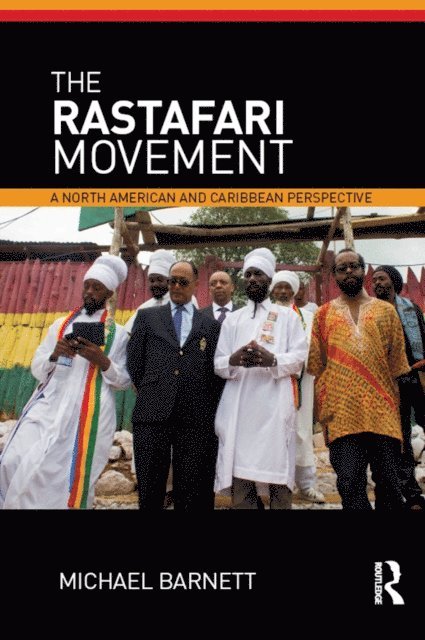
The Rastafari Movement: A North American and Caribbean Perspective provides a historical and ideological overview of the Rastafari movement in the context of its early beginnings in the island of Jamaica and its eventual establishment in other geographic locations. Building on previous scholarship and the author''s own fieldwork, the text goes on to provide a rich comparative analysis of the Rastafari movement with other Black theological movements, specifically the Nation of Islam and the Black Hebrew Israelites in the context of the United States. The text explores the following topics:
• Pan-Africanism, Black nationalism and Rastafari;
• gender dynamics;
• globalization;
• concepts and symbols;
• other Black theological movements.
This text is ideal for students of religious studies, sociology, anthropology, African Diaspora studies, African American studies, and Black studies who wish to gain an understanding of the history and beliefs of the Rastafari Movement.