1 585 kr
Läs direkt efter köp
1 585 kr
Läs direkt efter köp
1 123 kr
Skickas inom 10-15 vardagar
1 112 kr
Skickas inom 10-15 vardagar
1 112 kr
Skickas inom 10-15 vardagar
2 760 kr
Skickas inom 10-15 vardagar
2 843 kr
Skickas inom 10-15 vardagar
919 kr
Skickas inom 10-15 vardagar
2 571 kr
Skickas inom 10-15 vardagar
1 558 kr
Skickas inom 10-15 vardagar
1 034 kr
Läs direkt efter köp
1 034 kr
Läs direkt efter köp
1 066 kr
Läs direkt efter köp
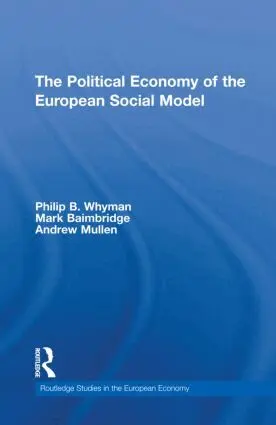
This book seeks to analyse the development of the European Union (EU), which was founded upon the principle of the free movement of capital, goods, services and people in 1957. Its central thesis is that, from a practical and theoretical point of view, such a basis is fundamentally at odds with the creation of an interventionist regime that the construction of a social Europe would require.
The authors argue convincingly that - economically: the EU does not currently possess the budget or the economic tools to pursue such a strategy; politically: close to none of the institutions of the EU have backed such a policy; practically: conservative and neo-liberal forces (among member states and the institutions of the EU) have repeatedly thwarted any moves in this direction. In reality, the Single Internal Market, Economic and Monetary Union, enlargement, the Lisbon Agenda and European Constitution projects all prioritise supply-side measures and expanding the scope of the market rather than the boosting of demand and other economic intervention. Consequently, constructing a social Europe in the face of this would appear problematic. Hence, in both theory and practice, the idea that there can be a social Europe vis-Ã -vis neoliberalisation is a contradiction in terms.
This controversial book will be an educating and refreshing read for advanced students and academics involved with European politics, the European Union, European Economics and Economic instititutions.

1 051 kr
Läs direkt efter köp
This book seeks to analyse the development of the European Union (EU), which was founded upon the principle of the free movement of capital, goods, services and people in 1957. Its central thesis is that, from a practical and theoretical point of view, such a basis is fundamentally at odds with the creation of an interventionist regime that the construction of a social Europe would require.
The authors argue convincingly that - economically: the EU does not currently possess the budget or the economic tools to pursue such a strategy; politically: close to none of the institutions of the EU have backed such a policy; practically: conservative and neo-liberal forces (among member states and the institutions of the EU) have repeatedly thwarted any moves in this direction. In reality, the Single Internal Market, Economic and Monetary Union, enlargement, the Lisbon Agenda and European Constitution projects all prioritise supply-side measures and expanding the scope of the market rather than the boosting of demand and other economic intervention. Consequently, constructing a social Europe in the face of this would appear problematic. Hence, in both theory and practice, the idea that there can be a social Europe vis-Ã -vis neoliberalisation is a contradiction in terms.
This controversial book will be an educating and refreshing read for advanced students and academics involved with European politics, the European Union, European Economics and Economic instititutions.

1 294 kr
Skickas inom 10-15 vardagar
1 896 kr
Läs direkt efter köp
This book explores economic developments across Europe in relation to its apparent segmentation, as disparities widen between core and periphery countries. In contrast to previous literature, the scope of analysis is extended to Europe as a continent rather than confining it solely to the European Union, thereby providing the reader with greater insight into the core/periphery nexus. The authors commence with a critical appraisal of economic thinking in relation to regional trade agreements and monetary integration. In relation to a number of EU economies, the book addresses issues of a liquidity trap, deflation, and twin deficits, together with the interconnection between exchange rates and current account balances. Importantly, they extend the discussion of segmentation through a series of focused case studies on Russia, Brexit and emergence of the mega-regionals.
929 kr
Skickas inom 10-15 vardagar
869 kr
Skickas inom 10-15 vardagar
1 045 kr
Läs direkt efter köp
1 022 kr
Läs direkt efter köp
661 kr
Läs direkt efter köp
1 801 kr
Skickas inom 7-10 vardagar
261 kr
Skickas inom 11-20 vardagar
690 kr
Skickas inom 7-10 vardagar
263 kr
Tillfälligt slut