Agents are computational systems that are capable of autonomous, reactive and proactive behaviour, and are also able to interact with each other. The application of agents in e-Commerce is one of the fastest-growing and most exciting areas of computer science. This emerging technology is enabling individuals and businesses to take advantage of the new and powerful medium of the World Wide Web. Agent Technology for e-Commerce introduces the main theory behind and the applications of agent technology in e-Commerce in a way that is accessible to students with a basic background in computer science. Bringing together economics, game theory and multi-agent systems in a clear and accessible way, this book offers an introduction to agent technology and architectures, as well as providing more in-depth coverage of subjects such as negotiation, auctions, bargaining, voting protocols and coalition formation. Mobile agents and issues of trust and security are also addressed.Containing exercises and topics for discussion, this book is ideal for classroom use or self-study, and will be of considerable interest to computing and IT professionals who wish explore the fast-moving discipline of agent technology for e-Commerce.
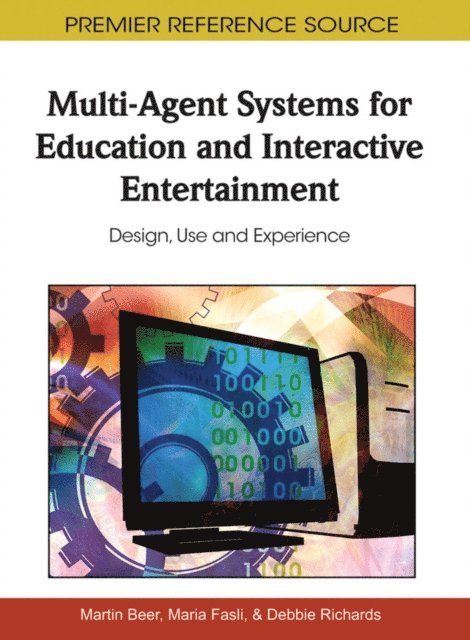
The increased sophistication of the multi-agent software now becoming available is allowing much more sophisticated learning scenarios to be attempted. This has caused interest in the role of artificial intelligence in interactive systems to grow in recent years. Increasingly powerful consumer hardware makes research-level AI usable in real-world games and/or immersive learning environments. Multi-Agent Systems for Education and Interactive Entertainment: Design, Use and Experience presents readers with a rich collection of ideas from researchers who are exploring the complex tradeoffs that must be made in designing agent systems for education and interactive entertainment. This book aims to provide a mixture of relevant theoretical and practical understanding of the use of multi-agent systems in educational and entertainment research, together with practical examples of the use of such systems in real application scenarios.
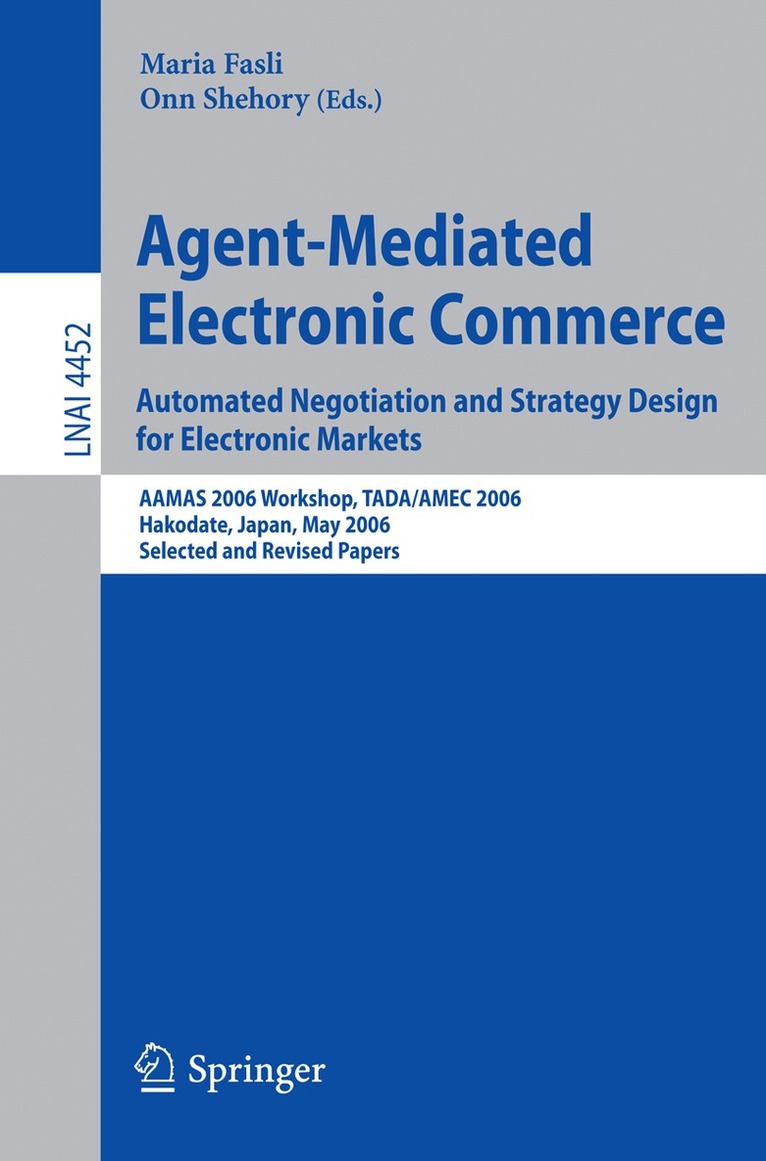
Thedesignandanalysisoftradingagentsandelectronictradingsystemsinwhich they are deployed involve ?nding solutions to a diverse set of problems, invo- ing individual behaviors, interaction, and collective behavior in the context of trade. A wide variety of trading scenarios and systems, and agent approaches to these, have been studied in recent years. The present volume includes a number of papers that were presented as part of the Joint International Workshop on Trading Agent Design and Analysis and Agent-Mediated Electronic Commerce which was collocated with the Autonomous Agents and Multi-agent Systems (AAMAS) Conference in Hakodate, Japan, in May 2006. The Joint TADA/AMEC Workshop brought together the two successful and well-established events of the Trading Agent Design and Analysis (TADA) and Agent-Mediated Electronic Commerce (AMEC) Workshops. The TADA series of workshops serves as a forum for presenting work on trading agent design and technologies, theoretical and empirical evaluation of strategies in complex trading scenarios as well as mechanism design. TADA also serves as the main forum for the Trading Agent Competition (TAC) research community. TAC is an annual tournament whose purpose is to stimulate research in trading agents and market mechanisms by providing a platform for agents competing in we- de?ned market scenarios (http://www. sics. se/tac). The AMEC series of wo- shops presents interdisciplinary researchon both theoretical and practical issues of agent-mediated electronic commerce ranging from the design of electronic marketplaces and e?cient protocols to behavioral aspects of agents operating in suchenvironments.