1 541 kr
Skickas inom 7-10 vardagar
1 541 kr
Skickas inom 7-10 vardagar
1 012 kr
Läs direkt efter köp
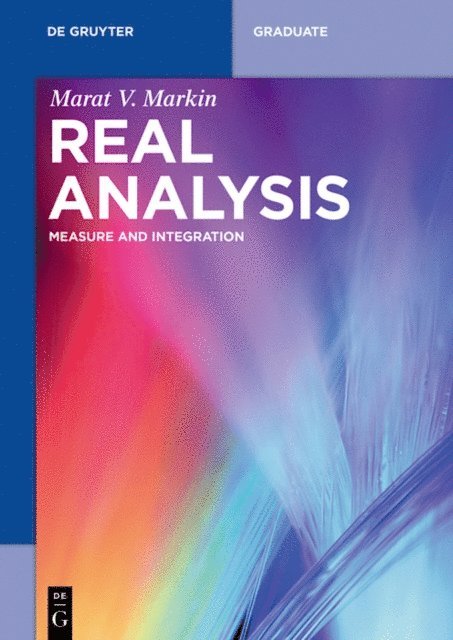
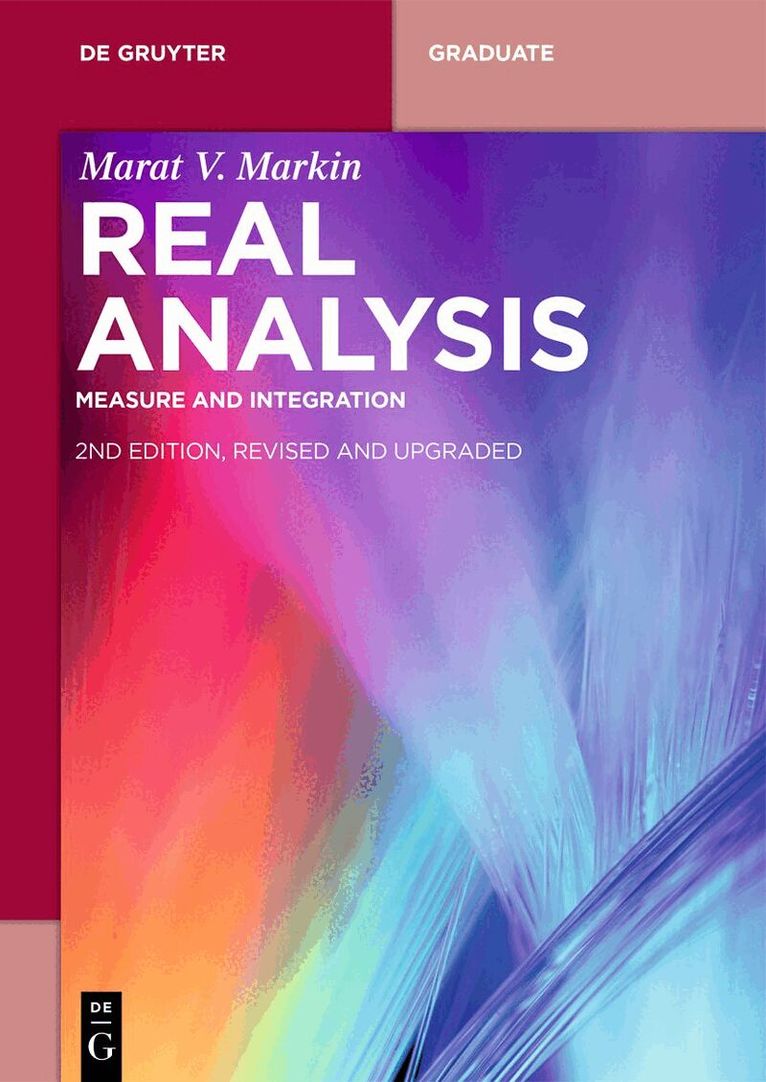
The philosophy of the book, which makes it quite distinct from many existing texts on the subject, is based on treating the concepts of measure and integration starting with the most general abstract setting and then introducing and studying the Lebesgue measure and integration on the real line as an important particular case.
The book consists of nine chapters and appendix, with the material flowing from the basic set classes, through measures, outer measures and the general procedure of measure extension, through measurable functions and various types of convergence of sequences of such based on the idea of measure, to the fundamentals of the abstract Lebesgue integration, the basic limit theorems, and the comparison of the Lebesgue and Riemann integrals. Also, studied are Lp spaces, the basics of normed vector spaces, and signed measures. The novel approach based on the Lebesgue measure and integration theory is applied to develop a better understanding of differentiation and extend the classical total change formula linking differentiation with integration to a substantially wider class of functions.
Being designed as a text to be used in a classroom, the book constantly calls for the student''s actively mastering the knowledge of the subject matter. There are problems at the end of each chapter, starting with Chapter 2 and totaling at 125. Many important statements are given as problems and frequently referred to in the main body. There are also 358 Exercises throughout the text, including Chapter 1 and the Appendix, which require of the student to prove or verify a statement or an example, fill in certain details in a proof, or provide an intermediate step or a counterexample. They are also an inherent part of the material. More difficult problems are marked with an asterisk, many problems and exercises are supplied with ``existential'''' hints.
The book is generous on Examples and contains numerous Remarks accompanying definitions, examples, and statements to discuss certain subtleties, raise questions on whether the converse assertions are true, whenever appropriate, or whether the conditions are essential.
With plenty of examples, problems, and exercises, this well-designed text is ideal for a one-semester Master''s level graduate course on real analysis with emphasis on the measure and integration theory for students majoring in mathematics, physics, computer science, and engineering.
A concise but profound and detailed presentation of the basics of real analysis with emphasis on the measure and integration theory. Designed for a one-semester graduate course, with plethora of examples, problems, and exercises. Is of interest to students and instructors in mathematics, physics, computer science, and engineering. Prepares the students for more advanced courses in functional analysis and operator theory.ContentsPreliminariesBasic Set ClassesMeasuresExtension of MeasuresMeasurable FunctionsAbstract Lebesgue IntegralLp SpacesDifferentiation and IntegrationSigned MeasuresThe Axiom of Choice and Equivalents
917 kr
Skickas inom 3-6 vardagar
949 kr
Skickas inom 3-6 vardagar
1 027 kr
Läs direkt efter köp
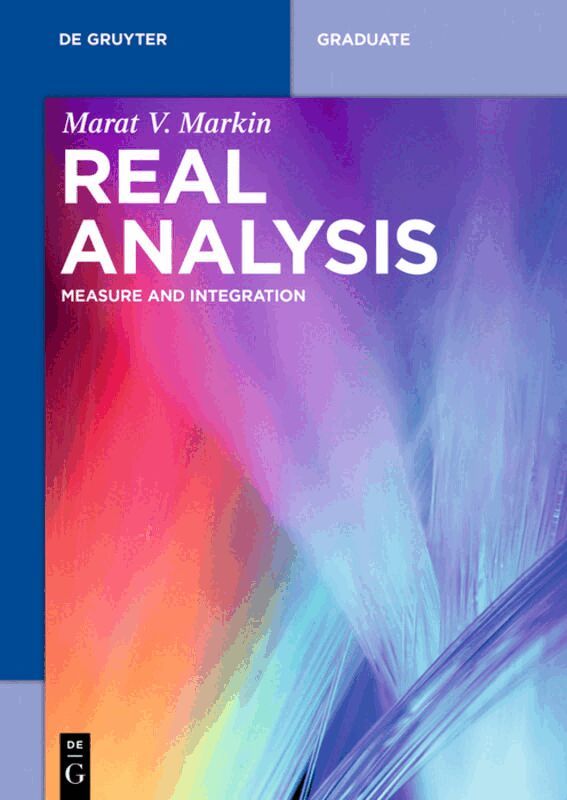
The philosophy of the book, which makes it quite distinct from many existing texts on the subject, is based on treating the concepts of measure and integration starting with the most general abstract setting and then introducing and studying the Lebesgue measure and integration on the real line as an important particular case.
The book consists of nine chapters and appendix, with the material flowing from the basic set classes, through measures, outer measures and the general procedure of measure extension, through measurable functions and various types of convergence of sequences of such based on the idea of measure, to the fundamentals of the abstract Lebesgue integration, the basic limit theorems, and the comparison of the Lebesgue and Riemann integrals. Also, studied are Lp spaces, the basics of normed vector spaces, and signed measures. The novel approach based on the Lebesgue measure and integration theory is applied to develop a better understanding of differentiation and extend the classical total change formula linking differentiation with integration to a substantially wider class of functions.
Being designed as a text to be used in a classroom, the book constantly calls for the student''s actively mastering the knowledge of the subject matter. There are problems at the end of each chapter, starting with Chapter 2 and totaling at 125. Many important statements are given as problems and frequently referred to in the main body. There are also 358 Exercises throughout the text, including Chapter 1 and the Appendix, which require of the student to prove or verify a statement or an example, fill in certain details in a proof, or provide an intermediate step or a counterexample. They are also an inherent part of the material. More difficult problems are marked with an asterisk, many problems and exercises are supplied with ``existential'''' hints.
The book is generous on Examples and contains numerous Remarks accompanying definitions, examples, and statements to discuss certain subtleties, raise questions on whether the converse assertions are true, whenever appropriate, or whether the conditions are essential.
With plenty of examples, problems, and exercises, this well-designed text is ideal for a one-semester Master''s level graduate course on real analysis with emphasis on the measure and integration theory for students majoring in mathematics, physics, computer science, and engineering.
A concise but profound and detailed presentation of the basics of real analysis with emphasis on the measure and integration theory. Designed for a one-semester graduate course, with plethora of examples, problems, and exercises. Is of interest to students and instructors in mathematics, physics, computer science, and engineering. Prepares the students for more advanced courses in functional analysis and operator theory.ContentsPreliminariesBasic Set ClassesMeasuresExtension of MeasuresMeasurable FunctionsAbstract Lebesgue IntegralLp SpacesDifferentiation and IntegrationSigned MeasuresThe Axiom of Choice and Equivalents
938 kr
Skickas inom 3-6 vardagar
1 084 kr
Läs direkt efter köp
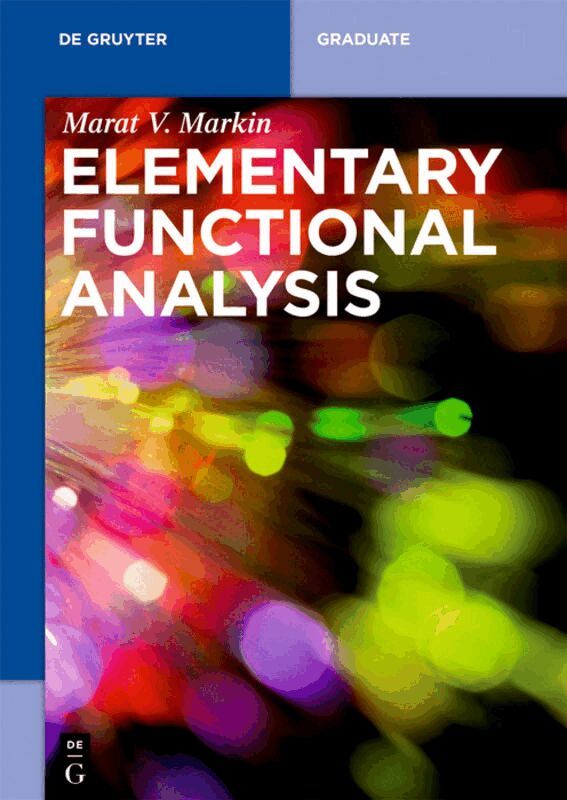
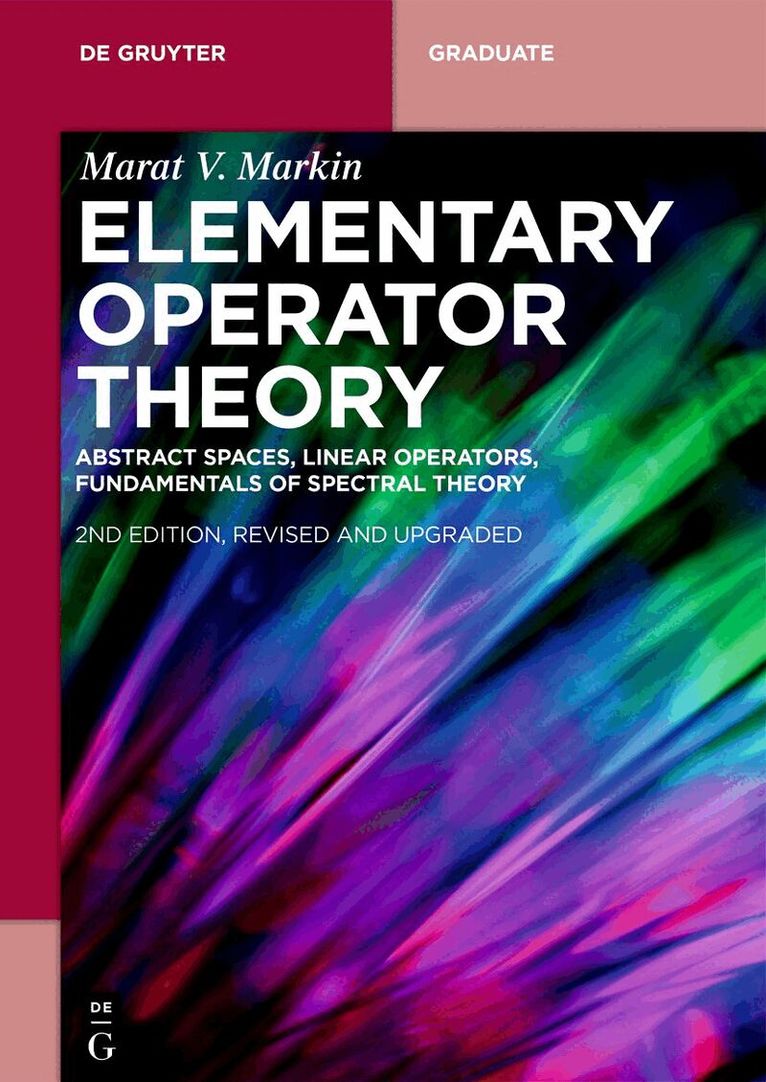
While there is a plethora of excellent, but mostly "tell-it-all'''' books on the subject, this one is intended to take a unique place in what today seems to be a still wide open niche for an introductory text on the basics of functional analysis to be taught within the existing constraints of the standard, for the United States, one-semester graduate curriculum (fifteen weeks with two seventy-five-minute lectures per week).
The book consists of seven chapters and an appendix taking the reader from the fundamentals of abstract spaces (metric, vector, normed vector, and inner product), through the basics of linear operators and functionals, the three fundamental principles (the Hahn-Banach Theorem, the Uniform Boundedness Principle, the Open Mapping Theorem and its equivalents: the Inverse Mapping and Closed Graph Theorems) with their numerous profound implications and certain interesting applications, to the elements of the duality and reflexivity theory. Chapter 1 outlines some necessary preliminaries, while the Appendix gives a concise discourse on the celebrated Axiom of Choice, its equivalents (the Hausdorff Maximal Principle, Zorn''s Lemma, and Zermello''s Well-Ordering Principle), and ordered sets.
Being designed as a text to be used in a classroom, the book constantly calls for the student''s actively mastering the knowledge of the subject matter. It contains 112 Problems, which are indispensable for understanding and moving forward. Many important statements are given as problems, a lot of these are frequently referred to and used in the main body. There are also 376 Exercises throughout the text, including Chapter 1 and the Appendix, which require of the student to prove or verify a statement or an example, fill in necessary details in a proof, or provide an intermediate step or a counterexample. They are also an inherent part of the material. More difficult problems are marked with an asterisk, many problem and exercises being supplied with "existential'''' hints.
The book is generous on Examples and contains numerous Remarks accompanying every definition and virtually each statement to discuss certain subtleties, raise questions on whether the converse assertions are true, whenever appropriate, or whether the conditions are essential.
The prerequisites are set intentionally quite low, the students not being assumed to have taken graduate courses in real or complex analysis and general topology, to make the course accessible and attractive to a wider audience of STEM (science, technology, engineering, and mathematics) graduate students or advanced undergraduates with a solid background in calculus and linear algebra.
With proper attention given to applications, plenty of examples, problems, and exercises, this well-designed text is ideal for a one-semester graduate course on the fundamentals of functional analysis for students in mathematics, physics, computer science, and engineering.
ContentsPreliminariesMetric SpacesNormed Vector and Banach SpacesInner Product and Hilbert SpacesLinear Operators and FunctionalsThree Fundamental Principles of Linear Functional AnalysisDuality and ReflexivityThe Axiom of Choice and Equivalents

1 091 kr
Läs direkt efter köp
While there is a plethora of excellent, but mostly "tell-it-all'''' books on the subject, this one is intended to take a unique place in what today seems to be a still wide open niche for an introductory text on the basics of functional analysis to be taught within the existing constraints of the standard, for the United States, one-semester graduate curriculum (fifteen weeks with two seventy-five-minute lectures per week).
The book consists of seven chapters and an appendix taking the reader from the fundamentals of abstract spaces (metric, vector, normed vector, and inner product), through the basics of linear operators and functionals, the three fundamental principles (the Hahn-Banach Theorem, the Uniform Boundedness Principle, the Open Mapping Theorem and its equivalents: the Inverse Mapping and Closed Graph Theorems) with their numerous profound implications and certain interesting applications, to the elements of the duality and reflexivity theory. Chapter 1 outlines some necessary preliminaries, while the Appendix gives a concise discourse on the celebrated Axiom of Choice, its equivalents (the Hausdorff Maximal Principle, Zorn''s Lemma, and Zermello''s Well-Ordering Principle), and ordered sets.
Being designed as a text to be used in a classroom, the book constantly calls for the student''s actively mastering the knowledge of the subject matter. It contains 112 Problems, which are indispensable for understanding and moving forward. Many important statements are given as problems, a lot of these are frequently referred to and used in the main body. There are also 376 Exercises throughout the text, including Chapter 1 and the Appendix, which require of the student to prove or verify a statement or an example, fill in necessary details in a proof, or provide an intermediate step or a counterexample. They are also an inherent part of the material. More difficult problems are marked with an asterisk, many problem and exercises being supplied with "existential'''' hints.
The book is generous on Examples and contains numerous Remarks accompanying every definition and virtually each statement to discuss certain subtleties, raise questions on whether the converse assertions are true, whenever appropriate, or whether the conditions are essential.
The prerequisites are set intentionally quite low, the students not being assumed to have taken graduate courses in real or complex analysis and general topology, to make the course accessible and attractive to a wider audience of STEM (science, technology, engineering, and mathematics) graduate students or advanced undergraduates with a solid background in calculus and linear algebra.
With proper attention given to applications, plenty of examples, problems, and exercises, this well-designed text is ideal for a one-semester graduate course on the fundamentals of functional analysis for students in mathematics, physics, computer science, and engineering.
ContentsPreliminariesMetric SpacesNormed Vector and Banach SpacesInner Product and Hilbert SpacesLinear Operators and FunctionalsThree Fundamental Principles of Linear Functional AnalysisDuality and ReflexivityThe Axiom of Choice and Equivalents
883 kr
Skickas inom 3-6 vardagar
1 266 kr
Skickas inom 7-10 vardagar
868 kr
Skickas inom 3-6 vardagar
573 kr
Skickas inom 7-10 vardagar