E-bok
PDF, Engelska, 20171 329 kr
Läs direkt efter köp
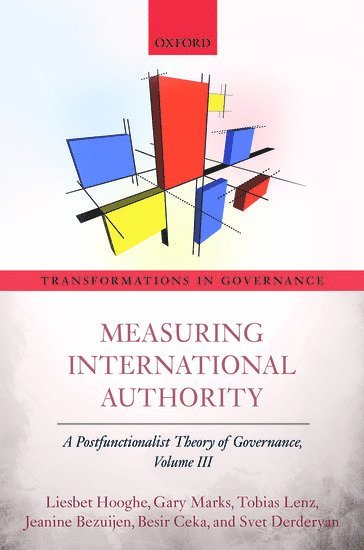
This is the third of five ambitious volumes theorizing the structure of governance above and below the central state. This book is written for those interested in the character, causes, and consequences of governance within the state.This book sets out a measure of authority for seventy-six international organizations (IOs) from 1950, or the time of their establishment, to 2010 which can allow researchers to test expectations about the character, sources, and consequences of international governance. The international organizations considered are regional (e.g. the EU, Andean Community, NAFTA), cross-regional (e.g. Commonwealth of Nations, the Organization of Islamic Cooperation), and global (e.g. the UN, World Bank, WTO). Firstly, the book introduces carefully constructed estimates for the scope and depth of authority exercised by international governments. The estimates are unique in their comparative scope, their specificity, and time span. Secondly, it describes describe broad trends in IO authority by comparing delegation and pooling, over time, across IOs, and across decision areas. Thirdly, it presents the evidence gathered by the authors to estimate international authority by carefully discussing forty-seven international organizations, and showing how their bodies are composed, what decisions each body makes, and how they make decisions. Transformations in Governance is a major new academic book series from Oxford University Press. It is designed to accommodate the impressive growth of research in comparative politics, international relations, public policy, federalism, environmental and urban studies concerned with the dispersion of authority from central states up to supranational institutions, down to subnational governments, and side-ways to public-private networks. It brings together work that significantly advances our understanding of the organization, causes, and consequences of multilevel and complex governance. The series is selective, containing annually a small number of books of exceptionally high quality by leading and emerging scholars. The series targets mainly single-authored or co-authored work, but it is pluralistic in terms of disciplinary specialization, research design, method, and geographical scope. Case studies as well as comparative studies, historical as well as contemporary studies, and studies with a national, regional, or international focus are all central to its aims. Authors use qualitative, quantitative, formal modeling, or mixed methods. A trade mark of the books is that they combine scholarly rigour with readable prose and an attractive production style. The series is edited by Liesbet Hooghe and Gary Marks of the University of North Carolina, Chapel Hill, and Walter Mattli of the University of Oxford.