533 kr
Skickas inom 10-15 vardagar
533 kr
Skickas inom 10-15 vardagar
354 kr
Skickas inom 3-6 vardagar
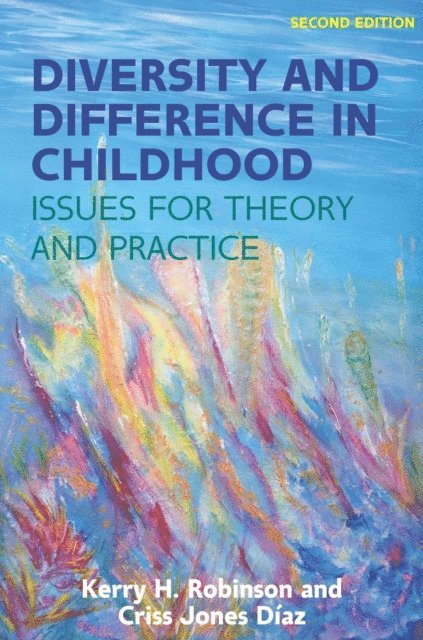
Educators and community-based professionals are often required to work with children and families from a range of diverse backgrounds. The second edition of this popular book goes beyond simplistic definitions of diversity, encouraging a much broader understanding and helping childhood educators and community-based professionals develop a critical disposition towards assumptions about children and childhood in relation to diversity, difference and social justice.
As well as drawing on research, the book gives an overview of relevant contemporary social theories, including poststructuralism, cultural studies, critical theory, postcolonialism, critical ‘race’ theory, feminist perspectives and queer theory. It interrogates practice and explores opportunities and strategies for creating a more equitable environment, whilst covering key issues impacting on children’s lives, including: globalization, neoliberalism, new racisms, immigration, Indigeneity, refugees, homophobia, heterosexism and constructions of childhood. Each chapter provides an overview of the area of discussion, a focus on the implications for practice, and recommended readings.
Providing insight into how social justice practices in childhood education and community-based service delivery can make a real difference in the lives of children, their families and communities, this is key reading for early childhood and primary educators, community-based professionals, university students and researchers.
“This thoughtful, topical book addresses a considerable range of diversity issues relevant to teacher educators, their students, and other professionals who work with children and their families within and beyond Australia. This timely second edition draws on the authors’ longstanding teacher education experiences, and their most recent research, to revisit the challenges of diversity and difference in children’s lives”. Dr Valerie N. Podmore, former associate professor, Faculty of Education and Social Work, the University of Auckland, New Zealand
“The second edition of Robinson and Jones Díaz’s Diversity and Difference in Childhood is a thoroughly welcome addition to my list of key texts for students of early childhood and childhood studies. It provides a means from the outset for educating undergraduate students from within critical postmodern and post structural perspectives – thus orienting their views of and actions within their future professions towards critical and equitable practices that value difference rather than treat is as a problem to be solved.”
Alexandra C. Gunn, Associate Dean (Teacher Education), University of Otago College of Education, New Zealand
“This is the 21st century early childhood education text. Diversity and Difference in Childhood provides early childhood educators and scholars a powerful space for asking social justice questions in a profoundly innovative way." Veronica Pacini-Ketchabaw, Ph.D., Professor, School of Child and Youth Care, University of Victoria, Canada
“This new edition of Diversity and Difference is both important and timely. Readers will find the new theoretical resources and additional chapters that have been included give the book a sense of enhanced rigour and its depth and breadth of coverage make it an ideal resource for a wide variety of interests and perspectives.”Christine Woodrow, Associate Professor and Senior Researcher, the Centre for Educational Research, Western Sydney University, Australia

340 kr
Läs direkt efter köp
Educators and community-based professionals are often required to work with children and families from a range of diverse backgrounds. The second edition of this popular book goes beyond simplistic definitions of diversity, encouraging a much broader understanding and helping childhood educators and community-based professionals develop a critical disposition towards assumptions about children and childhood in relation to diversity, difference and social justice.
As well as drawing on research, the book gives an overview of relevant contemporary social theories, including poststructuralism, cultural studies, critical theory, postcolonialism, critical ‘race’ theory, feminist perspectives and queer theory. It interrogates practice and explores opportunities and strategies for creating a more equitable environment, whilst covering key issues impacting on children’s lives, including: globalization, neoliberalism, new racisms, immigration, Indigeneity, refugees, homophobia, heterosexism and constructions of childhood. Each chapter provides an overview of the area of discussion, a focus on the implications for practice, and recommended readings.
Providing insight into how social justice practices in childhood education and community-based service delivery can make a real difference in the lives of children, their families and communities, this is key reading for early childhood and primary educators, community-based professionals, university students and researchers.
“This thoughtful, topical book addresses a considerable range of diversity issues relevant to teacher educators, their students, and other professionals who work with children and their families within and beyond Australia. This timely second edition draws on the authors’ longstanding teacher education experiences, and their most recent research, to revisit the challenges of diversity and difference in children’s lives”. Dr Valerie N. Podmore, former associate professor, Faculty of Education and Social Work, the University of Auckland, New Zealand
“The second edition of Robinson and Jones Díaz’s Diversity and Difference in Childhood is a thoroughly welcome addition to my list of key texts for students of early childhood and childhood studies. It provides a means from the outset for educating undergraduate students from within critical postmodern and post structural perspectives – thus orienting their views of and actions within their future professions towards critical and equitable practices that value difference rather than treat is as a problem to be solved.”
Alexandra C. Gunn, Associate Dean (Teacher Education), University of Otago College of Education, New Zealand
“This is the 21st century early childhood education text. Diversity and Difference in Childhood provides early childhood educators and scholars a powerful space for asking social justice questions in a profoundly innovative way." Veronica Pacini-Ketchabaw, Ph.D., Professor, School of Child and Youth Care, University of Victoria, Canada
“This new edition of Diversity and Difference is both important and timely. Readers will find the new theoretical resources and additional chapters that have been included give the book a sense of enhanced rigour and its depth and breadth of coverage make it an ideal resource for a wide variety of interests and perspectives.”Christine Woodrow, Associate Professor and Senior Researcher, the Centre for Educational Research, Western Sydney University, Australia
779 kr
Läs direkt efter köp
528 kr
Skickas inom 10-15 vardagar
738 kr
Läs direkt efter köp
688 kr
Skickas inom 7-10 vardagar
1 164 kr
Skickas inom 7-10 vardagar
738 kr
Läs direkt efter köp
School leadership instability is particularly problematic for scholars and practitioners concerned with PK-12 school improvement, as second only to teachers, campus leadership has been identified as a primary factor in students'' academic success (Young et al., 2007). Yet, while principals play an indispensable role in students'' academic success, the job has become considerably more stressful as the role of a school leader continues to evolve. Specifically, added responsibilities, increased work intensity, and the ever-present menace of high stakes accountability have intensified the stress levels encountered by today''s school leaders (Carpenter & Brewer, 2012; Chaplain, 2001; Darmody & Smyth, 2016; Wang, et al., 2018). This intensification negatively impacts a school’s teaching staff and its students, as the overall quality of the school experience can deteriorate if principals are unable to meet their potential due to the burnout and fatigue associated with chronic stress (Darmody & Smyth, 2016; Devos, et al., 2007).
For principals to fully realize their ability to serve as catalysts for school improvement, they should be allowed to prioritize physical, mental, cognitive, and emotional health. Desired levels of wellbeing occur in the absence of chronic physical, social, psychological, emotional, economic, and cognitive distress (La Placa, et al., 2013). As authors in this volume demonstrate, many school leaders have commenced specific practices targeting cognitive, emotional, and behavioral wellbeing to cope with occupational stress and flourishing- or, at the very least, surviving in such a challenging environment. Among coping strategies leaders have adopted include mindfulness and other wellbeing interventions/strategies intended to facilitate healthier lifestyles, relieve stress, and improve personal resilience (Aviles & Dent, 2015; Mahfouz, 2018; Wells, 2015).
Recently, there has been a call to consider educational leadership through a positive human flourishing lens. Research in this area focuses on integrating wellbeing practices in professional development programs for teachers and school administrators to highlight the positive effects of personal and collective wellbeing in schools (Cherkowski & Walker, 2014). For example, empirical studies have examined how incorporating mindfulness practice promotes positive adaptive skills, stress resilience, and social and emotional skills needed in a school environment (Abenavoli, et al., 2013; Benn, et al., 2012; Dvor a kova et al., 2017; Jennings, 2015; Meiklejohn et al., 2012; Mahfouz et al., 2018). New understandings about the relationship between school administrators'' wellbeing and school improvement efforts should ignite interest within the field. As such, this book’s chapters are organized into four distinct sections that provide: (a) an overview of the field (Section I), (b) an empirical argument for why such research is essential (Section II), (c) wellbeing models to be considered for use in the PK-12 setting (Section III), and, (d) specific wellbeing practices and frameworks currently being in PK-12 (Section IV).