349 kr
Skickas
349 kr
Skickas
511 kr
Läs direkt efter köp
Using Science as Evidence in Public Policy encourages scientists to think differently about the use of scientific evidence in policy making. This report investigates why scientific evidence is important to policy making and argues that an extensive body of research on knowledge utilization has not led to any widely accepted explanation of what it means to use science in public policy. Using Science as Evidence in Public Policy identifies the gaps in our understanding and develops a framework for a new field of research to fill those gaps.For social scientists in a number of specialized fields, whether established scholars or Ph.D. students, Using Science as Evidence in Public Policy shows how to bring their expertise to bear on the study of using science to inform public policy. More generally, this report will be of special interest to scientists who want to see their research used in policy making, offering guidance on what is required beyond producing quality research, beyond translating results into more understandable terms, and beyond brokering the results through intermediaries, such as think tanks, lobbyists, and advocacy groups. For administrators and faculty in public policy programs and schools, Using Science as Evidence in Public Policy identifies critical elements of instruction that will better equip graduates to promote the use of science in policy making.
757 kr
Läs direkt efter köp
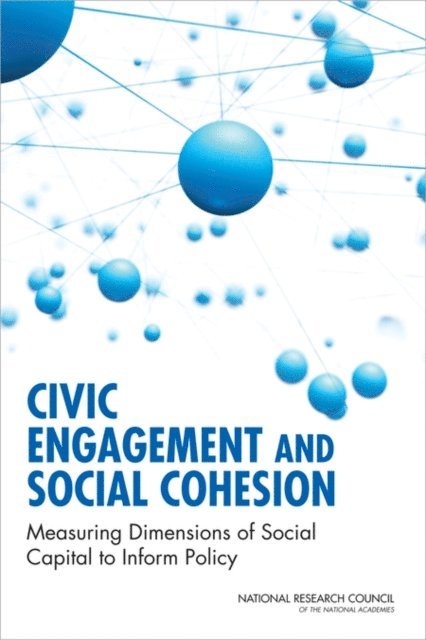
People''s bonds, associations and networks - as well as the civil, political, and institutional characteristics of the society in which they live - can be powerful drivers affecting the quality of life among a community''s, a city''s, or a nation''s inhabitants and their ability to achieve both individual and societal goals. Civic engagement, social cohesion, and other dimensions of social capital affect social, economic and health outcomes for individuals and communities. Can these be measured, and can federal surveys contribute toward this end? Can this information be collected elsewhere, and if so, how should it be collected?
Civic Engagement and Social Cohesion identifies measurement approaches that can lead to improved understanding of civic engagement, social cohesion, and social capital - and their potential role in explaining the functioning of society. With the needs of data users in mind, this report examines conceptual frameworks developed in the literature to determine promising measures and measurement methods for informing public policy discourse. The report identifies working definitions of key terms; advises on the feasibility and specifications of indicators relevant to analyses of social, economic, and health domains; and assesses the strength of the evidence regarding the relationship between these indicators and observed trends in crime, employment, and resilience to shocks such as natural disasters. Civic Engagement and Social Cohesion weighs the relative merits of surveys, administrative records, and non-government data sources, and considers the appropriate role of the federal statistical system. This report makes recommendations to improve the measurement of civic health through population surveys conducted by the government and identifies priority areas for research, development, and implementation.
445 kr
Skickas inom 7-10 vardagar
268 kr
Skickas inom 7-10 vardagar
346 kr
Läs direkt efter köp
A historical overview of the census race question—and a bold proposal for eliminating itAmerica is preoccupied with race statistics—perhaps more than any other nation. Do these statistics illuminate social reality and produce coherent social policy, or cloud that reality and confuse social policy? Does America still have a color line? Who is on which side? Does it have a different "race" line—the nativity line—separating the native born from the foreign born? You might expect to answer these and similar questions with the government''s "statistical races." Not likely, observes Kenneth Prewitt, who shows why the way we count by race is flawed.Prewitt calls for radical change. The nation needs to move beyond a race classification whose origins are in discredited eighteenth-century race-is-biology science, a classification that once defined Japanese and Chinese as separate races, but now combines them as a statistical "Asian race." One that once tried to divide the "white race" into "good whites" and "bad whites," and that today cannot distinguish descendants of Africans brought in chains four hundred years ago from children of Ethiopian parents who eagerly immigrated twenty years ago. Contrary to common sense, the classification says there are only two ethnicities in America—Hispanics and non-Hispanics. But if the old classification is cast aside, is there something better?What Is Your Race? clearly lays out the steps that can take the nation from where it is to where it needs to be. It''s not an overnight task—particularly the explosive step of dropping today''s race question from the census—but Prewitt argues persuasively that radical change is technically and politically achievable, and morally necessary.
1 099 kr
Skickas inom 3-6 vardagar
593 kr
Skickas inom 3-6 vardagar
1 626 kr
Tillfälligt slut