1 022 kr
Läs direkt efter köp
1 022 kr
Läs direkt efter köp
1 052 kr
Läs direkt efter köp
2 210 kr
Skickas inom 10-15 vardagar
893 kr
Skickas inom 10-15 vardagar
3 439 kr
Skickas inom 7-10 vardagar
2 987 kr
Läs direkt efter köp
2 967 kr
Läs direkt efter köp
4 968 kr
Skickas inom 7-10 vardagar
1 082 kr
Skickas inom 10-15 vardagar
1 449 kr
Läs direkt efter köp
The book discusses intelligent system design using soft computing and similar systems and their interdisciplinary applications. It also focuses on the recent trends to use soft computing as a versatile tool for designing a host of decision support systems.
1 082 kr
Skickas inom 10-15 vardagar
1 459 kr
Läs direkt efter köp
1 082 kr
Skickas inom 10-15 vardagar
1 459 kr
Läs direkt efter köp
1 082 kr
Skickas inom 10-15 vardagar
1 459 kr
Läs direkt efter köp
1 082 kr
Skickas inom 10-15 vardagar
1 199 kr
Skickas inom 11-20 vardagar
1 082 kr
Skickas inom 10-15 vardagar
1 082 kr
Skickas inom 10-15 vardagar
1 319 kr
Skickas inom 10-15 vardagar
1 548 kr
Läs direkt efter köp
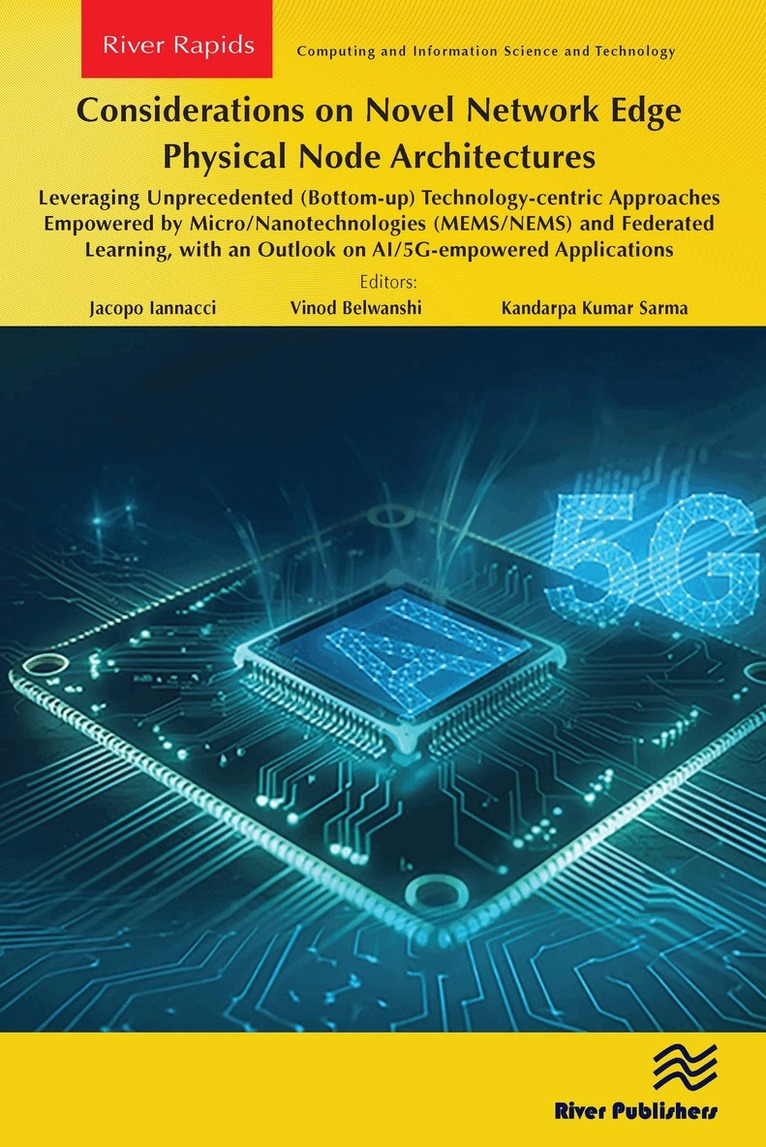
The relentless pace of technological advancement, particularly in telecommunications, is reshaping how we connect and communicate. What once took a decade to standardize now evolves in just a few years, blurring generational divides and delivering seamless transitions to users. Against this backdrop, Considerations on Novel Network Edge Physical Node Architectures explores the complex paradigm of 6G mobile communications—anticipated to emerge around 2030—and casts a longer-term vision toward future networks (FNs).
The scientific community has been engaged in 6G research since 2017–2018, defining use cases, key enabling technologies (KETs), and performance indicators (KPIs). Ambitious targets include peak data rates of 1 Tbps, average user rates of 10–100 Gbps, sub-0.1 ms latency, and reliability greater than 10â»â¸. Application domains span holographic communications, digital twins, multi-sensory extended reality (XR), tactile and haptic interactions, and integrated space–terrestrial networks.
While these expectations hold the promise of a more interconnected world, realizing them demands a fundamental shift in approach. The projected density of 10–100 million smart devices per square kilometer in 6G networks cannot be addressed through conventional hardware–software co-design alone. This book proposes new ways of conceiving the physical building blocks of edge intelligence (EI), where intelligence is embedded at the network’s edge.
Central to this vision is the use of micro- and nanotechnologies (MEMS/NEMS) to create miniaturized sensors, actuators, and transducers (SATs) that serve as distributed intelligence units. These physical innovations are examined alongside non-physical enablers such as artificial intelligence (AI) and federated learning (FL), illustrating how a holistic integration of technologies can enable practical, scalable applications.
By bridging physical and digital innovations, Considerations on Novel Network Edge Physical Node Architectures aims to inject fresh ideas into scientific discourse and provide a foundation for turning the ambitious visions of 6G and future networks into reality. It is an essential resource for researchers, engineers, and industry professionals seeking to shape the next generation of telecommunications infrastructure.
1 460 kr
Läs direkt efter köp
The relentless pace of technological advancement, particularly in telecommunications, is reshaping how we connect and communicate. What once took a decade to standardize now evolves in just a few years, blurring generational divides and delivering seamless transitions to users. Against this backdrop, Considerations on Novel Network Edge Physical Node Architectures explores the complex paradigm of 6G mobile communications—anticipated to emerge around 2030—and casts a longer-term vision toward future networks (FNs).
The scientific community has been engaged in 6G research since 2017–2018, defining use cases, key enabling technologies (KETs), and performance indicators (KPIs). Ambitious targets include peak data rates of 1 Tbps, average user rates of 10–100 Gbps, sub-0.1 ms latency, and reliability greater than 10â»â¸. Application domains span holographic communications, digital twins, multi-sensory extended reality (XR), tactile and haptic interactions, and integrated space–terrestrial networks.
While these expectations hold the promise of a more interconnected world, realizing them demands a fundamental shift in approach. The projected density of 10–100 million smart devices per square kilometer in 6G networks cannot be addressed through conventional hardware–software co-design alone. This book proposes new ways of conceiving the physical building blocks of edge intelligence (EI), where intelligence is embedded at the network’s edge.
Central to this vision is the use of micro- and nanotechnologies (MEMS/NEMS) to create miniaturized sensors, actuators, and transducers (SATs) that serve as distributed intelligence units. These physical innovations are examined alongside non-physical enablers such as artificial intelligence (AI) and federated learning (FL), illustrating how a holistic integration of technologies can enable practical, scalable applications.
By bridging physical and digital innovations, Considerations on Novel Network Edge Physical Node Architectures aims to inject fresh ideas into scientific discourse and provide a foundation for turning the ambitious visions of 6G and future networks into reality. It is an essential resource for researchers, engineers, and industry professionals seeking to shape the next generation of telecommunications infrastructure.