3 941 kr
Skickas inom 10-15 vardagar
3 941 kr
Skickas inom 10-15 vardagar
733 kr
Skickas inom 10-15 vardagar
2 610 kr
Skickas inom 10-15 vardagar
850 kr
Läs direkt efter köp
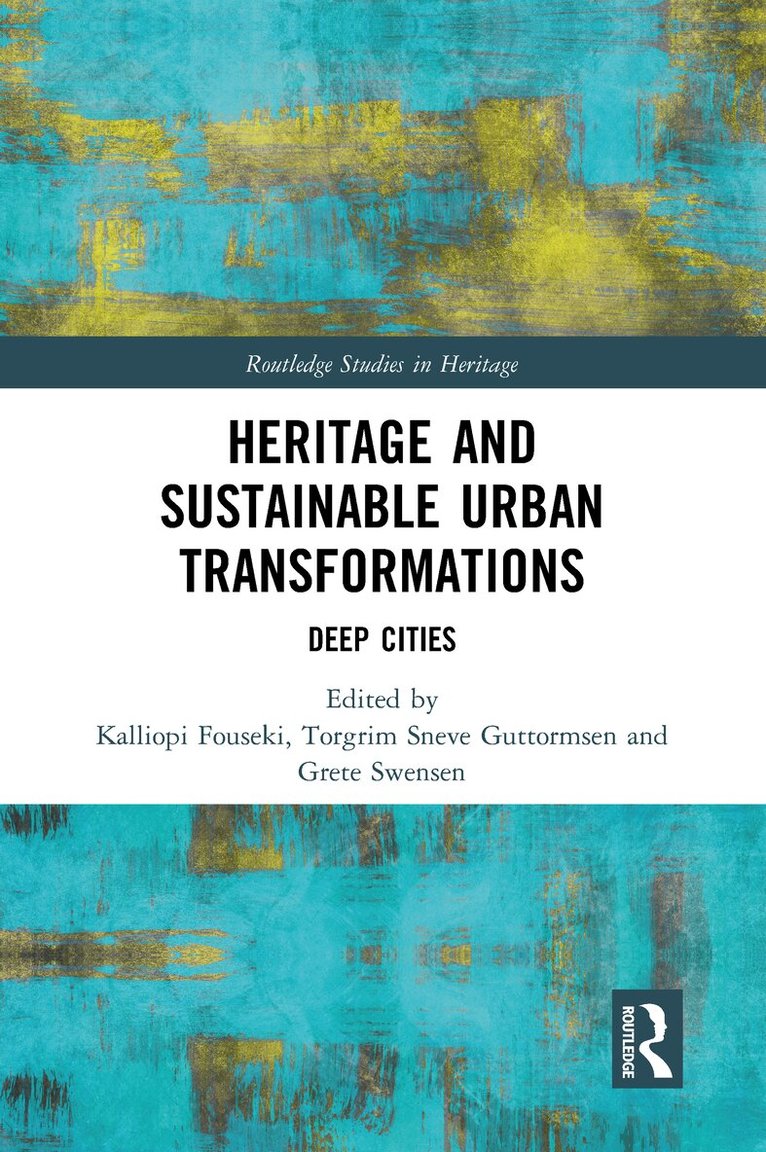
Heritage and Sustainable Urban Transformations introduces the concept of ‘deep cities’, a novel approach to the understanding and management of sustainable historic cities that will advance knowledge about how the long-term, temporal and transformative character of urban heritage can be better integrated into urban policies for sustainable futures. Contrary to the growing emphasis on green or smart cities, which focus only on the present and future, the concept of ‘deep cities’ offers an approach that combines an in-depth understanding of the past with the present and future.
Bringing together chapters that cover theoretical, methodological and management issues related to ‘deep cities’, the volume argues that using this approach will force researchers, managers and consultants to actively use the heritage and history of a city in the planning and management of sustainable cities. Exploring different definitions of ‘deep cities’, the book reveals varying and sometimes conflicting views among stakeholders concerning how, where and when the depth of a city should be conceptualized. Despite this, the book demonstrates how this new approach can help to create robust cities for the future, as new and innovative solutions are combined with the preservation and strengthening of historical features.
Heritage and Sustainable Urban Transformations is the first international collection on the subject of sustainable historic cities. As such, the book will be of great interest to academics and students engaged in the study of heritage, heritage management, architecture, heritage conservation, anthropology, development studies, geography, planning and archaeology.
886 kr
Läs direkt efter köp
This handbook presents cutting-edge and global insights on sustainable heritage, engaging with ideas such as data science in heritage, climate change and environmental challenges, indigenous heritage, contested heritage and resilience. It does so across a diverse range of global heritage sites.
Organized into six themed parts, the handbook offers cross-disciplinary perspectives on the latest theory, research and practice. Thirty-five chapters offer insights from leading scholars and practitioners in the field as well as early career researchers. This book fills a lacuna in the literature by offering scientific approaches to sustainable heritage, as well as multicultural perspectives by exploring sustainable heritage in a range of different geographical contexts and scales. The themes covered revolve around heritage values and heritage risk; participatory approaches to heritage; dissonant heritage; socio-environmental challenges to heritage; sustainable heritage-led transformation and new cross-disciplinary methods for heritage research.
This book will be an invaluable resource for students and scholars in heritage studies, archaeology, museum studies, cultural studies, architecture, landscape, urban design, planning, geography and tourism.
892 kr
Läs direkt efter köp
This handbook presents cutting-edge and global insights on sustainable heritage, engaging with ideas such as data science in heritage, climate change and environmental challenges, indigenous heritage, contested heritage and resilience. It does so across a diverse range of global heritage sites.
Organized into six themed parts, the handbook offers cross-disciplinary perspectives on the latest theory, research and practice. Thirty-five chapters offer insights from leading scholars and practitioners in the field as well as early career researchers. This book fills a lacuna in the literature by offering scientific approaches to sustainable heritage, as well as multicultural perspectives by exploring sustainable heritage in a range of different geographical contexts and scales. The themes covered revolve around heritage values and heritage risk; participatory approaches to heritage; dissonant heritage; socio-environmental challenges to heritage; sustainable heritage-led transformation and new cross-disciplinary methods for heritage research.
This book will be an invaluable resource for students and scholars in heritage studies, archaeology, museum studies, cultural studies, architecture, landscape, urban design, planning, geography and tourism.
764 kr
Skickas inom 10-15 vardagar
1 082 kr
Läs direkt efter köp
1 106 kr
Läs direkt efter köp
2 610 kr
Skickas inom 10-15 vardagar
945 kr
Skickas inom 10-15 vardagar
449 kr
Skickas inom 3-6 vardagar
793 kr
Skickas inom 3-6 vardagar
How does heritage emerge, change, stagnate, disappear and/or revive over time? Should heritage be approached as a ?non-renewable resource? that needs to be sustained for eternity, or as a ?renewable resource? that adapts to change and transformation?
Heritage Dynamics deconstructs the dynamic nature of heritage. Heritage as a socio-cultural practice goes through non-linear, continuous lifecycles, where certain factors will be the catalyst for the ending of one lifecycle and the revival for another. Kalliopi Fouseki develops a theoretical and methodological framework of ?heritage dynamics?, which is used as the analytical thread of six heritage contexts: heritage-led transformation in historic urban places; decision-making on energy efficiency and heritage conservation in ?everyday heritage? residential buildings; lifecycles of heritage collections; exhibition dynamics and the impact of participation with emphasis of ?difficult heritage?; dynamics of dissonance on contested museums and the dynamics of ?intangible heritage? with emphasis on flamenco.
The book offers a new theoretical and methodological framework that will enable heritage scholars and practitioners to unpack the ways and conditions under which heritage changes. The new theoretical framework will re-orientate current thinking of heritage as a thing, a process or discourse towards a new, more systemic thinking that captures the complexity of heritage.
Methodologically, Heritage Dynamics introduces the potential of systemic methods, such as system dynamics, in capturing the dynamic nature of heritage. The new theory and method not only opens up new avenues for theoretical explorations, but also offers a significant tool for heritage managers and policymakers.
Praise for Heritage Dynamics
?In this innovative and highly important study, Fouseki challenges our concept of heritage by emphasising elements of change and adaptation. Combining theory and practice in a unique study, this work will be an essential addition to the field.? Ross Wilson, University of Nottingham
'?Heritage Dynamics? encourages a shift from ??materiality?, ?authenticity? and ?originality?? towards ??creativity?, ?adaptation? and ?innovation??. This shift in focus can be helpful in the current discourse of sustainable heritage development, and I would add care, grounded in a theoretical framework that emphasises contextuality and change as part of the process.' Journal of the Institute of Conservation