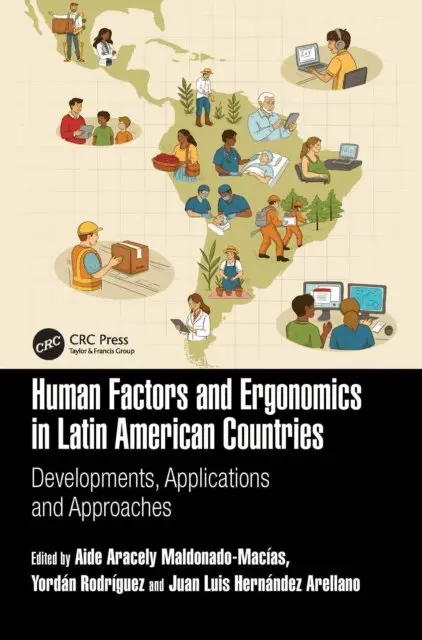
While the discipline of Human Factors and Ergonomics (HFE) has expanded globally, the specific sociotechnical realities of developing nations have long remained underrepresented in scientific literature. Human Factors and Ergonomics in Latin American Countries: Developments, Applications and Approaches bridges this gap, offering the first authoritative synthesis of research, applications, and legal frameworks dedicated entirely to the region.Featuring a foreword by the Presidents of the International Ergonomics Association (IEA), this volume presents Latin America not merely as a site for applying existing theories, but as a "living laboratory" for generating context-sensitive solutions. The book curates 24 chapters that traverse the full spectrum of the discipline—from the high-tech challenges of Industry 4.0 and passive exoskeletons to the critical social issues of the informal economy and inclusive design.Readers will explore how HFE principles are adapted to diverse sectors, including healthcare, where system dynamics are used to manage ICU nursing workloads; manufacturing; addressing "quiet quitting" and burnout in export industries; public safety; and analyzing coordination in forest fire control centers. Uniquely, the text also examines ergonomics for vulnerable populations, presenting studies on indigenous women involved in street vending, pregnant workers, and the elderly in digital banking.This book is an essential resource for researchers, practitioners, and policymakers. It moves beyond diagnosis to offer actionable strategies for improving productivity, safety, and well-being in one of the world’s most dynamic emerging markets.
While the discipline of Human Factors and Ergonomics (HFE) has expanded globally, the specific sociotechnical realities of developing nations have long remained underrepresented in scientific literature. Human Factors and Ergonomics in Latin American Countries: Developments, Applications and Approaches bridges this gap, offering the first authoritative synthesis of research, applications, and legal frameworks dedicated entirely to the region.Featuring a foreword by the Presidents of the International Ergonomics Association (IEA), this volume presents Latin America not merely as a site for applying existing theories, but as a "e;living laboratory"e; for generating context-sensitive solutions. The book curates 24 chapters that traverse the full spectrum of the discipline-from the high-tech challenges of Industry 4.0 and passive exoskeletons to the critical social issues of the informal economy and inclusive design.Readers will explore how HFE principles are adapted to diverse sectors, including healthcare, where system dynamics are used to manage ICU nursing workloads; manufacturing; addressing "e;quiet quitting"e; and burnout in export industries; public safety; and analyzing coordination in forest fire control centers. Uniquely, the text also examines ergonomics for vulnerable populations, presenting studies on indigenous women involved in street vending, pregnant workers, and the elderly in digital banking.This book is an essential resource for researchers, practitioners, and policymakers. It moves beyond diagnosis to offer actionable strategies for improving productivity, safety, and well-being in one of the world's most dynamic emerging markets.
Product design is an important field where ergonomics and human factors should be applied. To achieve this goal, effective strategies for process improvement must be researched and implemented. The Handbook of Research on Ergonomics and Product Design is a critical scholarly resource that provides new theories, methodologies, and applications of ergonomics and product design and redesign. Featuring a broad range of topics such as additive manufacturing, product analysis, and sustainable packing development, this book is geared towards academicians, practitioners, and researchers seeking current research on new theories, methods, and applications related to ergonomics and product design.