154 kr
Läs direkt efter köp
154 kr
Läs direkt efter köp
144 kr
Läs direkt efter köp
154 kr
Läs direkt efter köp
154 kr
Läs direkt efter köp
153 kr
Läs direkt efter köp
153 kr
Läs direkt efter köp
150 kr
Läs direkt efter köp
154 kr
Läs direkt efter köp
154 kr
Läs direkt efter köp
154 kr
Läs direkt efter köp
153 kr
Läs direkt efter köp
153 kr
Läs direkt efter köp
154 kr
Läs direkt efter köp
153 kr
Läs direkt efter köp
154 kr
Läs direkt efter köp
150 kr
Läs direkt efter köp
200 kr
Läs direkt efter köp
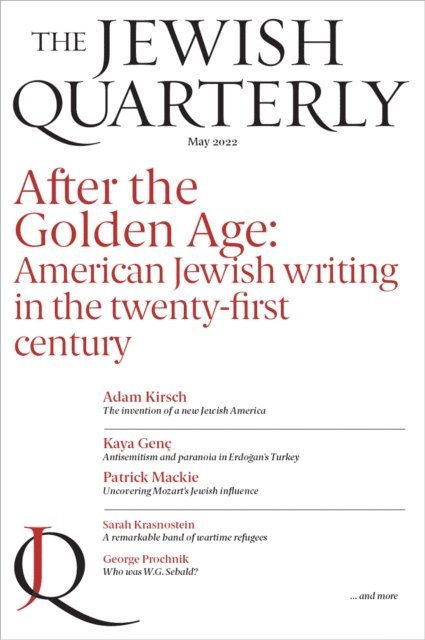
"Younger writers were freed to think about specifically Jewish questions. [Their] work has a narrower appeal. Only time will tell if it is also a deeper one." —Adam Kirsch
After the Golden Age examines the current generation of leading American Jewish writers as they grapple with questions about religion, Israel, politics and multiculturalism. In a ground-breaking essay, one of America's foremost literary critics, Adam Kirsch, shows how a new wave of writers, including Jonathan Safran Foer, Nicole Krauss and Joshua Cohen, is charting and creating a modern Jewish world that is different from that of Roth, Bellow and Malamud.
The issue also includes a report by Kaya Genç on paranoia and conspiracy theories in Erdoğan's Turkey, Jo Glanville on the vanishing Jews of Dublin and a colourful portrait from Patrick Mackie of Mozart's Jewish librettist. Sarah Krasnostein delves into the extraordinary feats of the "enemy aliens" shipped from Britain to Australia in 1940, and George Prochnik explores the worlds of W.G. Sebald and Daniel Mendelsohn.
150 kr
Läs direkt efter köp
154 kr
Läs direkt efter köp
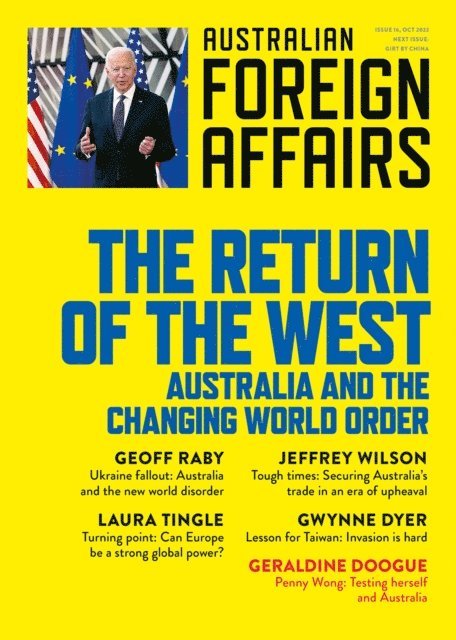
How has Russia''s invasion of Ukraine changed the international security, economic and political terrain?
“The war in Europe will leave China in a stronger position, as it unifies the West. This is something Canberra has largely failed to recognise.” Geoff Raby
The sixteenth issue of Australian Foreign Affairs examines the global upheaval caused by the war in Ukraine, which has heightened the tensions between democracies and authoritarian states, and has led to a more assertive Europe that could represent a new force in world affairs.
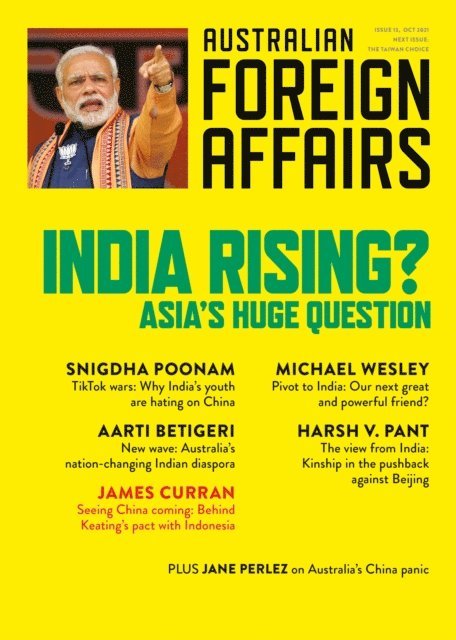
The Return of the West looks at the challenges for Australia in the post-invasion international order and the changing role of economics, military power, cyber capabilities and strongman rulers.
• Geoff Raby explores the impact of the war in Ukraine on the world order and what this means for Australia''s foreign policy.• Jeffrey Wilson looks at how Australia can secure its economy against the growing threats to the global trade system.• Laura Tingle reports from Europe on whether it can shake off its lethargy to become a great global power.• Gwynne Dyer analyses what Taiwan can learn from Russia''s invasion of Ukraine about how to defend itself against China.• Geraldine Doogue examines the challenges facing Penny Wong as Australia''s new foreign minister.• Melissa Conley Tyler and Cherie Lagakali propose a partnership with the Pacific to boost the region''s digital capabilities.PLUS Correspondence on AFA15: Our Unstable Neighbourhood from Huong Le Thu, Marc Purcell, Michael Wesley and more.
200 kr
Läs direkt efter köp
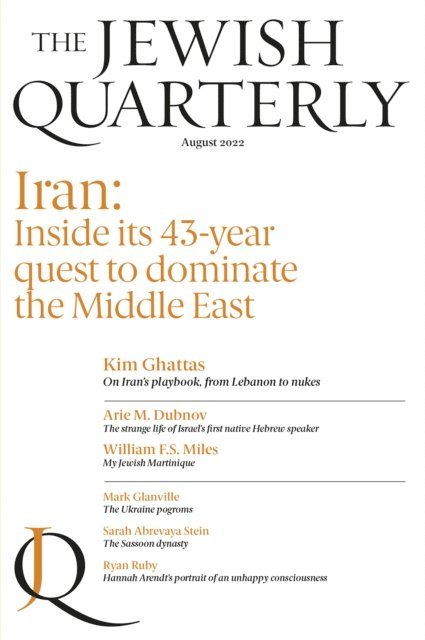
In this issue of The Jewish Quarterly, renowned writer and analyst Kim Ghattas examines the motivations behind Iran's changing role and influence in the Middle East. Delving into the regime's secretive strategy and tactics, Ghattas investigates Tehran's interventions in the affairs of countries across the region and its relationship with the West, and explores Iran's future role and posture in the Middle East.
Also in this issue, Arie M. Dubnov shares keen insights into the intriguing life and ideas of modern Israel's first native Hebrew speaker, and William F.S. Miles brings to life the history and colour of a tiny Jewish community in a French outpost in the Caribbean Sea. Mark Glanville locates Ukraine's post–Great War pogroms in their newly relevant historical context, Sarah Abrevaya Stein takes a fresh look at the extraordinary global success of the Sassoon dynasty and Ryan Ruby critiques Hannah Arendt's Rahel Varnhagen.
199 kr
Läs direkt efter köp
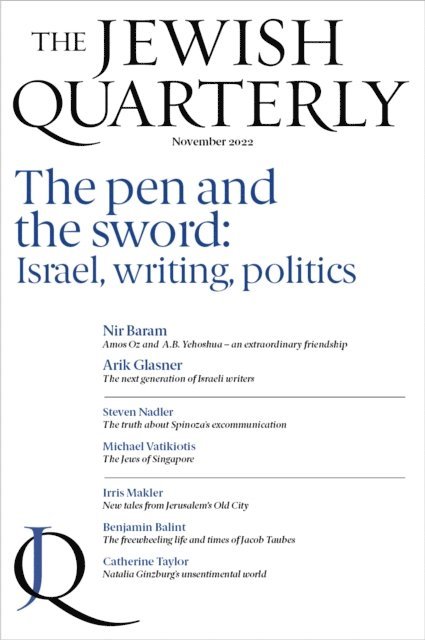
Successive generations of Israeli writers have charted the hopes of peace and the pain of conflict. What does the nation''s writing reveal about the challenges of today?
“The process of saying goodbye to these two authors, who had been a visible presence in Israeli society for decades, is far from over.” —Nir Baram
The Pen and the Sword explores the efforts by successive generations of Israeli writers to grapple with their nation''s difficult political questions. In a probing essay, Israeli novelist Nir Baram examines the remarkable friendship between two giants of Israeli literature – Amos Oz and A.B. Yehoshua – whose lives, writing and passionate disputes reflect their country''s recent turbulent history and divides. And leading critic Arik Glasner surveys a younger generation of Israeli writers, whose disparate voices and stories provide a crucial glimpse into Israel today.
The issue also includes Steven Nadler''s new insights into the excommunication of Spinoza, Michael Vatikiotis''s portrait of the Jewish community of pluralist Singapore and book reviews by Irris Makler, Benjamin Balint and Catherine Taylor.
200 kr
Läs direkt efter köp
154 kr
Läs direkt efter köp
200 kr
Läs direkt efter köp
196 kr
Läs direkt efter köp
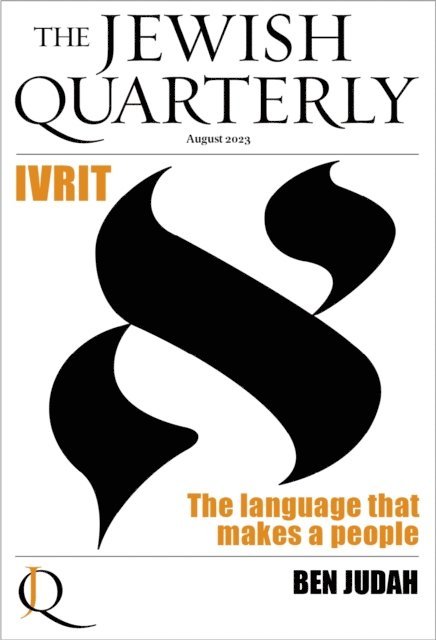
The story of Hebrew -- its origins, revival and continuing evolution - is the story of a people.
"Our religion, our story, is, at its heart, a love of this language and a refusal to let it go."--Ben Judah
Ivrit explores the remarkable evolution and revival of Hebrew -- a language whose trajectory charts the recent history of the Jewish people. In a colourful, in-depth essay, award-winning writer Ben Judah explores the crucial role of modern Hebrew in defining and reshaping Israel and the Jewish people. He brings key figures to life, including his own ancestors, and contends that, while the dreams of Zionism are a mix of tragic successes and partial failures, the dream of the Hebraists is the one complete triumph.
The issue also includes a short story by Isaac Bashevis Singer translated into English for the first time, cultural criticism by Joanna Rakoff about literary accounts of female publishing assistants, an essay by Marta Figlerowicz about the Polish writer and artist Bruno Schulz, and a delicious celebration of Jewish-Italian food by Luisa Weiss.
154 kr
Läs direkt efter köp
153 kr
Läs direkt efter köp
168 kr
Läs direkt efter köp
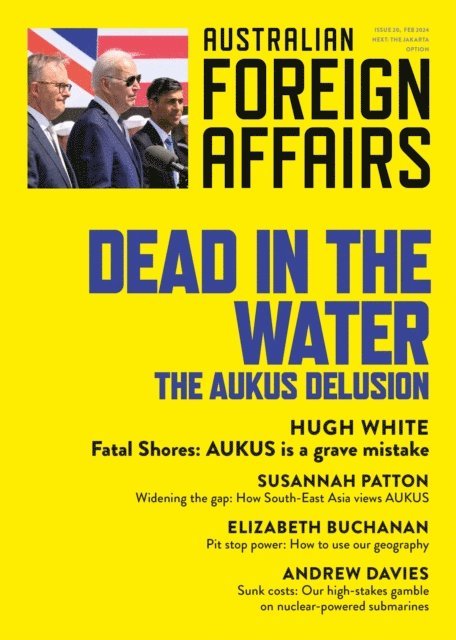
The twentieth issue of Australian Foreign Affairs examines Australia's momentous decision to form a security pact with the United States and the United Kingdom that includes an ambitious, expensive and risky plan to acquire nuclear-power submarines – a move that will have far-reaching military and strategic consequences.
Dead in the Water looks at whether AUKUS will enhance or undermine Australia's security as tensions between China and the US rise, how the deal will affect Australia's ties with its regional neighbours, and whether the submarines are likely to ever arrive.
Hugh White examines whether Australia needs nuclear-powered submarines and whether the AUKUS plan will deliver them.Susannah Patton looks at the lessons for Australia from the region's responses to AUKUS.Elizabeth Buchanan explores how Australia could use its valuable geography to enhance ties with AUKUS allies and other partners.Andrew Davies weighs the benefits of nuclear-powered submarines against the costs of acquiring and maintaining them.Hervé Lemahieu proposes that Australia pursue a common travel area and an integrated digital market with the Pacific.Jack Corbett considers Solomon Islands' economic options in an era of great power rivalry.PLUS Paul Monk on Australia's military posture, correspondence on AFA19: The New Domino Theory from Albert Zhang and Jieh-Yung Lo, and more.
168 kr
Läs direkt efter köp
"Indonesia's commitment to Cold War–era non-alignment has only been possible because no force was capable of pressuring Jakarta to move beyond it. China may be that force." SAM ROGGEVEEN
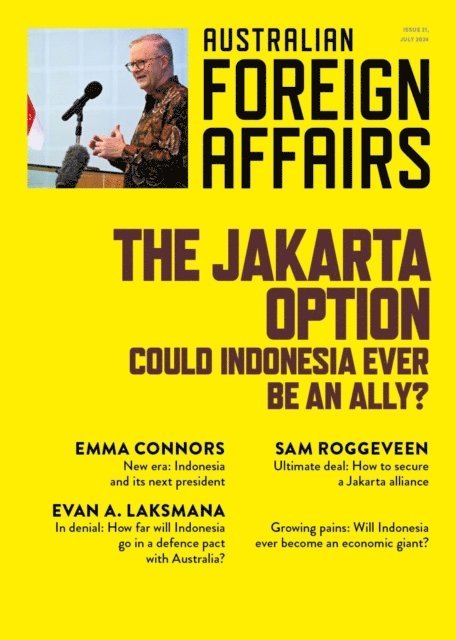
Canberra and Jakarta face similar threats in a changing Asia. Could this lead to closer ties? The twenty-first issue of Australian Foreign Affairs examines Australia's relationship with Indonesia and the prospects of the two neighbours working together to boost their collective security as tensions in Asia increase.
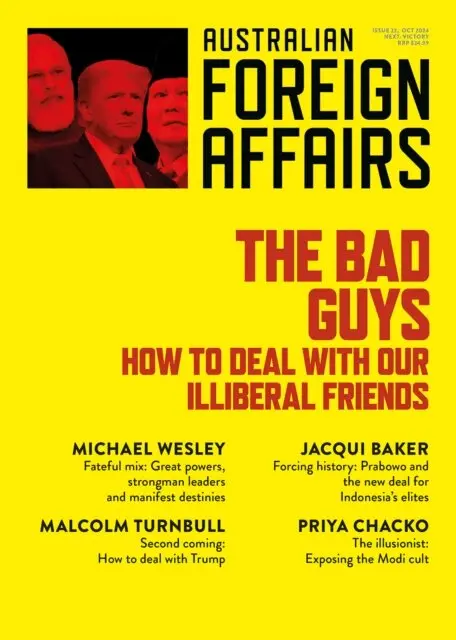
The Jakarta Option explores how Canberra should adapt to a changing Indonesia as the world's fourth-most populous nation enters a new era under its next president, the former general Prabowo Subianto, and outlines some of the social and economic challenges he will inherit.
Sam Roggeveen considers why Australia and Indonesia need to form a military alliance, and what it might aim to achieve.Evan A. Laksmana argues that Indonesia's long-held policy of non-alignment will prevent it siding with Australia against China.Emma Connors examines Indonesia's prospects under its president- elect, Prabowo Subianto.Maria Monica Wihardja looks at the demographic challenges that Prabowo's economic plans will need to overcome.Bart Hogeveen & Gatra Priyandita call for Australia to lead a cyber peacekeeping effort in the Indo-Pacific.Sarah Percy assesses Australia's complex security challenges through a maritime lens.PLUS Ian Hall on India, Steven Ratuva on Pacific climate politics, and correspondence on AFA20: Dead in the Water from Josh Wilson, Jennifer Parker, Hugh White and more.
167 kr
Läs direkt efter köp