695 kr
Skickas inom 10-15 vardagar
695 kr
Skickas inom 10-15 vardagar
645 kr
Skickas inom 10-15 vardagar
489 kr
Skickas inom 10-15 vardagar
2 526 kr
Skickas inom 10-15 vardagar
827 kr
Skickas inom 10-15 vardagar
2 820 kr
Skickas inom 10-15 vardagar
3 047 kr
Skickas inom 10-15 vardagar
915 kr
Skickas inom 10-15 vardagar
1 738 kr
Skickas inom 3-6 vardagar
645 kr
Läs direkt efter köp
612 kr
Skickas inom 10-15 vardagar
746 kr
Läs direkt efter köp
This book traces the rise of contemporary populism in Western democracies, marked by the return of would-be ''strong men'' politicians. It seeks to make sense of the nature, origins, and consequences of their ascendancy—as expressed, for example, in the startling rise of the social movement surrounding Trump in the US, Brexit in the UK and the remarkable spread of ideologies that express resistance to ‘facts,’ science, and expertise.
Uniquely, the book shows how what began as a form of penal populism in the early 1990s transformed into a more wide ranging populist politics. This has had the potential to undermine or even overthrow the democratic order altogether. It examines the way in which the COVID-19 pandemic has impacted on these forces, arguing it threw the flailing democratic order an important lifeline, as Vladimir Putin has subsequently done with his war in Ukraine. The book argues that contemporary political populism can be seen as a wider manifestation of the earlier tropes and appeal of penal populism arising under neo-liberalism. The author traces this cross over and the roots of discontent, anxiety, anti-elites sentiment and the sense of being forgotten, that lie at the heart of populism, along with its effects in terms of climate denial, ‘fake news’, othering, nativism and the denigration of scientific and other forms of expertise. In a highly topical and important extension to the field the author suggests that the current COVID pandemic might prove to be an ‘antidote’ to populism, providing the conditions in which scientific and medical expertise, truth telling, government intervention in the economy and in health policy, and social solidarity, are revalorised.
Encompassing numerous subject areas and crossing many conventional disciplinary boundaries, this book will be of great interest to students and scholars of criminology and criminal justice, sociology, political science, law, and public policy.
762 kr
Läs direkt efter köp
This book traces the rise of contemporary populism in Western democracies, marked by the return of would-be ''strong men'' politicians. It seeks to make sense of the nature, origins, and consequences of their ascendancy—as expressed, for example, in the startling rise of the social movement surrounding Trump in the US, Brexit in the UK and the remarkable spread of ideologies that express resistance to ‘facts,’ science, and expertise.
Uniquely, the book shows how what began as a form of penal populism in the early 1990s transformed into a more wide ranging populist politics. This has had the potential to undermine or even overthrow the democratic order altogether. It examines the way in which the COVID-19 pandemic has impacted on these forces, arguing it threw the flailing democratic order an important lifeline, as Vladimir Putin has subsequently done with his war in Ukraine. The book argues that contemporary political populism can be seen as a wider manifestation of the earlier tropes and appeal of penal populism arising under neo-liberalism. The author traces this cross over and the roots of discontent, anxiety, anti-elites sentiment and the sense of being forgotten, that lie at the heart of populism, along with its effects in terms of climate denial, ‘fake news’, othering, nativism and the denigration of scientific and other forms of expertise. In a highly topical and important extension to the field the author suggests that the current COVID pandemic might prove to be an ‘antidote’ to populism, providing the conditions in which scientific and medical expertise, truth telling, government intervention in the economy and in health policy, and social solidarity, are revalorised.
Encompassing numerous subject areas and crossing many conventional disciplinary boundaries, this book will be of great interest to students and scholars of criminology and criminal justice, sociology, political science, law, and public policy.
826 kr
Läs direkt efter köp
Hosoi, Tatsuno and Pratt examine the realities, problems and backgrounds of crimes committed by elderly people in both Japan and international perspectives.
Japan’s aging population is a commonly known issue globally, and the world looks to Japan to understand the issues that other nations may experience in the future. One such aspect is an increase in crimes committed by the elderly. According to the National Police Agency in Japan, the proportion of elders arrested for committing theft has doubled over the past 10 years. The chapters in this volume look to answer questions around the reason for elder crime, the types of crime and punishment that exists in this cohort of society and how this increasingly large problem in society can be managed.
This book offers important insights into the societal issues and potential solutions for aging societies around the world. It will be a valuable research reference for scholars of mental health, criminology, population studies and Asian studies.
813 kr
Läs direkt efter köp
Hosoi, Tatsuno and Pratt examine the realities, problems and backgrounds of crimes committed by elderly people in both Japan and international perspectives.
Japan’s aging population is a commonly known issue globally, and the world looks to Japan to understand the issues that other nations may experience in the future. One such aspect is an increase in crimes committed by the elderly. According to the National Police Agency in Japan, the proportion of elders arrested for committing theft has doubled over the past 10 years. The chapters in this volume look to answer questions around the reason for elder crime, the types of crime and punishment that exists in this cohort of society and how this increasingly large problem in society can be managed.
This book offers important insights into the societal issues and potential solutions for aging societies around the world. It will be a valuable research reference for scholars of mental health, criminology, population studies and Asian studies.
829 kr
Skickas
645 kr
Skickas inom 10-15 vardagar
710 kr
Skickas inom 10-15 vardagar
2 526 kr
Skickas inom 10-15 vardagar
757 kr
Läs direkt efter köp
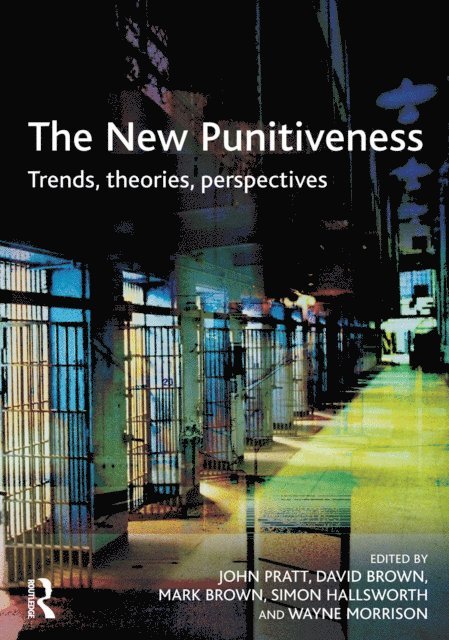
Throughout much of the western world more and more people are being sent to prison, one of a number of changes inspired by a ''new punitiveness'' in penal and political affairs. This book seeks to understand these developments, bringing together leading authorities in the field to provide a wide-ranging analysis of new penal trends, compare the development of differing patterns of punishment across different types of societies, and to provide a range of theoretical analyses and commentaries to help understand their significance.
As well as increases in imprisonment this book is also concerned to address a number of other aspects of ''the new punitiveness'': firstly, the return of a number of forms of punishment previously thought extinct or inappropriate, such as the return of shaming punishments and chain gangs (in parts of the USA); and secondly, the increasing public involvement in penal affairs and penal development, for example in relation to length of sentences and the California Three Strikes Law, and a growing accreditation of the rights of victims.
The book will be essential reading for students seeking to understand trends and theories of punishment on law, criminology, penology and other courses.
762 kr
Läs direkt efter köp
Throughout much of the western world more and more people are being sent to prison, one of a number of changes inspired by a ''new punitiveness'' in penal and political affairs. This book seeks to understand these developments, bringing together leading authorities in the field to provide a wide-ranging analysis of new penal trends, compare the development of differing patterns of punishment across different types of societies, and to provide a range of theoretical analyses and commentaries to help understand their significance.
As well as increases in imprisonment this book is also concerned to address a number of other aspects of ''the new punitiveness'': firstly, the return of a number of forms of punishment previously thought extinct or inappropriate, such as the return of shaming punishments and chain gangs (in parts of the USA); and secondly, the increasing public involvement in penal affairs and penal development, for example in relation to length of sentences and the California Three Strikes Law, and a growing accreditation of the rights of victims.
The book will be essential reading for students seeking to understand trends and theories of punishment on law, criminology, penology and other courses.
447 kr
Läs direkt efter köp
450 kr
Läs direkt efter köp
814 kr
Läs direkt efter köp
Expertly drawing on international examples and existing literature, Penal Populism closes a gap in the field of criminology. In this fascinating expose of current crime policy John Pratt examines the role played by penal populism on trends in contemporary penal policy.
Penal populism is associated with the public''s decline of deference to the criminal justice establishment amidst alarm that crime is out of control. Pratt argues that new media technology is helping to spread national insecurities and politicians are not only encouraging such sentiments but are also being led on by them. Pratt explains it is having most influence in the development of policy on sex offenders, youth crime, persistent criminals and anti-social behaviour.
This topical resource also covers new dimensions of the phenomenon, including:
the changing nature and structure of the mass media less reliance on the more orthodox expertise of civil servants and academics limitations to the impact of populism, bureaucratic resistance from judges, lawyers and academics and the restorative justice movement.This is essential reading for students, researchers and professionals working in criminology and crime policy.
814 kr
Läs direkt efter köp
Expertly drawing on international examples and existing literature, Penal Populism closes a gap in the field of criminology. In this fascinating expose of current crime policy John Pratt examines the role played by penal populism on trends in contemporary penal policy.
Penal populism is associated with the public''s decline of deference to the criminal justice establishment amidst alarm that crime is out of control. Pratt argues that new media technology is helping to spread national insecurities and politicians are not only encouraging such sentiments but are also being led on by them. Pratt explains it is having most influence in the development of policy on sex offenders, youth crime, persistent criminals and anti-social behaviour.
This topical resource also covers new dimensions of the phenomenon, including:
the changing nature and structure of the mass media less reliance on the more orthodox expertise of civil servants and academics limitations to the impact of populism, bureaucratic resistance from judges, lawyers and academics and the restorative justice movement.This is essential reading for students, researchers and professionals working in criminology and crime policy.

949 kr
Läs direkt efter köp
970 kr
Läs direkt efter köp
988 kr
Läs direkt efter köp
Why do some modern societies punish their offenders differently to others? Why are some more punitive and others more tolerant in their approach to offending and how can these differences be explained? Based on extensive historical analysis and fieldwork in the penal systems of England, Australia and New Zealand on the one hand and Finland, Norway and Sweden on the other, this book seeks to answer these questions.
The book argues that the penal differences that currently exist between these two clusters of societies emanate from their early nineteenth-century social arrangements, when the Anglophone societies were dominated by exclusionary value systems that contrasted with the more inclusionary values of the Nordic countries. The development of their penal programmes over this two hundred year period, including the much earlier demise of the death penalty in the Nordic countries and significant differences between the respective prison rates and prison conditions of the two clusters, reflects the continuing influence of these values. Indeed, in the early 21st century these differences have become even more pronounced.
John Pratt and Anna Eriksson offer a unique contribution to this topic of growing importance: comparative research in the history and sociology of punishment. This book will be of interest to those studying criminology, sociology, punishment, prison and penal policy, as well as professionals working in prisons or in the area of penal policy across the six societies that feature in the book.
1 106 kr
Läs direkt efter köp
Why do some modern societies punish their offenders differently to others? Why are some more punitive and others more tolerant in their approach to offending and how can these differences be explained? Based on extensive historical analysis and fieldwork in the penal systems of England, Australia and New Zealand on the one hand and Finland, Norway and Sweden on the other, this book seeks to answer these questions.
The book argues that the penal differences that currently exist between these two clusters of societies emanate from their early nineteenth-century social arrangements, when the Anglophone societies were dominated by exclusionary value systems that contrasted with the more inclusionary values of the Nordic countries. The development of their penal programmes over this two hundred year period, including the much earlier demise of the death penalty in the Nordic countries and significant differences between the respective prison rates and prison conditions of the two clusters, reflects the continuing influence of these values. Indeed, in the early 21st century these differences have become even more pronounced.
John Pratt and Anna Eriksson offer a unique contribution to this topic of growing importance: comparative research in the history and sociology of punishment. This book will be of interest to those studying criminology, sociology, punishment, prison and penal policy, as well as professionals working in prisons or in the area of penal policy across the six societies that feature in the book.
355 kr
Skickas inom 10-15 vardagar