1 159 kr
Läs direkt efter köp
1 159 kr
Läs direkt efter köp
1 017 kr
Skickas inom 10-15 vardagar
987 kr
Skickas inom 10-15 vardagar
1 003 kr
Skickas inom 10-15 vardagar
3 838 kr
Skickas inom 7-10 vardagar
2 602 kr
Skickas inom 10-15 vardagar
1 204 kr
Läs direkt efter köp
2 491 kr
Kommande
1 513 kr
Skickas inom 7-10 vardagar
1 689 kr
Läs direkt efter köp
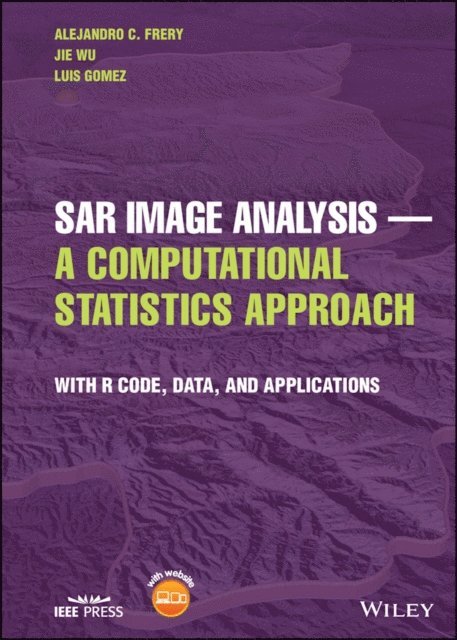
Discover how to use statistics to extract information from SAR imagery
In SAR Image Analysis — A Computational Statistics Approach, an accomplished team of researchers delivers a practical exploration of how to use statistics to extract information from SAR imagery. The authors discuss various models, supply sample data and code, and explain theoretical aspects of SAR image analysis that are highly relevant to practitioners and students.
The book offers the theoretical properties of models, estimators, interpretation, data visualization, and advanced techniques, along with the data and code samples, that students require to learn effectively and efficiently.
SAR Image Analysis — A Computational Statistics Approach provides various exercises throughout the book to help readers reinforce and retain the extensive information on parameter estimation, applications, reproducibility, replicability, and advanced topics, like robust estimators and stochastic distances, contained within.
The book also includes:
Thorough introductions to data acquisition and the elements of data analysis and image processing with R, including useful R packages, preprocessing SAR data, and visualization Comprehensive explorations of intensity SAR data and the multiplicative model, including the (SAR) gamma distribution, the K distribution, the G0 distribution, and more general distributions under the multiplicative model Practical discussions of parameter estimations, including the Bernoulli distribution, the negative binomial distribution, and the uniform distribution In-depth examinations of applications, including statistical filters and classificationPerfect for undergraduate and graduate students studying remote sensing, data analysis, and statistics, SAR Image Analysis — A Computational Statistics Approach is also an indispensable resource for researchers, practitioners, and professionals seeking a one-stop resource on how to use statistics to extract information from SAR imagery.

1 731 kr
Läs direkt efter köp
Discover how to use statistics to extract information from SAR imagery
In SAR Image Analysis — A Computational Statistics Approach, an accomplished team of researchers delivers a practical exploration of how to use statistics to extract information from SAR imagery. The authors discuss various models, supply sample data and code, and explain theoretical aspects of SAR image analysis that are highly relevant to practitioners and students.
The book offers the theoretical properties of models, estimators, interpretation, data visualization, and advanced techniques, along with the data and code samples, that students require to learn effectively and efficiently.
SAR Image Analysis — A Computational Statistics Approach provides various exercises throughout the book to help readers reinforce and retain the extensive information on parameter estimation, applications, reproducibility, replicability, and advanced topics, like robust estimators and stochastic distances, contained within.
The book also includes:
Thorough introductions to data acquisition and the elements of data analysis and image processing with R, including useful R packages, preprocessing SAR data, and visualization Comprehensive explorations of intensity SAR data and the multiplicative model, including the (SAR) gamma distribution, the K distribution, the G0 distribution, and more general distributions under the multiplicative model Practical discussions of parameter estimations, including the Bernoulli distribution, the negative binomial distribution, and the uniform distribution In-depth examinations of applications, including statistical filters and classificationPerfect for undergraduate and graduate students studying remote sensing, data analysis, and statistics, SAR Image Analysis — A Computational Statistics Approach is also an indispensable resource for researchers, practitioners, and professionals seeking a one-stop resource on how to use statistics to extract information from SAR imagery.
1 134 kr
Läs direkt efter köp
1 177 kr
Läs direkt efter köp
Future requirements for computing speed, system reliability, and cost-effectiveness entail the development of alternative computers to replace the traditional von Neumann organization. As computing networks come into being, one of the latest dreams is now possible - distributed computing. Distributed computing brings transparent access to as much computer power and data as the user needs for accomplishing any given task - simultaneously achieving high performance and reliability.The subject of distributed computing is diverse, and many researchers are investigating various issues concerning the structure of hardware and the design of distributed software. Distributed System Design defines a distributed system as one that looks to its users like an ordinary system, but runs on a set of autonomous processing elements (PEs) where each PE has a separate physical memory space and the message transmission delay is not negligible. With close cooperation among these PEs, the system supports an arbitrary number of processes and dynamic extensions.Distributed System Design outlines the main motivations for building a distributed system, including:
inherently distributed applications performance/cost resource sharing flexibility and extendibility availability and fault tolerance scalabilityPresenting basic concepts, problems, and possible solutions, this reference serves graduate students in distributed system design as well as computer professionals analyzing and designing distributed/open/parallel systems.Chapters discuss: the scope of distributed computing systems general distributed programming languages and a CSP-like distributed control description language (DCDL) expressing parallelism, interprocess communication and synchronization, and fault-tolerant design two approaches describing a distributed system: the time-space view and the interleaving view mutual exclusion and related issues, including election, bidding, and self-stabilization prevention and detection of deadlock reliability, safety, and security as well as various methods of handling node, communication, Byzantine, and software faults efficient interprocessor communication mechanisms as well as these mechanisms without specific constraints, such as adaptiveness, deadlock-freedom, and fault-tolerance virtual channels and virtual networks load distribution problems synchronization of access to shared data while supporting a high degree of concurrency1 177 kr
Läs direkt efter köp
Future requirements for computing speed, system reliability, and cost-effectiveness entail the development of alternative computers to replace the traditional von Neumann organization. As computing networks come into being, one of the latest dreams is now possible - distributed computing. Distributed computing brings transparent access to as much computer power and data as the user needs for accomplishing any given task - simultaneously achieving high performance and reliability.The subject of distributed computing is diverse, and many researchers are investigating various issues concerning the structure of hardware and the design of distributed software. Distributed System Design defines a distributed system as one that looks to its users like an ordinary system, but runs on a set of autonomous processing elements (PEs) where each PE has a separate physical memory space and the message transmission delay is not negligible. With close cooperation among these PEs, the system supports an arbitrary number of processes and dynamic extensions.Distributed System Design outlines the main motivations for building a distributed system, including:
inherently distributed applications performance/cost resource sharing flexibility and extendibility availability and fault tolerance scalabilityPresenting basic concepts, problems, and possible solutions, this reference serves graduate students in distributed system design as well as computer professionals analyzing and designing distributed/open/parallel systems.Chapters discuss: the scope of distributed computing systems general distributed programming languages and a CSP-like distributed control description language (DCDL) expressing parallelism, interprocess communication and synchronization, and fault-tolerant design two approaches describing a distributed system: the time-space view and the interleaving view mutual exclusion and related issues, including election, bidding, and self-stabilization prevention and detection of deadlock reliability, safety, and security as well as various methods of handling node, communication, Byzantine, and software faults efficient interprocessor communication mechanisms as well as these mechanisms without specific constraints, such as adaptiveness, deadlock-freedom, and fault-tolerance virtual channels and virtual networks load distribution problems synchronization of access to shared data while supporting a high degree of concurrency545 kr
Skickas inom 10-15 vardagar
728 kr
Läs direkt efter köp
Multiprocessor platforms play important roles in modern computing systems, and appear in various applications, ranging from energy-limited hand-held devices to large data centers. As the performance requirements increase, energy-consumption in these systems also increases significantly. Dynamic Voltage and Frequency Scaling (DVFS), which allows processors to dynamically adjust the supply voltage and the clock frequency to operate on different power/energy levels, is considered an effective way to achieve the goal of energy-saving. This book surveys existing works that have been on energy-aware task scheduling on DVFS multiprocessor platforms.
Energy-aware scheduling problems are intrinsically optimization problems, the formulations of which greatly depend on the platform and task models under consideration. Thus, Energy-aware Scheduling on Multiprocessor Platforms covers current research on this topic and classifies existing works according to two key standards, namely, homogeneity/heterogeneity of multiprocessor platforms and the task types considered. Under this classification, other sub-issues are also included, such as, slack reclamation, fixed/dynamic priority scheduling, partition-based/global scheduling, and application-specific power consumption, etc.2 601 kr
Skickas inom 10-15 vardagar
1 231 kr
Läs direkt efter köp
231 kr
Skickas inom 3-6 vardagar
2 818 kr
Skickas inom 7-10 vardagar
2 097 kr
Skickas inom 7-10 vardagar
2 460 kr
Läs direkt efter köp
315 kr
Skickas inom 11-20 vardagar
1 632 kr
Skickas inom 10-15 vardagar
2 065 kr
Läs direkt efter köp
1 632 kr
Skickas inom 10-15 vardagar
2 182 kr
Skickas inom 10-15 vardagar
2 925 kr
Läs direkt efter köp
662 kr
Skickas inom 7-10 vardagar
2 182 kr
Skickas inom 10-15 vardagar