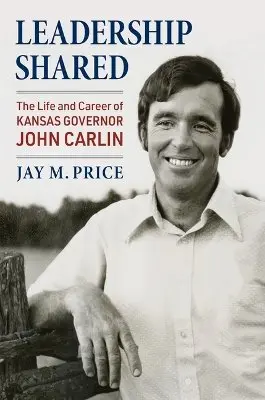
Drawing on extensive interviews and unprecedented access to personal papers, this revealing biography of John Carlin—the former Democratic governor of Kansas and later Archivist of the United States—offers a compelling portrait of pragmatic leadership and bipartisan governance during an era of profound political change.John W. Carlin was not supposed to become governor. A Democratic dairy farmer from the small Swedish community of Smolan, he seemed an unlikely challenger to Republican governor Robert Bennett, a sophisticated attorney from Johnson County. Yet Carlin defied expectations—and went on to lead Kansas through one of the most consequential periods of political and economic change in the state's modern history.From the Kansas legislature to two terms as a Democratic governor in a heavily Republican state and, later, to leadership of the National Archives and Records Administration, Carlin repeatedly emerged as the unlikely choice. He encountered resistance from Republicans and members of his own party alike, working with—and, when necessary, challenging—the political establishment. His collaborative, pragmatic approach stood apart from entrenched party networks and the increasingly polarized politics taking shape around him. Years later, as Archivist of the United States, he faced skepticism from archival and historical communities as he pushed to modernize the National Archives. Throughout his career, Carlin drew on lessons learned in 4-H and dairy farming: listen carefully, make decisions, bring the right people together, and keep moving forward even when formidable obstacles stood in the way.Carlin’s life and career also provide a revealing window into the transformation of Kansas—and American politics—from the 1960s into the twenty-first century. Beginning in 1968, Kansas underwent sweeping changes in the structure of state government, agency consolidation, transportation and water policy, and the political coalitions that had long defined the state. When Carlin entered public life, Kansas largely reflected the pragmatic, moderate Republican tradition associated with Dwight D. Eisenhower. By the early 2000s, the state had become nationally associated with a more socially and politically conservative Republican movement. Through Carlin’s remarkable career, this book traces the people, institutions, conflicts, and shifting political forces that helped bring about that transformation.At once a political biography and a story of leadership, this book reveals that Carlin’s accomplishments were never his alone. His career depended on building networks, crossing political and institutional divides, and empowering people whose expertise exceeded his own. Rather than embracing the traditional image of the commanding political leader, Carlin cultivated collaboration and trusted knowledgeable people to help turn ideas into action. His story offers not only a fresh perspective on decades of Kansas and American political history but also a timely examination of a model of leadership built on pragmatism, relationships, and the willingness to work across differences.