3 093 kr
Skickas inom 10-15 vardagar
3 093 kr
Skickas inom 10-15 vardagar
859 kr
Skickas inom 10-15 vardagar
2 534 kr
Skickas inom 10-15 vardagar
771 kr
Skickas inom 10-15 vardagar
2 534 kr
Skickas inom 10-15 vardagar
1 015 kr
Läs direkt efter köp
1 022 kr
Läs direkt efter köp
499 kr
Läs direkt efter köp
This book tells the fascinating story of the reemergence of the American political left over the last quarter century in the form of the new Progressive Movement. Born out of Liberalism''s crushing defeats at the hands of conservative strategists of the Reagan/Bush era, this new movement has cleverly reverse engineered the conservative''s institutional networking strategy to plan and finance its resurgence. Progressive strategists have constructed an elaborate network of foundations, advocacy groups, and other institutions to advance their agenda. But where the conservatives relied on affirmative corporate support to help power their movement, the Progressive Left has used an anti-corporate strategy whose purpose is three-fold: 1. To reclaim the moral high ground of politics by challenging corporate power and influence. 2. To gain effective control over "other people''s money" (e.g., pension funds, mutual funds) and use it to press for changes in corporate social policies. 3. To leverage this influence over corporate decision-making to change the direction of American politics and public policy. Biz War extends the argument of Manheim''s 2001 book, The Death of A Thousand Cuts, by showing how anti-corporate campaigns have evolved from economically-oriented labor actions to ideological and programmatic political struggles. It details how the strategies and tactics crafted by organized labor are being employed with increasing effect by the political left. The book will be of interest to students of contemporary American politics, strategic communication, political movements, and business management. Likewise it will help corporate executives and financial analysts understand more fully the proxy wars and other attacks against their companies.
502 kr
Läs direkt efter köp
This book tells the fascinating story of the reemergence of the American political left over the last quarter century in the form of the new Progressive Movement. Born out of Liberalism''s crushing defeats at the hands of conservative strategists of the Reagan/Bush era, this new movement has cleverly reverse engineered the conservative''s institutional networking strategy to plan and finance its resurgence. Progressive strategists have constructed an elaborate network of foundations, advocacy groups, and other institutions to advance their agenda. But where the conservatives relied on affirmative corporate support to help power their movement, the Progressive Left has used an anti-corporate strategy whose purpose is three-fold: 1. To reclaim the moral high ground of politics by challenging corporate power and influence. 2. To gain effective control over "other people''s money" (e.g., pension funds, mutual funds) and use it to press for changes in corporate social policies. 3. To leverage this influence over corporate decision-making to change the direction of American politics and public policy. Biz War extends the argument of Manheim''s 2001 book, The Death of A Thousand Cuts, by showing how anti-corporate campaigns have evolved from economically-oriented labor actions to ideological and programmatic political struggles. It details how the strategies and tactics crafted by organized labor are being employed with increasing effect by the political left. The book will be of interest to students of contemporary American politics, strategic communication, political movements, and business management. Likewise it will help corporate executives and financial analysts understand more fully the proxy wars and other attacks against their companies.
932 kr
Läs direkt efter köp
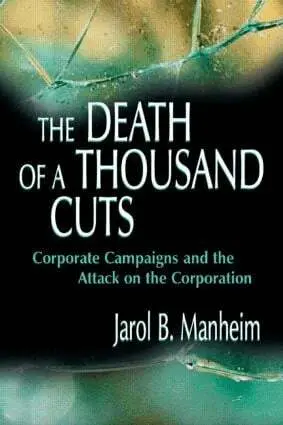
A corporate campaign is an organized assault on the reputation of a company that has offended some interest group. Although corporate campaigns often involve political, economic, and legal tactics, they are centered around the media, where protagonists attempt to redefine the image--and undermine the reputation--of the target company. It is a strategy most frequently employed by unions but is also employed by special interests, such as environmental or human rights groups. Sometimes it is even employed by one corporation against another. It is a rapidly growing phenomenon that is still unknown to the general public, to most academics and journalists, and is rarely understood by the corporations that find themselves on the firing line. The Death of a Thousand Cuts argues and demonstrates that corporate campaigns are a distinctive phenomenon whose manifestations are today ubiquitous in both the marketplace and the media. This volume examines, in considerable detail, the history, strategy, tactics, effects, consequences, and likely future directions of the corporate campaign and of its nonlabor-based cousin, the anticorporate campaign. The book is based on ample sources and methods, among them an extensive review and analysis of media coverage, news releases, previous scholarship, union publications, campaign materials, interviews and conversations with individuals who have experienced corporate campaigns, public presentations by labor leaders and others, correspondence, Internet postings, case law summaries, documents, videotapes, and other materials. Through original data and interpretation, this book adds context and integration to these materials thus giving them new meaning. Key features of this outstanding new book include: * A thorough and clear explanation of what a corporate campaign is and how it differs from other more mundane "public relations" campaigns. * A detailed examination of strategies and tactics that includes their historical development. Some of the more high profile target companies in recent years include Coca-Cola, Microsoft, Caterpillar, Campbell''s Soup, Federal Express, General Dynamics, Home Depot, International Paper, K-Mart, Nike, Texaco, Walmart, Starbucks, and UPS. * Hundreds of examples that help explain such contemporary events as the anti-sweatshop movement on college campuses, the living wage movement, and the protests against the World Trade Organization, International Monetary Fund, and World Bank. * A lengthy appendix contains abbreviated descriptions of nearly 200 corporate campaigns waged by labor unions and various advocacy groups since the idea of the corporate campaign was first developed in the 1960''s.

932 kr
Läs direkt efter köp
A corporate campaign is an organized assault on the reputation of a company that has offended some interest group. Although corporate campaigns often involve political, economic, and legal tactics, they are centered around the media, where protagonists attempt to redefine the image--and undermine the reputation--of the target company. It is a strategy most frequently employed by unions but is also employed by special interests, such as environmental or human rights groups. Sometimes it is even employed by one corporation against another. It is a rapidly growing phenomenon that is still unknown to the general public, to most academics and journalists, and is rarely understood by the corporations that find themselves on the firing line. The Death of a Thousand Cuts argues and demonstrates that corporate campaigns are a distinctive phenomenon whose manifestations are today ubiquitous in both the marketplace and the media. This volume examines, in considerable detail, the history, strategy, tactics, effects, consequences, and likely future directions of the corporate campaign and of its nonlabor-based cousin, the anticorporate campaign. The book is based on ample sources and methods, among them an extensive review and analysis of media coverage, news releases, previous scholarship, union publications, campaign materials, interviews and conversations with individuals who have experienced corporate campaigns, public presentations by labor leaders and others, correspondence, Internet postings, case law summaries, documents, videotapes, and other materials. Through original data and interpretation, this book adds context and integration to these materials thus giving them new meaning. Key features of this outstanding new book include: * A thorough and clear explanation of what a corporate campaign is and how it differs from other more mundane "public relations" campaigns. * A detailed examination of strategies and tactics that includes their historical development. Some of the more high profile target companies in recent years include Coca-Cola, Microsoft, Caterpillar, Campbell''s Soup, Federal Express, General Dynamics, Home Depot, International Paper, K-Mart, Nike, Texaco, Walmart, Starbucks, and UPS. * Hundreds of examples that help explain such contemporary events as the anti-sweatshop movement on college campuses, the living wage movement, and the protests against the World Trade Organization, International Monetary Fund, and World Bank. * A lengthy appendix contains abbreviated descriptions of nearly 200 corporate campaigns waged by labor unions and various advocacy groups since the idea of the corporate campaign was first developed in the 1960''s.
901 kr
Läs direkt efter köp
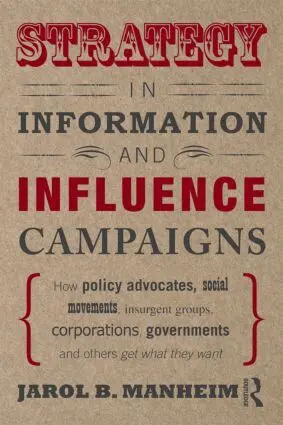
Information and influence campaigns are a particularly cogent example of the broader phenomenon we now term strategic political communication. If we think of political communication as encompassing the creation, distribution, control, use, processing and effects of information as a political resource, then we can characterize strategic political communication as the purposeful management of such information to achieve a stated objective based on the science of individual, organizational, and governmental decision-making. IICs are more or less centralized, highly structured, systematic, and carefully managed efforts to do just that.
Strategy in Information and Influence Campaigns sets out in comprehensive detail the underlying assumptions, unifying strategy, and panoply of tactics of the IIC, both from the perspective of the protagonist who initiates the action and from that of the target who must defend against it. Jarol Manheim’s forward-looking, broad, and systematic analysis is a must-have resource for scholars and students of political and strategic communication, as well as practitioners in both the public and private sectors.
433 kr
Skickas inom 10-15 vardagar
815 kr
Skickas inom 10-15 vardagar
305 kr
Tillfälligt slut