442 kr
Skickas inom 7-10 vardagar
442 kr
Skickas inom 7-10 vardagar
435 kr
Skickas inom 7-10 vardagar
342 kr
Skickas inom 7-10 vardagar
418 kr
Skickas inom 7-10 vardagar
605 kr
Skickas inom 7-10 vardagar
428 kr
Läs direkt efter köp
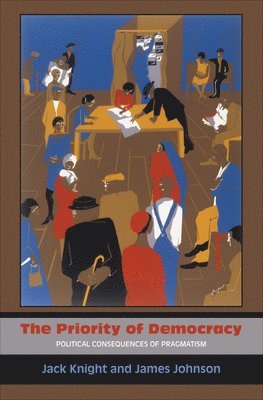
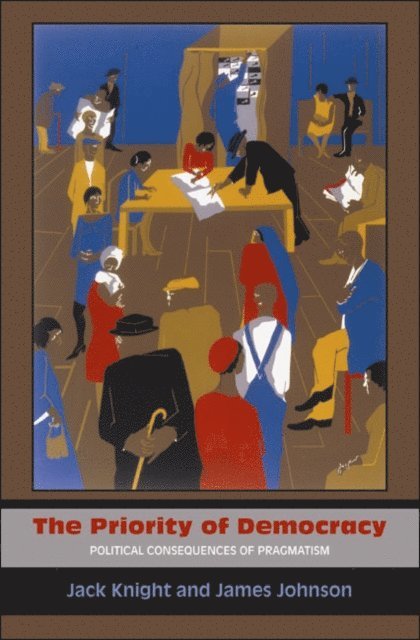
Why democracy is the best way of deciding how decisions should be madePragmatism and its consequences are central issues in American politics today, yet scholars rarely examine in detail the relationship between pragmatism and politics. In The Priority of Democracy, Jack Knight and James Johnson systematically explore the subject and make a strong case for adopting a pragmatist approach to democratic politics—and for giving priority to democracy in the process of selecting and reforming political institutions.What is the primary value of democracy? When should we make decisions democratically and when should we rely on markets? And when should we accept the decisions of unelected officials, such as judges or bureaucrats? Knight and Johnson explore how a commitment to pragmatism should affect our answers to such important questions. They conclude that democracy is a good way of determining how these kinds of decisions should be made—even if what the democratic process determines is that not all decisions should be made democratically. So, for example, the democratically elected U.S. Congress may legitimately remove monetary policy from democratic decision-making by putting it under the control of the Federal Reserve.Knight and Johnson argue that pragmatism offers an original and compelling justification of democracy in terms of the unique contributions democratic institutions can make to processes of institutional choice. This focus highlights the important role that democracy plays, not in achieving consensus or commonality, but rather in addressing conflicts. Indeed, Knight and Johnson suggest that democratic politics is perhaps best seen less as a way of reaching consensus or agreement than as a way of structuring the terms of persistent disagreement.
814 kr
Skickas
831 kr
Skickas inom 10-15 vardagar
765 kr
Skickas inom 10-15 vardagar
845 kr
Skickas inom 10-15 vardagar
831 kr
Skickas inom 10-15 vardagar
186 kr
Skickas inom 7-10 vardagar
1 555 kr
Skickas inom 3-6 vardagar
281 kr
Skickas inom 3-6 vardagar
281 kr
Skickas inom 3-6 vardagar
281 kr
Skickas inom 3-6 vardagar
278 kr
Skickas inom 3-6 vardagar
1 297 kr
Skickas inom 10-15 vardagar
1 746 kr
Läs direkt efter köp
This book reflects on the research and career of political theorist Russell Hardin from scholars of Political Science, Philosophy, Sociology, Economics, and Law, among other disciplines. Contributions address core issues of political theory as perceived by Hardin, starting with his insistence that many of the basic institutions of modern society and their formative historical beginnings can be understood as proceeding primarily from the self-interested motives of the participants. Many of the contributions in this volume struggle with the constraints imposed on political theorizing by the idea of self-interested agents, or homo economicus. Some reject the idea as empirically unfounded. Others try to show that homo economicus is even more versatile than Hardin depicts. And yet others accept the constraints and work within them. But all pay tribute to the lasting intellectual contribution of Russell Hardin and the challenge he poses. The book should appeal to scholars and students interested in collective action, public choice and democracy, moral reasoning and its limits, constitutionalism, liberalism, conventions and coordination, trust, identity politics, social epistemology, and methods in politics philosophy.
1 312 kr
Skickas inom 10-15 vardagar
1 835 kr
Tillfälligt slut