*A Financial Times Book of the Year*'The economist ditching ideology for reality... Weber prescribes a common-sense solution to poverty, inequality and fascism' GuardianWhat would it mean to create an economics that guarantees dignity for all?For decades, we were told that free markets would safeguard democracy. Instead, we are now living in an age of emergencies as the cost of living rises, democratic institutions weaken and the far right gains ground across the world. But it doesn't have to be this way. Drawing on history, political economy and her own experience at the centre of recent inflation debates, economist Isabella Weber argues that the rise of today's authoritarian movements is not an accident. It is rooted in an economic order that has treated livelihoods as expendable while elevating markets above democratic choice.This book offers a bold alternative. Recovering the forgotten post-war ambition of an economics committed to ‘never again’, Weber argues that governments should secure affordable essentials, guarantee dignified work and build resilient economies capable of confronting climate change, technological disruption and geopolitical conflict. In place of market fundamentalism, she sets out a practical programme for an economy organised around human dignity rather than profit fundamentalism.Both a clear-eyed diagnosis of our age and an inspiring blueprint for renewal, Anti-Fascist Economics shows that the future of democracy depends on choosing an economy that serves all of us.
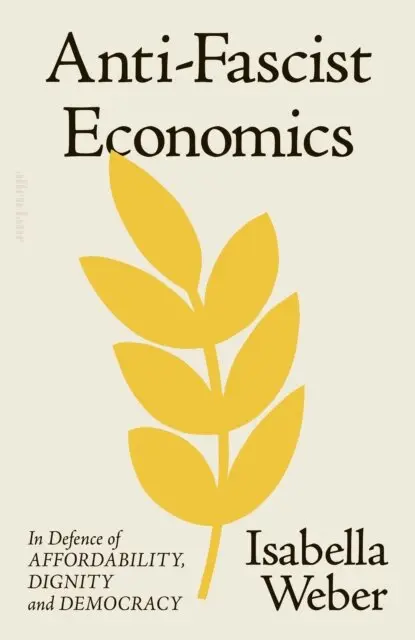
'The economist ditching ideology for reality... Weber prescribes a common-sense solution to poverty, inequality and fascism' GuardianWhat would it mean to create an economics that guarantees dignity for all?For decades, we were told that free markets would safeguard democracy. Instead, we are now living in an age of emergencies as the cost of living rises, democratic institutions weaken and the far right gains ground across the world. But it doesn't have to be this way. Drawing on history, political economy and her own experience at the centre of recent inflation debates, economist Isabella Weber argues that the rise of today's authoritarian movements is not an accident. It is rooted in an economic order that has treated livelihoods as expendable while elevating markets above democratic choice.This book offers a bold alternative. Recovering the forgotten post-war ambition of an economics committed to ‘never again’, Weber argues that governments should secure affordable essentials, guarantee dignified work and build resilient economies capable of confronting climate change, technological disruption and geopolitical conflict. In place of market fundamentalism, she sets out a practical programme for an economy organised around human dignity rather than profit fundamentalism.Both a clear-eyed diagnosis of our age and an inspiring blueprint for renewal, Anti-Fascist Economics shows that the future of democracy depends on choosing an economy that serves all of us.

As inequality, inflation, and overwhelming corporate power threaten democracy, a rising-star economist asks what it would mean to create an anti-fascist economics that guarantees dignity for all.On the night of President Trump's second presidential victory, economist Isabella Weber tweeted: "Can we now finally have a serious conversation about an anti-fascist economics?" In her view, Democrats had missed the seriousness of the affordability crisis in the wake of pandemic-era inflation. By refusing to step in to protect their constituencies against price explosions in essentials and corporate profiteering, they left room amidst the global crisis for the resurgence of the politics of resentment that Trump and the right reveled in. Her question, though, was a bold one with implications that reached far beyond one election. In a neoliberal world, we tell people at the same time: Democracy is the highest form of political organization. And: When it comes to the economy, to the material foundation of our life, the best the representatives of the people can do is to subordinate their constituencies to the corporate pursuit of profits. This basic contradiction between the rule of the people and the rule of the market makes neoliberal democracy vulnerable to the threat of fascism, she argues. Economists have too often acted as prophets of market subordination and ended up waxing the slippery slope to fascism. Isabella Weber warns that if we are serious about saving democracy and preventing the further rise of fascists, we need an economics that serves democracy and centers people’s needs and dignity rather than seeing their fulfillment as a welcome side effect in the pursuit of other goals.In Anti-Fascist Economics, Weber proposes just such a way out. She envisions an economics that centers on essentials for livelihoods and production, that strives to make life on our planet livable for all, that confronts rather than conceals corporate power, and that charts the way towards international cooperation rather than getting stuck in the dichotomy of free trade and trade wars. To halt the further rise of fascism, we need a tangible alternative to the dystopian status quo, she insists, one that takes affordability seriously as a foundation of democracy. In this paradigm-shifting book, Weber recalls a history of mid-twentieth-century economists for whom “never again” was the North star and reinvents their thinking for our day.