This title was first published in 2002: This volume focuses on the Roman provinces of Syria and Arabia, above all the lands now within Lebanon, Syria and Jordan. The first articles look at questions of geography, cartography and toponymy, particularly in Strabo, Pliny and Ptolemy. The following sections are concerned with settlement patterns and urban development in the region. In the Roman and early Byzantine periods, the inland areas underwent a gradual transformation, from a semi-sedentary, lightly populated and predominantly rural region, to one of large cities and a network of prosperous, socially sophisticated villages, linked by a network of roads. That change is documented by a wealth of epigraphy from both the urban communities and their outlying settlements (the subject of several articles). By the 4th century, too, Christianity had become the dominant religion and remained such until the arrival of Islam.
This title was first published in 2002: This volume focuses on the Roman provinces of Syria and Arabia, above all the lands now within Lebanon, Syria and Jordan. The first articles look at questions of geography, cartography and toponymy, particularly in Strabo, Pliny and Ptolemy. The following sections are concerned with settlement patterns and urban development in the region. In the Roman and early Byzantine periods, the inland areas underwent a gradual transformation, from a semi-sedentary, lightly populated and predominantly rural region, to one of large cities and a network of prosperous, socially sophisticated villages, linked by a network of roads. That change is documented by a wealth of epigraphy from both the urban communities and their outlying settlements (the subject of several articles). By the 4th century, too, Christianity had become the dominant religion and remained such until the arrival of Islam.
This title was first published in 2002: This volume focuses on the Roman provinces of Syria and Arabia, above all the lands now within Lebanon, Syria and Jordan. The first articles look at questions of geography, cartography and toponymy, particularly in Strabo, Pliny and Ptolemy. The following sections are concerned with settlement patterns and urban development in the region. In the Roman and early Byzantine periods, the inland areas underwent a gradual transformation, from a semi-sedentary, lightly populated and predominantly rural region, to one of large cities and a network of prosperous, socially sophisticated villages, linked by a network of roads. That change is documented by a wealth of epigraphy from both the urban communities and their outlying settlements (the subject of several articles). By the 4th century, too, Christianity had become the dominant religion and remained such until the arrival of Islam.
This title was first published in 2002: This volume focuses on the Roman provinces of Syria and Arabia, above all the lands now within Lebanon, Syria and Jordan. The first articles look at questions of geography, cartography and toponymy, particularly in Strabo, Pliny and Ptolemy. The following sections are concerned with settlement patterns and urban development in the region. In the Roman and early Byzantine periods, the inland areas underwent a gradual transformation, from a semi-sedentary, lightly populated and predominantly rural region, to one of large cities and a network of prosperous, socially sophisticated villages, linked by a network of roads. That change is documented by a wealth of epigraphy from both the urban communities and their outlying settlements (the subject of several articles). By the 4th century, too, Christianity had become the dominant religion and remained such until the arrival of Islam.
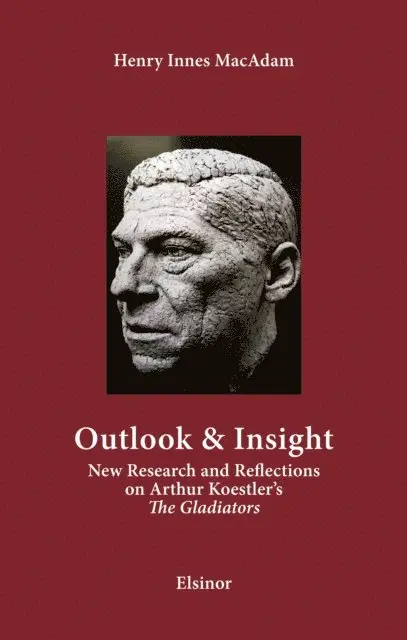
The title of this volume, "Outlook and Insight", is deliberately evocative of Koestler''s "Insight and Outlook" (1949), an investigation of the similarities he found among and within art, science, and social ethics. In this study of Koestler through his early novel "The Gladiators", his particular interest in revolutions via "The Law of Detours" is the focus of Outlook (Part 1). Those reflections are explored in ten segments, one of which is Koestler''s own unpublished summary of the first half of "The Gladiators". The volume closes with an account of the attempt to film "The Gladiators" in the late 1950s, including the recent publication of that thwarted project''s unproduced screenplay. Additional Insight (Part 2) may be gained from reading the first full publication of the newly discovered correspondence generated by Edith Simon''s agreement to translate Koestler''s now-published MS of "Der Sklavenkrieg". A Postscript presents a representative selection of Edith Simon''s sketches of characters in "The Gladiators".