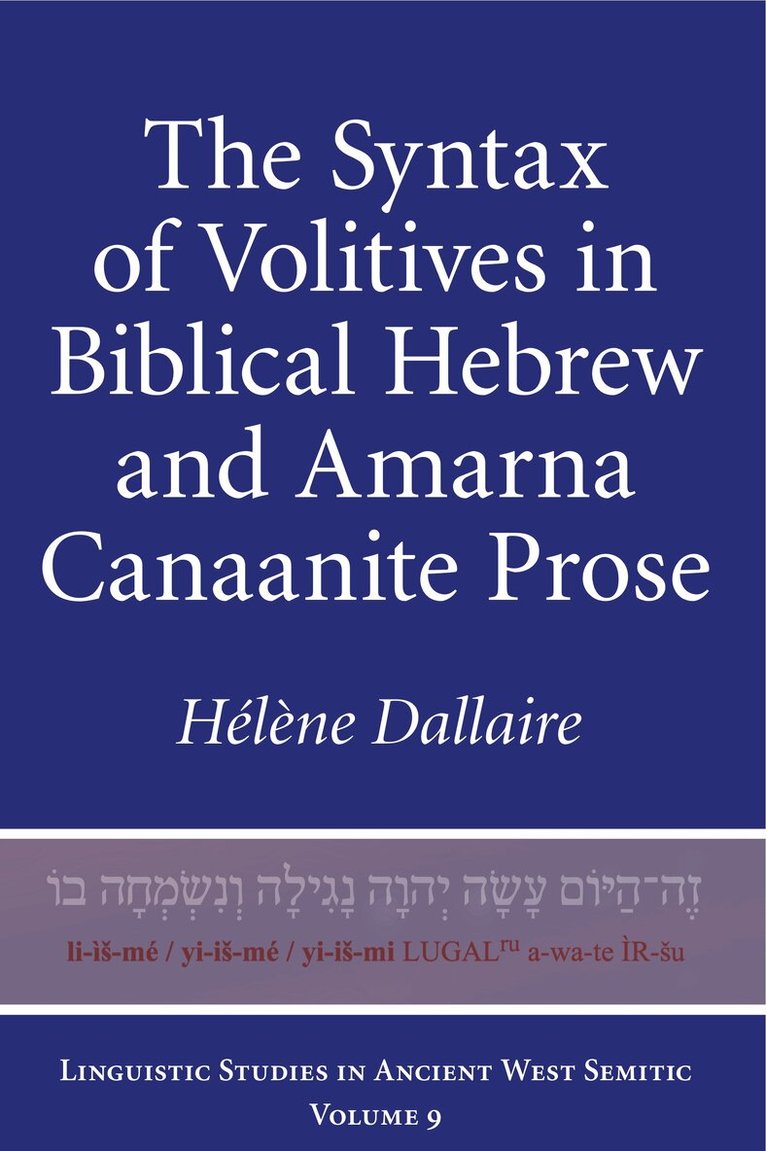
During the past century, numerous books and articles have appeared on the verbal system of Semitic languages. Thanks to the discovery of Ugaritic texts, Akkadian tablets, Canaanite letters found at Tell el-Amarna in Egypt, Hebrew and Aramaic inscriptions, and the Dead Sea Scrolls, our understanding of the phonology, morphology, and syntax of the Semitic languages has increased substantially.Dallaire focuses primarily on prose texts in Biblical Hebrew and Amarna Canaanite in which the verbal system (morphemes, syntax) expresses nuances of wishes, desires, requests, and commands. According to her, volitional concepts are found in every language and are expressed through verbal morphemes, syntagmas, intonation, syntax, and other linguistic means.The Syntax of Volitives in Biblical Hebrew and Amarna Canaanite Prose attempts to answer the following questions: Do volitives function in a similar way in Biblical Hebrew and Amarna Canaanite? Where and why is there overlap in morphology and syntax between these two languages? What morphological and syntactical differences exist between the volitional expressions of the languages? In attempting to answer these questions, the author bears in mind the fact that, within each of these two languages, scribes from different areas used specific dialectal and scribal traditions (for example, northern versus southern, peripheral versus central).
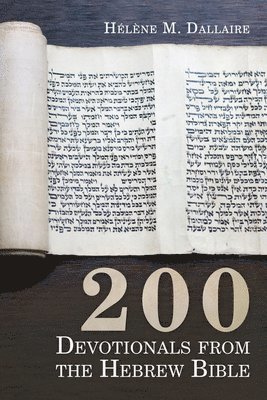
Readers of this volume--200 Devotionals from the Hebrew Bible--will find nuggets of wisdom in short devotionals written by the author and her students. Each devotional includes (1) one or two verses in Hebrew, (2) an English translation, (3) a brief explanation of the biblical context, (4) an exposition for life application, (5) a few New Testament verses, (6) a prayer, and (7) space for personal reflections. The rich spiritual truths found in the devotionals are designed to provide nourishment for all believers, including academics, church leaders, congregants, students, and youth. The Hebrew texts included in the devotionals are drawn both from prosaic and poetic texts found in the Torah, historical books, and wisdom literature. They cover themes such as the image of God in humans, healthy relationships, managing God''s blessings, dealing with doubts, responding to God''s call, and much more.
Where Shall Wisdom Be Found: A Grammatical Tribute to Professor Stephen A. Kaufman honors Stephen A. Kaufman, Professor Emeritus of Bible and Cognate Literature at Hebrew Union College-Jewish Institute of Religion (HUC-JIR) and co-founder of the Comprehensive Aramaic Lexicon project, for his contributions to the world of Semitic studies and for his influence on young scholars of Bible and ancient Near Eastern studies. Professor Kaufman is a distinguished professor, internationally known expert and scholar, who for several decades guided the doctoral work of numerous graduate students in Hebrew and Cognate Studies at HUC-JIR (Cincinnati). A prolific author, editor, and innovator in the field of Semitic linguistics, Professor Kaufman challenged his students to delve deep into the study of Semitic languages in order to identify what the original authors intended to communicate in these ancient texts. Furthermore, he inspired countless scholars to reexamine the traditional interpretation of Semitic linguistic features and age-old seemingly unshakable paradigms of Akkadian, Ugaritic, Hebrew, Aramaic, and other Semitic languages.Shaped by the expertise of Professor Kaufman, the scholars who contributed to this volume present recent developments in the study of the morphology, grammar, and syntax of Biblical Hebrew: nouns; adjectives; adverbs; definiteness; prepositions; tense, mood, and aspect; the verbal stems (binyanim); qatal; yiqtol;Â volitives; weqatal; wayyiqtol; participles; infinitives; conjunction and disjunction; Hebrew poetry; and Hebrew pedagogy. The volume is intended to serve as a scholarly resource for those interested in the morphological and syntactic features of Biblical Hebrew and as a textbook for advanced Biblical Hebrew classes in institutions of higher learning.