Light and Life in the Universe: Selected Lectures in Physics, Biology and the Origin of Life is a collection of lectures given at the 1964 Nuclear Research Foundation Summer Science School for High School Students, held at the University of Sydney, Australia, on January 6-17, 1964. The papers explore various aspects of life, both on earth and in the universe generally. Emphasis is placed on the ""units"" of living matter, how life may have started on earth, and the possibility of life on other planets. This book is comprised of 15 chapters and begins with a brief description of some of the properties of atoms and how they join up to form molecules, as well as some of the properties of the central core of each atom. The discussion then turns to electromagnetic radiation, highlighting the difficulties originally encountered by Ernest Rutherford''s picture of the atom. Subsequent chapters focus on the influence of gravitational fields; the origin of the solar system; the evolution of life on earth; and link between the primordial atmosphere and the origin of life. The functions of proteins, the practical effects of biology on humans, and the replication of living molecules are also considered. This monograph is written specifically for fourth-year high school students interested in astronomy, physics, chemistry, and biology.
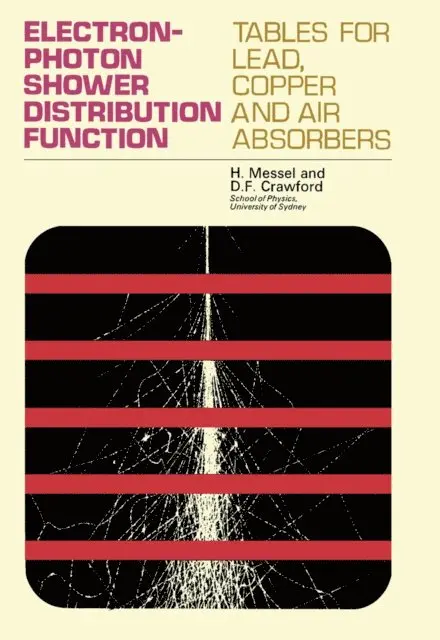
Electron-Photon Shower Distribution Function: Tables for Lead, Copper and Air Absorbers presents numerical results of the electron-photon shower distribution function for lead, copper, and air absorbers. Electron or photon interactions, including Compton scattering, elastic Coulomb scattering, and the photo-electric effect, are taken into account in the calculations. This book consists of four chapters and begins with a review of both theoretical and experimental work aimed at deducing the characteristics of the cascade produced from the propagation of high energy electrons and photons through matter. The next two chapters discuss in some detail the method of simulating the electron-photon cascade on a digital computer and present the cross-sections for all processes that are simulated in the program written for the English-Electric-Leo KDF9. The manner in which each process is subjected to computer simulations is described. The results come from two computer programs: the first was written for SILLIAC and the second for KDF9. This monograph will be a valuable resource for computer scientists, mathematicians, and physicists.
Abridged Science for High School Students, Volume I is a general science book that provides a concise discussion of wide array of scientific topics. The book is designed to supplement integrated science courses. The contents of the text cover a wide variety of scientific disciplines and are not structured in any way. The coverage of the book includes discussions on matter, heat, weather, gravity, time, and evolution. The book will be of great interest to anyone who wants to have access to a wide variety of scientific disciplines in one publication.
Abridged Science for High School Students, Volume II is a general science book that provides a concise discussion of wide array of scientific topics. This is volume sets out to continue where the first volume left off by covering Chapters 22 to 49. The contents of the text cover a wide variety of scientific disciplines and are not structured in any way. The coverage of the book includes discussions on vertebrates and invertebrates, solar system, evolution, electromagnetism, the Earth, the moon, energy, and classification of organisms. The book will be of great interest to anyone who wants to have access to a wide variety of scientific disciplines in one publication.
Solar Energy is a collection of lecture from the 17th International Science School for High School Students. The book presents nine papers that tackle concerns in solar energy. The text first covers the world energy resource and consumption, and then proceeds to tackling energy conversion, the atmospheric environment, and climatic change. In the third chapter, the book details the nature of solar energy and optical magnification of solar radiation. Chapter IV deals with the biological conversion of solar energy, while Chapter V talks about batteries. Next, the selection covers thermal conversion, solar devices, and direct solar production of electricity. The eighth chapter discusses selective surfaces, and the last chapter details heat transfer and storage. The book will be of great interest to anyone concerned with the development of alternative energy technology, particularly solar energy.
Time and Man focuses on the endeavors of humans to probe the mysteries of time and to elucidate its properties. The discussions are both philosophical and factual in nature and encompass science as well as the physical sciences, biology and related disciplines (for example, evolution), and the humanities (for example, religion). Factual information is presented to help the reader gain a better understanding of the concepts associated with time. Comprised of nine chapters, this volume first considers the passage of time and the experiences which humans associate with the concept of time before reflecting on what is meant by time. The discussion then turns to the questions of science related to the concept of time; the standards and measurement of time as well as the basic properties of clocks; and the connection between time and relativity. An operational definition of time is also presented. Subsequent chapters deal with the direction of time; the relationship of time to the universe and to natural events; and how human ideas of time had evolved based on a firm foundation of experiment, due almost entirely to Jean Piaget. This book is aimed at students of all ages.