Social capital--the resources and goodwill of network contacts--can be activated to enhance employees' performance, leadership effectiveness, careers, and overall organizational functioning. Despite years of research highlighting networks' role in addressing business challenges, organizational solutions still overwhelmingly focus on enhancing individual knowledge and skills or changing formal organizational structures and processes. Shifts in the business environment make adding a social capital lens to the historical human capital lens no longer just 'nice to do' but an imperative. Employees and organizations will benefit from carefully considering network connections and intentional efforts to foster their development and use. By prioritizing intentional connections, organizations can create a virtuous cycle of opportunities and prevent a vicious cycle of overwhelm. This book guides practitioners in revealing novel insights using network analysis and creating impact by developing and leveraging organizational networks. The opening section provides readers with a strong foundation in network science. The remainder of the book includes review chapters and case studies in strategic application areas. Review chapter authors provide readers with a strong scientific grounding explaining why networks are important for each application area and the likely implications of revealing, developing, and leveraging networks. Case authors provide inspiration and opportunities to learn from their real-life experiences, sharing challenges faced, actions taken, and lessons learned from applying network science within organizations. This book aims to provide clearer links between insights, actions, and outcomes practitioners can expect when revealing, developing, and leveraging organizational networks, demonstrating the powerful perspective that a social capital lens adds.
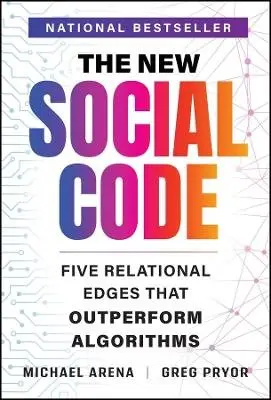
Master five irreplaceable human advantages to thrive alongside AIThe New Social Code reveals the five relational edges that help professionals thrive through unforgettable stories, practical strategies and decades of social science. Written by Michael Arena and Greg Pryor, co-founders of the Connected Commons, this book draws on a decade of research across nearly 100 organizations including AWS, General Motors, and Workday to reveal how Opportunity, Trust, Attention, Insight, and Influence create human centered advantages algorithms cannot replicate.The greatest misconception about the AI revolution is that it is primarily a technology story. It isn't, it is also a relational one. As intelligence becomes abundant, connections become the new scarcity. Computer code instructs machines on how to execute. The New Social Code instructs people on how to connect, enabling them to accomplish what machines cannot.Readers will also find: The five relational edges framework, built from a decade of applied network science research across major global organizationsCompelling stories of well-known exemplars like Harrison Ford, Billie Eilish, and even Pope Leo, alongside less known professionalsApplied relational practices converting AI anxiety into purposeful action by leveraging irreplaceable human relational edgesEighteen tactical play mapped across the five relational edges to elevate successAuthors research featured in Harvard Business Review, The Wall Street Journal, and Forbes, grounded in real professional successThe New Social Code is written for professionals, leaders, and recent graduates who want to position themselves for success and their organizations to lead through technological disruption. It provides a proven framework for anyone seeking to build lasting competitive advantage through human connection rather than competing against machines through endless reskilling.
As with the successful first edition, the new edition of Microbiology: A Clinical Approach is written specifically for pre-nursing and allied health students. It is clinically-relevant throughout and uses the theme of infection as its foundation. Microbiology is student-friendly: its text, figures, and electronic resources have been carefully designed to help students understand difficult concepts and keep them interested in the material.The Second Edition includes a robust instructor ancillary package that allows professors to easily incorporate the book’s unique approach into their lectures. In addition to the many free resources for students—including the E-Tutor, Bug Parade, Flashcards, and MicroMovies—the new edition is supported by Garland Science Learning System. The Garland Science Learning System is a homework platform designed to evaluate and improve student performance and allows instructors to select assignments on specific topics and review the performance of the entire class, as well as individual students, via the instructor dashboard. Students receive immediate feedback on their mastery of the topics, and will be better prepared for lectures and classroom discussions. The user-friendly system provides a convenient way to engage students while assessing progress. Performance data can be used to tailor classroom discussion, activities, and lectures to address students’ needs precisely and efficiently. For more information and sample material, visit http://garlandscience.rocketmix.com/.